




Virtual Staging in California: Transforming Homes from LA to Bay Area


Share:
Table of Contents
- 1. What is virtual staging? A photographic and architectural definition for California realtors
- 2. Why virtual staging is essential for California real estate
- 3. Types of virtual staging services for California
- 4. Behind the scenes: Professional tools and techniques for virtual staging in California
- 5. Use cases: Who needs virtual staging for California?
- 6. The business case of virtual staging in California: Conversion rates and return on investment (ROI)
- 7. The strategic choice: In-house, outsourcing, freelancer, AI, or human?
- 8. Introducing Fotober’s virtual staging solutions for California
- 9. Future horizons: Virtual staging trends in 2026 and beyond
- 10. Frequently asked questions about virtual staging in California (FAQ)
- 11. Conclusion: Partner with Fotober to elevate your listings
In the fast-paced, visually driven world of California real estate, your listing has less than two seconds to capture online attention. A vacant, cold room or an outdated, cluttered space will prompt a swift swipe left. As seasoned professionals working at the intersection of architectural photography, interior design, and real estate marketing, we understand that selling a home is about selling a lifestyle. In a state known for its architectural diversity, ranging from mid-century modern masterpieces in Palm Springs and coastal villas in San Diego to ultra-luxury estates in Los Angeles and high-tech minimalist condos in the San Francisco Bay Area, traditional staging has long been the gold standard.
However, traditional home staging in California comes with a premium price tag, logistically complex setups, and physical limitations. With virtual staging, a high-tech, hyper-realistic, and cost-effective digital revolution, how properties are presented and sold is being rewritten. In this comprehensive guide, we will dive deep into the mechanics, aesthetics, and business economics of virtual staging in California, exploring why it has become an indispensable tool for California’s top-producing real estate professionals.
1. What is virtual staging? A photographic and architectural definition for California realtors
To the untrained eye, virtual staging might seem like simply "placing digital furniture into a photo." But for an architectural photographer and 3D rendering artist, virtual staging is the precise science of digital interior architecture and the integration of photographic lighting.
The virtual staging process: [2D empty photo] -> [3D camera matching] -> [3D assets] -> [Lighting/Shadow] -> [Rendering & QA] -> [Final staged image]
Mathematically and artistically, virtual staging is the process of taking a high-resolution photograph of an empty or outdated room and overlaying highly detailed, three-dimensional digital furniture, decor, lighting, and textures. The goal is to make the digital additions indistinguishable from physical items.
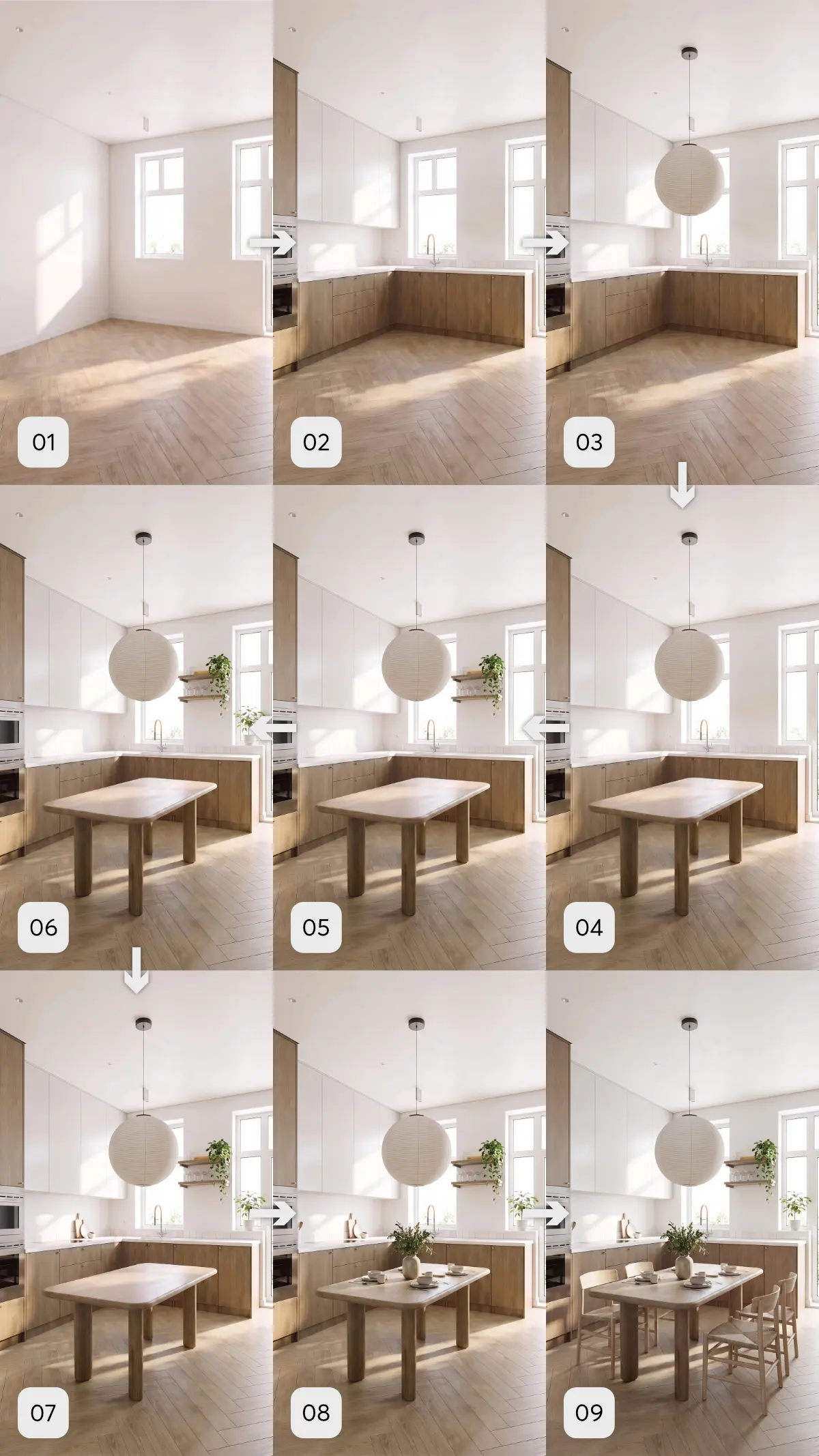
Achieving true photorealism requires mastering several critical components:
- Perspective and camera matching: Aligning the virtual camera's focal length, height, tilt, and sensor size perfectly with the physical lens used by the real estate photographer.
- Light behavior (global illumination): Ensuring that the digital objects cast realistic shadows and reflect the actual light sources in the room, whether it is the bright afternoon sun streaming through a Malibu beach house window or the warm glow of recessed LED ceiling lights in a Silicon Valley condo.
- Material textures (PBR): Utilizing Physically Based Rendering (PBR) materials to ensure that velvet looks soft, polished concrete looks cool and reflective, and reclaimed white oak floors show subtle grain textures under light.
When executed by experts, virtual staging in California does not look like a computer-generated graphic; it looks like a professional photograph from Architectural Digest.
2. Why virtual staging is essential for California real estate
California's housing market is unique. It features some of the highest median home prices in the United States, incredibly discerning buyers, and highly diverse architectural landscapes. Whether you are marketing a property under the banner of virtual staging Los Angeles, virtual staging San Diego, or virtual staging Bay Area, the local demand for premium visuals is exceptionally high.
2.1. The financial burden of traditional staging
Physical home staging in California is notoriously expensive. In major metropolitan areas, staging a standard 3-bedroom home can cost anywhere from $3,000 to $10,000 for an initial three-month contract, plus monthly renewal fees if the home stays on the market longer. For luxury estates, these costs can easily skyrocket to $20,000+.

Additionally, physical staging carries risks of property damage during furniture moving, requires extensive coordination, and leaves the property empty once the contract expires, leaving buyers who visit late in the sales cycle disappointed.
2.2. The speed and flexibility of digital solutions
In real estate, time is money. While physical staging can take a week to coordinate, select, transport, and arrange, professional virtual staging in California can be completed in 24 to 48 hours.
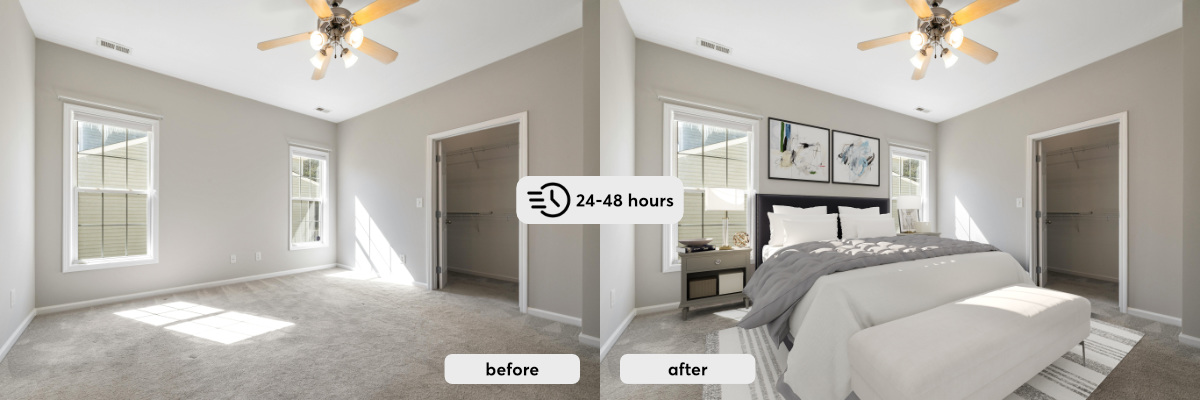
Furthermore, virtual staging offers infinite flexibility. If a property isn't attracting buyers with a "Coastal Contemporary" aesthetic, a digital stager can swap the entire furniture set to "Modern Industrial" or "Transitional Luxury" in a matter of hours, targeting a completely different buyer demographic without lifting a single physical chair.
3. Types of virtual staging services for California
Virtual staging for California is not a one-size-fits-all solution. Depending on the condition of the property and the target demographic, different digital techniques must be applied.
|
Virtual staging taxonomy | ||
|
Service type |
Best used for |
Key benefit |
|
Vacant staging |
Brand new builds, empty rentals |
Fills empty, cold spaces with warmth and scale. |
|
Furniture swap |
Outdated homes, lived-in spaces |
Replaces old furniture with modern designs. |
|
Virtual renovation |
Fixer-uppers, outdated kitchens |
Visualizes structural changes without construction costs. |
|
Decluttering |
Messy properties, occupied rentals |
Removes personal items and cleans up spaces visually. |
|
Virtual twilight |
All property types |
Creates high-end curb appeal at a fraction of the cost. |
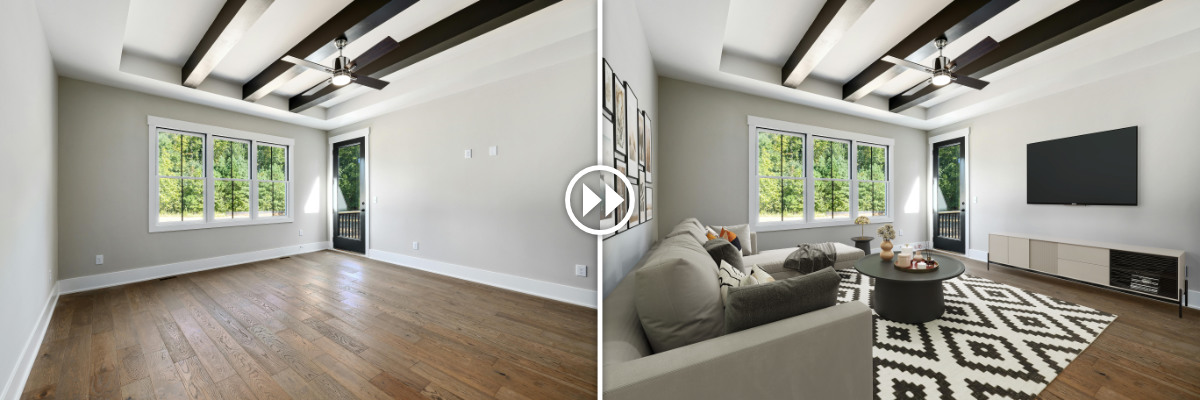
3.1. Full virtual staging (Vacant rooms)
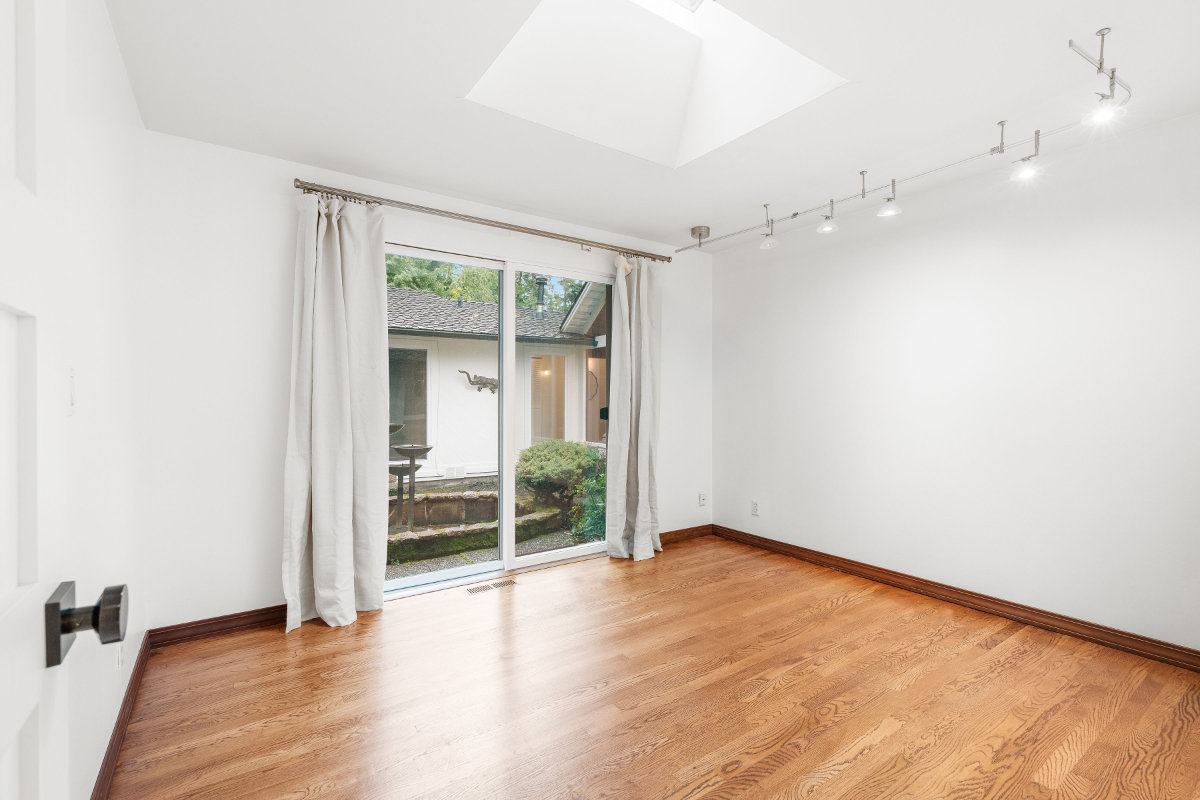
This is the most common application. We take high-quality photographs of empty rooms and digitally design them from scratch. It defines the purpose of a space, establishes scale, and helps buyers visualize how furniture fits into challenging layouts.
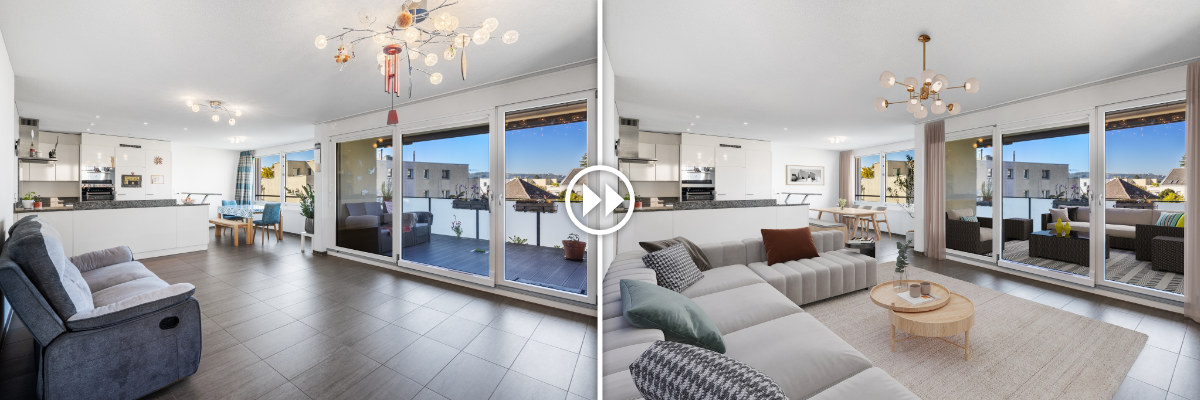
3.2. Virtual furniture replacement & redecorating
Often, lived-in homes have outdated, oversized, or worn-out furniture that clashes with the home’s architectural integrity. We digitally erase the existing furniture and replace it with curated, modern, and high-end pieces that elevate the overall aesthetic of the home.
3.3. Decluttering and depersonalization
Properties occupied by tenants or busy families can sometimes be messy. Cluttered countertops, family photos, and pet beds distract buyers. Our digital artists can seamlessly remove these items, patch up drywall imperfections, clean carpet stains, and present a clean, pristine canvas.
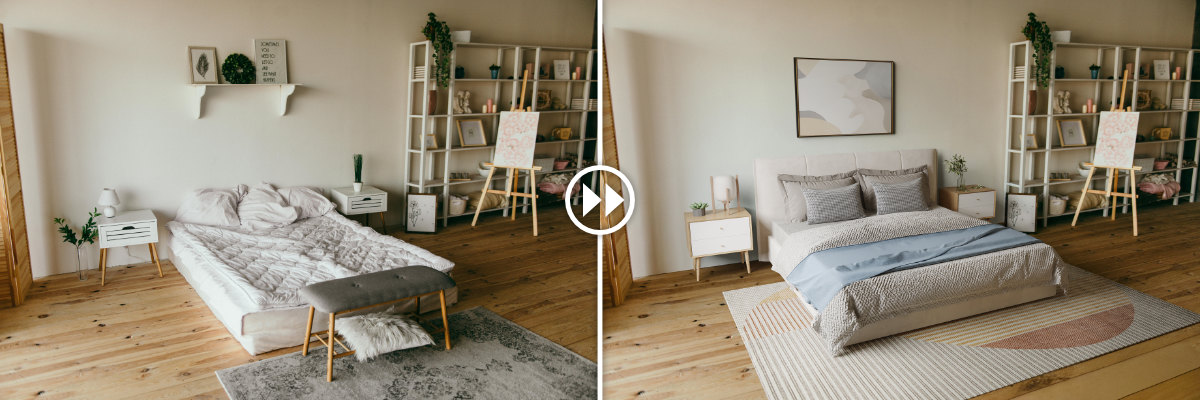
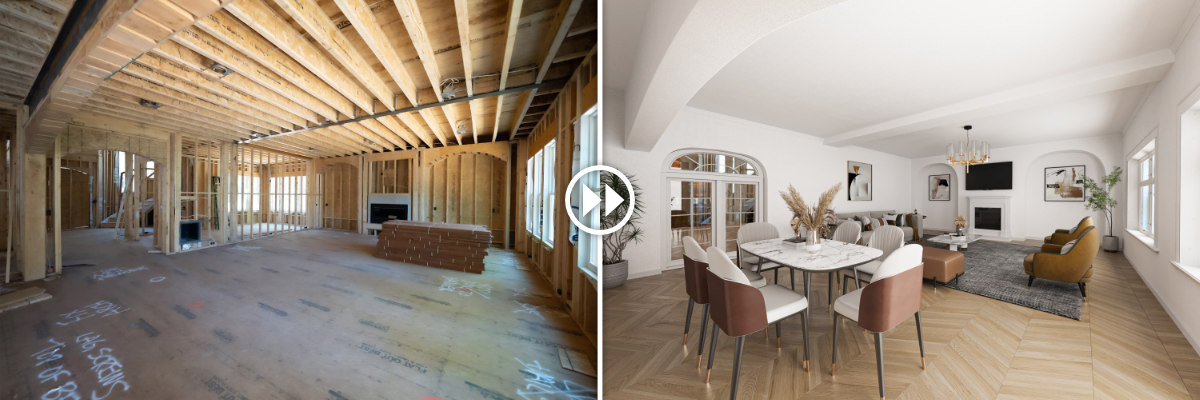
3.4. Virtual renovation and remodeling (Fixer-uppers)
For homes needing major updates, virtual remodeling is a game-changer. We can digitally:
- Replace old carpet with luxury engineered hardwood.
- Knock down non-load-bearing walls to show an open-concept layout.
- Update outdated kitchens with quartz countertops, marble backsplashes, and professional-grade stainless steel appliances.
- This allows buyers to see the property's potential without the seller spending tens of thousands of dollars on actual renovations before the sale.
3.5. Virtual twilight and exterior enhancement
The exterior shot of a home is your primary hook. A daytime photo can be digitally transformed into a stunning sunset/twilight photo. We adjust the sky to a gorgeous golden-hour gradient, turn on interior and exterior lighting, and cast warm, inviting glows onto the driveway and pool area, instantly boosting curb appeal.

4. Behind the scenes: Professional tools and techniques for virtual staging in California
Creating hyper-realistic virtual staging is an art form that bridges the gap between photography and advanced digital rendering. At Fotober, we combine artistic vision with cutting-edge technology to deliver flawless results.
4.1. The professional software stack
- 3ds Max & Cinema 4D: The industry standards for complex 3D modeling. These programs allow us to construct high-fidelity 3D assets with millions of polygons, ensuring soft curves and realistic folds in fabrics.
- Chaos Corona & V-Ray: Advanced rendering engines that simulate the physical properties of light. They calculate how light bounces off walls, penetrates glass, and diffuses across different surfaces.
- Adobe Photoshop (Creative Cloud): Used for meticulous post-production, color grading, shadow refinement, and blending the digital elements seamlessly with the original high-resolution photograph.
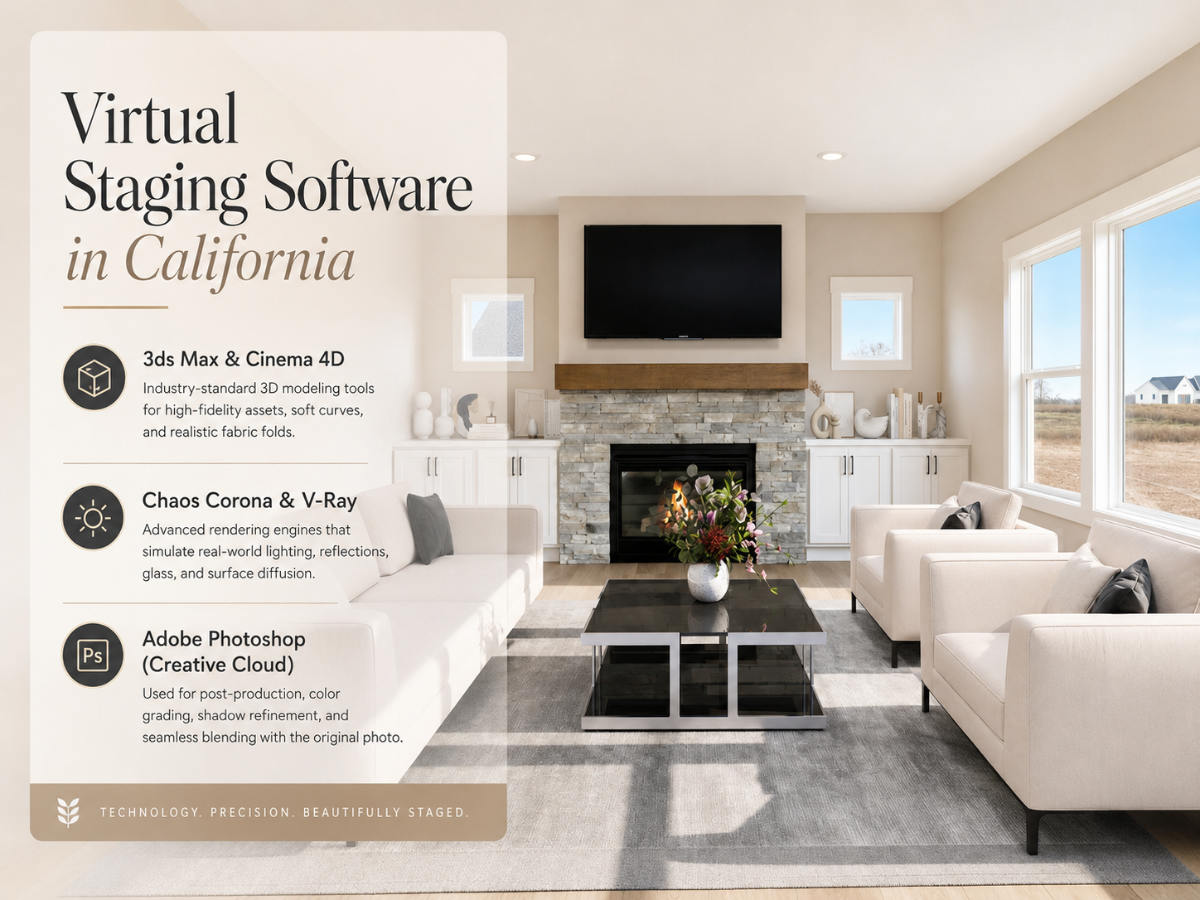 Virtual staging for the California market requires a set of professional architectural software to achieve the finest results.
4.2. The architectural & photographic principles we apply
1. Strict perspective calibration: We use vanishing point grids to align the virtual camera exactly with the height and tilt of the photographer’s tripod. If the camera angle is off by even half a degree, the furniture will look like it is sliding off the floor.
2. Color space matching: We match the white balance and color temperature of the ambient light. If the room is lit by cool daylight (6500K), the virtual furniture cannot have warm yellow highlights (3000K).
3. Realistic ambient occlusion (Contact shadows): Furniture does not just cast a shadow away from the light; it also creates dark, soft contact shadows where its legs touch the floor. Without this, objects appear to "float."
4. Appropriate scale and ergonomics: We never shrink digital furniture to make a room look bigger. We adhere strictly to standard architectural dimensions (e.g., standard sofa depths, dining table heights, and clearance paths) so that the visual representation remains honest and accurate.
5. Use cases: Who needs virtual staging for California?
Virtual staging is a versatile asset that serves multiple sectors of the real estate and design industries.
5.1. Real estate agents & brokers
For listing agents representing properties in competitive markets like virtual staging for San Diego or virtual staging for Los Angeles, standing out is paramount. Staged homes attract more clicks, generate more showing requests, and make agents look highly professional and tech-savvy to potential listing clients.

5.2. Property developers & builders
When selling new construction or pre-sale developments, builders often have nothing but empty drywall or 3D floor plan renderings. Virtual staging for California allows developers to market and sell units before construction is even completed, securing buyers early and reducing carrying costs.

5.3. Professional real estate photographers
Photographers are always looking to add value to their services. By partnering with a virtual staging provider like Fotober, photographers can offer virtual staging and real estate photo editing for California as an upsell to their realtor clients, boosting their revenue per shoot without adding hours of field work.

5.4. Real estate investors & flippers
Fix-and-flip investors need to move inventory quickly to maximize their annualized returns. Empty flips can be virtually staged to highlight the finished quality of the home, allowing investors to list immediately upon completion of construction without waiting for staging furniture deliveries.
6. The business case of virtual staging in California: Conversion rates and return on investment (ROI)
For real estate professionals, every marketing dollar spent must yield a return. The numbers behind virtual staging are incredibly compelling. According to data compiled by the National Association of Realtors (NAR) and industry-wide marketing analyses, 82% of buyers’ agents said staging made it easier for a buyer to visualize the property as a future home. Staged homes sell up to 73% faster than their vacant counterparts. Virtually staged listings receive up to 400% more online views than listings with empty photos.
Cost efficiency: While physical staging in California costs an average of $4,500 per property, virtual staging with Fotober costs a tiny fraction of that (often under $150 to $300 for a full suite of photos).
ROI calculation example: Let's look at a typical listing in the Bay Area, where the median home price hovers around $1,200,000.
|
Metric |
Traditional home staging |
Virtual staging (Fotober) |
|
Initial cost |
$6,000 |
$200 (5 key rooms) |
|
Setup time |
5 - 7 days |
1 - 2 days |
|
Days on market (Avg.) |
21 days |
19 days |
|
Carrying costs (Mortgage/Taxes/Ins.) |
$5,000/month |
$5,000/month |
|
Total investment |
$6,000 + time lost |
$200 |
|
Net marketing savings |
- |
$5,800 saved upfront |
By choosing virtual staging for California, the agent or seller preserves thousands of dollars in equity while enjoying the same, if not better, speed of sale.
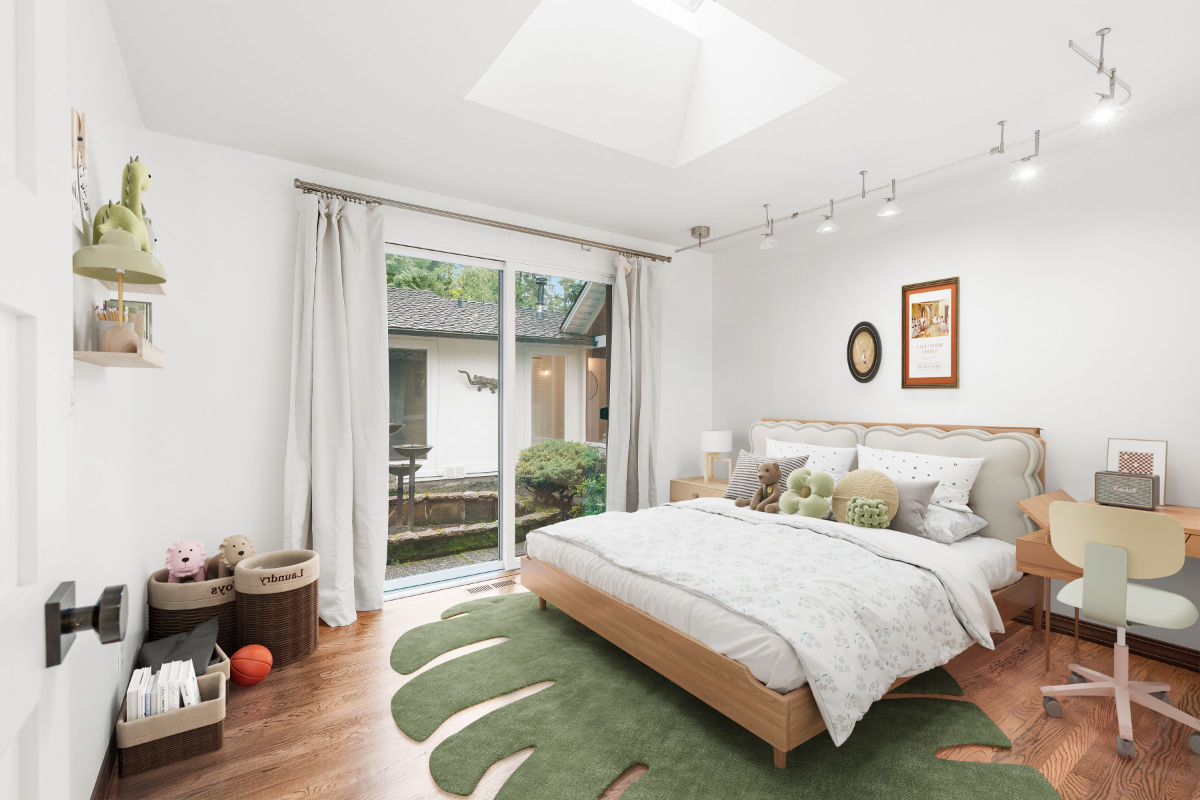
7. The strategic choice: In-house, outsourcing, freelancer, AI, or human?
As virtual staging has grown in popularity, a wide variety of solutions have emerged. Making the right choice for your business requires evaluating speed, cost, and, most importantly, visual quality.
|
Virtual staging vendor matrix | ||
|
Option |
Pros |
Cons |
|
DIY / In-House |
Complete control |
Steep learning curve, expensive software |
|
Low-cost AI apps |
Instant turnaround, cheap |
Poor lighting, floating furniture, uninspiring layouts |
|
Freelancers |
Direct communication |
Inconsistent quality, capacity limits, unpredictable timelines |
|
Agency (Fotober) |
Flawless quality, fast turnaround, large scale |
Requires a small monetary investment |
7.1. In-house staging vs. professional outsourcing
Some agencies attempt to train their internal staff to perform virtual staging using basic software. However, the time spent teaching an assistant to model furniture is time taken away from prospecting, negotiating, and closing deals. Outsourcing to dedicated professionals keeps your team focused on revenue-generating activities.
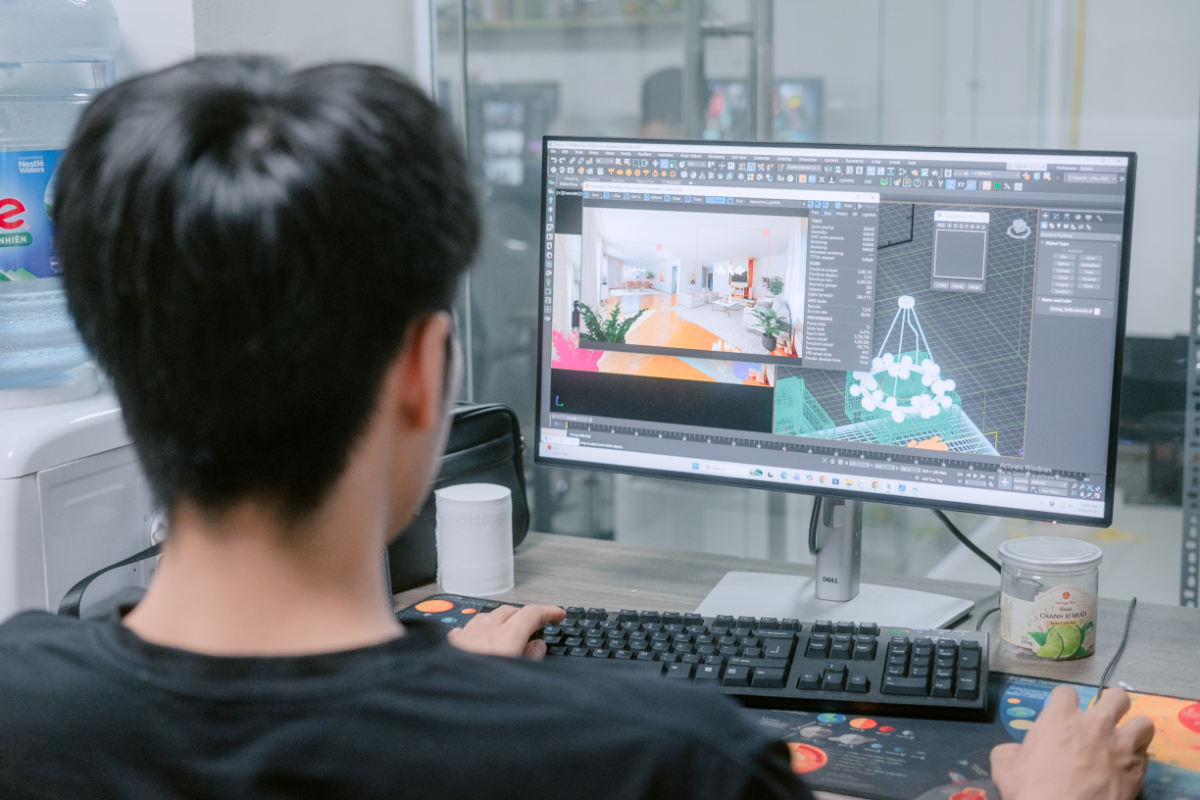
7.2. Freelance platforms vs. professional studios (Agencies)
Using cheap freelance platforms often leads to inconsistent quality, missed deadlines, and communication barriers. A dedicated professional agency like Fotober provides standardized quality control, a team of specialized designers, secure payment systems, and reliable, guaranteed turnaround times.
7.3. Artificial intelligence (AI) vs. human artistry
In 2026, AI-generated virtual staging tools have become widely available. While AI can place furniture in a room in 10 seconds, it still struggles with key elements:
- Structural understanding: AI often places table legs straight through solid walls or generates chairs with five legs.
- Design sensibility: AI lacks an understanding of regional California tastes. It might place an ultra-modern Nordic plastic chair in a classic Spanish Revival home in Pasadena, creating a jarring aesthetic clash.
- Resolution and clarity: AI images often lose clarity and look blurry upon zooming.
- The hybrid approach: At Fotober, we leverage advanced computational tools to speed up minor tasks, but every project is hand-guided, refined, and quality-controlled by human design experts and architectural editors. This ensures the perfect balance of speed and flawless, realistic quality.
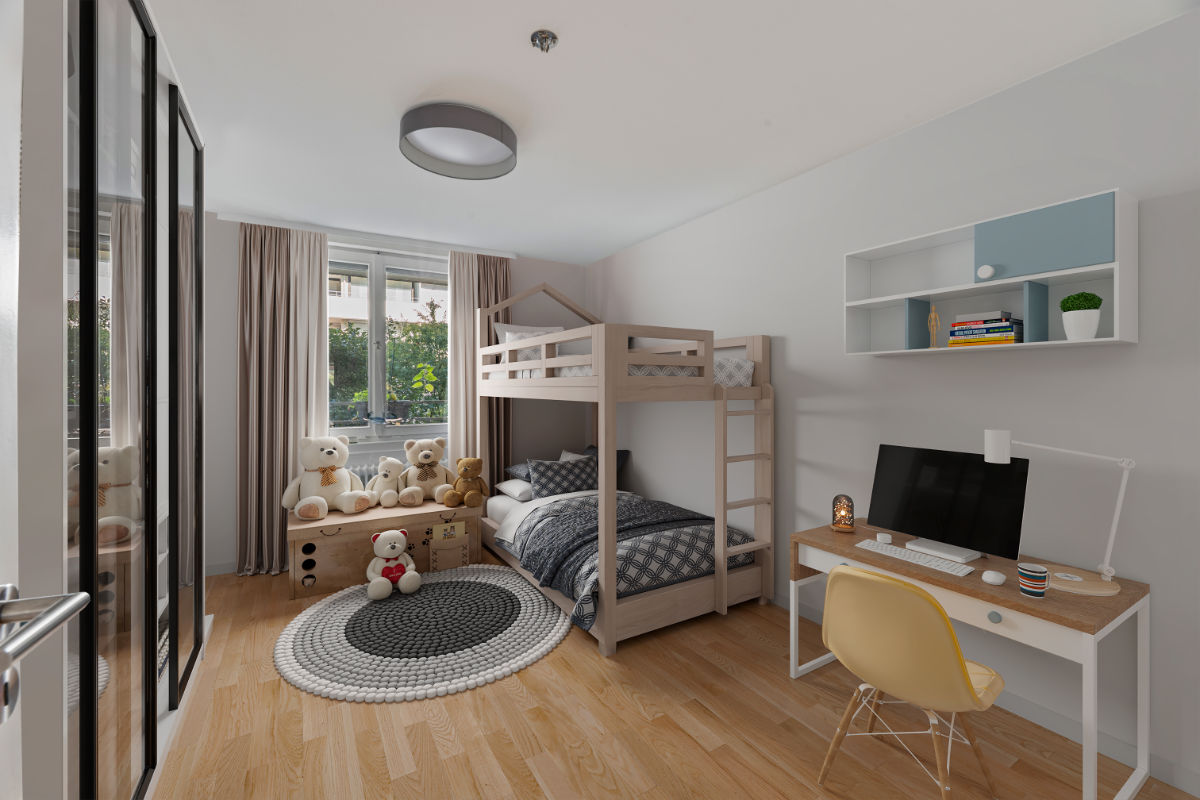 AI staging without human refinement is imperfect.
8. Introducing Fotober’s virtual staging solutions for California
At Fotober, we have spent years perfecting the art of digital real estate enhancement. We understand that a home in Silicon Valley needs a different aesthetic touch than an estate in Beverly Hills or a bungalow in North Park, San Diego.
8.1. Our tailored services for California’s diverse markets
- Virtual staging for Los Angeles: We specialize in high-end, luxury, and celebrity-level aesthetics. From sleek Hollywood Hills modernism to warm, organic modern designs, we curate high-end digital furniture that matches LA’s affluent buyer expectations.
- Virtual staging for San Diego: We bring the outdoors in. Our designs for the San Diego market emphasize bright, airy, coastal, and transitional styles, making perfect use of natural light and outdoor living spaces.
- Virtual staging for Bay Area: Catering to tech executives and modern professionals, our Bay Area designs focus on smart, space-efficient, mid-century modern, and minimalist contemporary styles that highlight clean lines and high-end finishes.
- Home staging California-wide: No matter where your listing is located, from Sacramento to Orange County, we offer complete digital solutions that elevate your listings to premium standards.
|
Fotober’s design styles for virtual staging in California |
|
Coastal Contemporary (San Diego) |
8.2. What makes Fotober different?
- Curated style libraries: We don't use generic, outdated 3D models. Our digital furniture library is updated weekly to reflect current interior design trends, featuring replicas of pieces from high-end brands like Restoration Hardware, West Elm, and Crate & Barrel.
- Uncompromising quality assurance: Every single image undergoes a multi-step QA check by our senior editors to ensure lighting, perspective, and scale are perfect before it reaches your inbox.
- Super-fast turnaround: We know that real estate moves fast. We deliver your fully staged, high-resolution images within 24 to 48 hours.
- No hidden fees & unlimited revisions: We work with you until you are completely satisfied with the look and feel of your staged rooms.
9. Future horizons: Virtual staging trends in 2026 and beyond
As technology continues to evolve, the real estate marketing landscape is shifting rapidly. Here are the key trends shaping the future of virtual staging in California and worldwide:
9.1. High-fidelity interactive 3D staging
Static photos are just the beginning. We are moving toward interactive environments where buyers can click on a virtually staged room and swap design styles in real time, viewing the space in Modern, Industrial, or Bohemian styles with the click of a button.
9.2. Immersive augmented reality (AR) & virtual reality (VR)
With the widespread adoption of advanced mixed-reality headsets like the Apple Vision Pro and Meta Quest, buyers touring empty homes in person can put on headsets and walk through rooms that are virtually staged in real time, experiencing the scale and design in full 3D space.
[Empty Room] + [Mixed-Reality Headset] ---> [Real-time 3D Staged Space]
9.3. Sustainable and green staging
As environmental awareness continues to grow, virtual staging is increasingly recognized as a green alternative. By eliminating the carbon footprint of moving trucks, plastic bubble wrap, and physical manufacturing of temporary staging furniture, virtual staging is the most eco-friendly choice for sustainable real estate practices.
10. Frequently asked questions about virtual staging in California (FAQ)
Q: Do I need to disclose that the photos are virtually staged?
A: Yes, transparency is key. We highly recommend adding a small watermark or caption to the photo saying "Virtually Staged" or showing a side-by-side comparison of the vacant and staged room in your online listing. This builds trust with buyers and sets accurate expectations for physical showings.
Q: What is the ideal photo quality required for virtual staging?
A: For the best results, photos should be taken by a professional real estate photographer using a wide-angle lens, shot from standard chest height (around 4-5 feet), and delivered in high-resolution JPG or RAW format with balanced lighting. However, our team can work miracles even with decent smartphone photos.
Q: Can you remove existing cluttered furniture and replace it?
A: Absolutely. This is our furniture replacement / decluttering service. We digitally erase the old furniture, reconstruct the hidden floors and walls behind it, and then place new, modern virtual furniture in the clean space.
Q: How long does the virtual staging process take?
A: Our standard turnaround time is 24 to 48 hours from the moment we receive your high-resolution images and design preferences.
Q: Can I choose the style of furniture?
A: Yes! You can choose from a wide variety of styles, including Modern, Contemporary, Industrial, Coastal, Scandinavian, Traditional, and Farmhouse. If you aren't sure, our expert designers will analyze your property’s architecture and select the style that best appeals to local buyers.
11. Conclusion: Partner with Fotober to elevate your listings
In California's competitive real estate landscape, you cannot afford to let your listings blend into the background. Whether you are marketing a chic beach condo in San Diego, a luxury estate in Los Angeles, or a sleek contemporary home in the Bay Area, virtual staging for California is your secret weapon to attract more buyers, secure higher offers, and sell your properties faster.
At Fotober, we combine technical precision with high-end architectural and interior design expertise to deliver virtual staging that is stunningly realistic and highly effective. Don’t let vacant rooms or outdated decor hold your listings back. Contact Fotober today to submit your first project, and let us help you transform your real estate photography into an irresistible digital experience.
Follow us on social media to stay updated with the latest visualization services to make every home look premium and sell it before construction.
- Facebook: fotobermedia.co
- YouTube: Fotober
- TikTok: @fotober
- Instagram: fotober_media.
Related posts

Cincinnati Housing Market 2026: Prices, Trends, and What It Means for Buyers, Sellers, and Investors
October 20, 2026

Modern Luxe Interior Design: Elements, Style Guide and How to Stage It
October 10, 2026

Minimalist Interior Design: Characteristics, Style Guide, and Staging
October 8, 2026

Coastal Interior Design: Style Definition & Staging Guide
September 30, 2026
