




Orlando Population Growth in 2026: Trends & Housing Demand

Share:
Table of Contents
- 1. Key takeaways
- 2. How fast is Orlando growing in 2026
- 3. Who’s moving to Orlando and how population growth drives housing demand
- 4. Why Orlando population growth drives listing competition
- 5. How Fotober helps Orlando listings compete in market growth
- 6. Frequently asked questions about Orlando population growth
- 7. Conclusion
Few American metros are expanding as fast as Central Florida's hub, and Orlando's population growth is reshaping the region's housing market in real time. More people means more households, more demand for homes, and, crucially for anyone selling a property, more listings competing for attention. Understanding who is moving in, how fast, and what it does to the market is essential whether you're a buyer, an investor, or an agent trying to sell faster in an increasingly crowded field.
Let's lay out the 2026 picture: how fast Orlando is really growing, who's driving the migration, how that growth fuels Florida housing demand, and what it means for investors. It ends with the practical takeaway sellers can't ignore: why rapid population growth actually intensifies listing competition, and how strong presentation helps a home rise above the crowd. Let's start with the numbers.
1. Key takeaways
- Orlando population growth is among the fastest in the country, with the metro ranked the fastest-growing in Florida in the latest Census data.
- The metro added roughly 37,690 residents in a single year, and the city's population has risen more than 10% since the 2020 census.
- Orlando population growth is driving strong housing demand and rental demand, keeping the market active even as supply struggles to keep pace.
- Those dynamics make Orlando attractive to real estate investors, though buyers should weigh affordability and insurance costs.
- Fast growth means more listings compete for buyers, so professional presentation, photo editing, and virtual staging are what help a home stand out and sell.
2. How fast is Orlando growing in 2026
Orlando population growth remains among the strongest in Florida in 2026, with the latest U.S. Census Bureau estimates showing that the Orlando–Kissimmee–Sanford metropolitan area added 37,690 residents between July 2024 and July 2025. That brought the metro population to approximately 2.96 million, up from 2.92 million a year earlier. Orlando recorded the 10th-largest numeric population gain of any U.S. metro area during that period and the largest increase among Florida metros in the Census ranking. (U.S. Census Bureau)
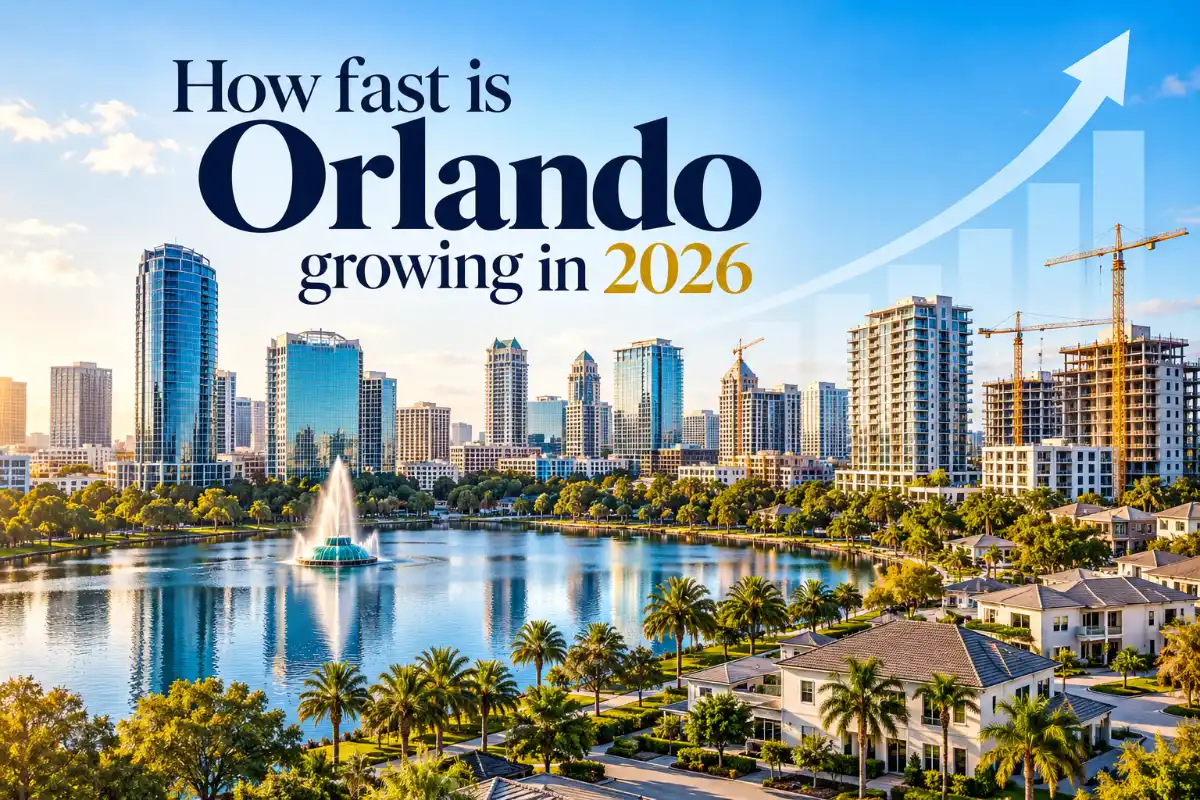
The more important story is that this is not a one-year surge. Census estimates place the Orlando metro at roughly 2.67 million residents in 2020, meaning it added about 284,000 people by mid-2025, an increase of more than 10% in roughly five years. That sustained expansion puts additional pressure on housing, infrastructure, schools, transportation, and other services throughout Central Florida rather than only within Orlando city limits. (U.S. Census Bureau)
The City of Orlando itself is growing as well, although it is important not to confuse city and metro figures. The Census Bureau's latest official estimate puts Orlando proper at 333,888 residents as of July 1, 2025, up 8.4% from its 2020 estimates base of 308,101. Some demographic sites project the city's population at around 340,000 in 2026, but that figure is a projection rather than an official 2026 Census estimate. For housing-market analysis, the metro population is generally the more useful measure because buyer demand extends across Orange, Osceola, Seminole, and surrounding communities rather than stopping at Orlando's municipal boundary. (U.S. Census Bureau)
The housing implications are already visible. The City of Orlando reports that its population grew about 14% between 2020 and 2024 while housing stock increased by only 11%, creating an estimated shortage of approximately 9,400 housing units. Looking ahead, city planners project more than 90,000 additional residents by 2035 and estimate that roughly 46,000 new housing units will be needed to accommodate that growth. Orlando currently has thousands of units under construction or in the development pipeline, but the city has explicitly identified the gap between population and housing supply as a planning priority. (City of Orlando)
For the real estate market, continued Orlando population growth creates a durable base of housing demand, but it does not automatically mean every listing will sell quickly or appreciate at the same rate. Higher inventory, mortgage rates, new construction, affordability, and neighborhood-level supply still influence pricing and absorption. What the population data does show is that Orlando continues to add households at a scale large enough to support long-term demand for both owner-occupied and rental housing across the region.
3. Who’s moving to Orlando and how population growth drives housing demand
Understanding who is moving to Orlando helps explain why Orlando population growth continues to shape the housing market. For years, Central Florida has attracted retirees, families, remote workers, and professionals from other U.S. states, supported by job opportunities, Florida’s lack of a state individual income tax, and comparatively attainable housing versus many major coastal metros. International migration has also become an important part of the region’s increasingly diverse population.
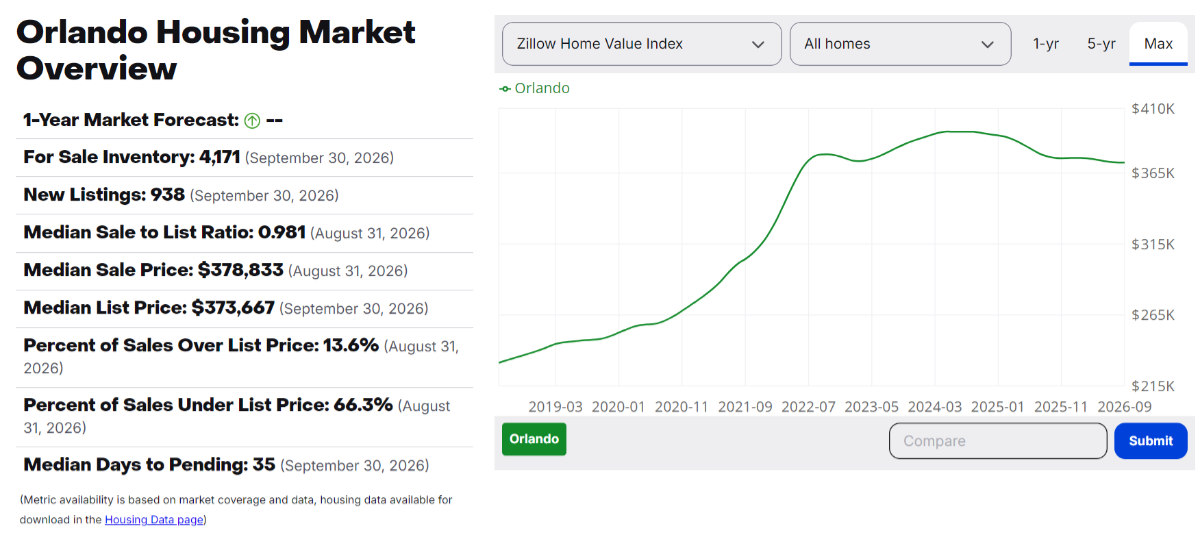
The scale of that growth is significant. According to NewHomeSource’s 2026 Orlando demographic update, the Orlando region added more than 200,000 residents between 2020 and 2024 and is projected to surpass 3.1 million people by the end of the decade. The same analysis notes that household growth is running even faster than population growth, an important signal because new households translate more directly into demand for homes and rentals.
That connection makes Orlando population growth a major underlying driver of local housing demand. Every wave of new residents creates households that need somewhere to live, whether they buy immediately or rent while becoming familiar with the area. Demand is also spread across different property types, from suburban family homes and new-build communities to apartments, retirement housing, and homes designed for multigenerational living.
For sellers and investors, however, population growth does not mean every property will automatically attract strong offers. Buyers still have listings to compare, and new construction continues to add alternatives across Central Florida. The opportunity is therefore not simply having a home in a growing market, but presenting and pricing it well enough to capture demand from the new households that growth is bringing into the region.
4. Why Orlando population growth drives listing competition
Strong Orlando population growth expands the buyer pool, but it does not automatically make every home easier to sell. Population gains create new households and long-term housing demand, yet Orlando is also adding resale inventory and new construction at the same time. The result is a market where sellers may benefit from a growing customer base while still competing aggressively for buyer attention.
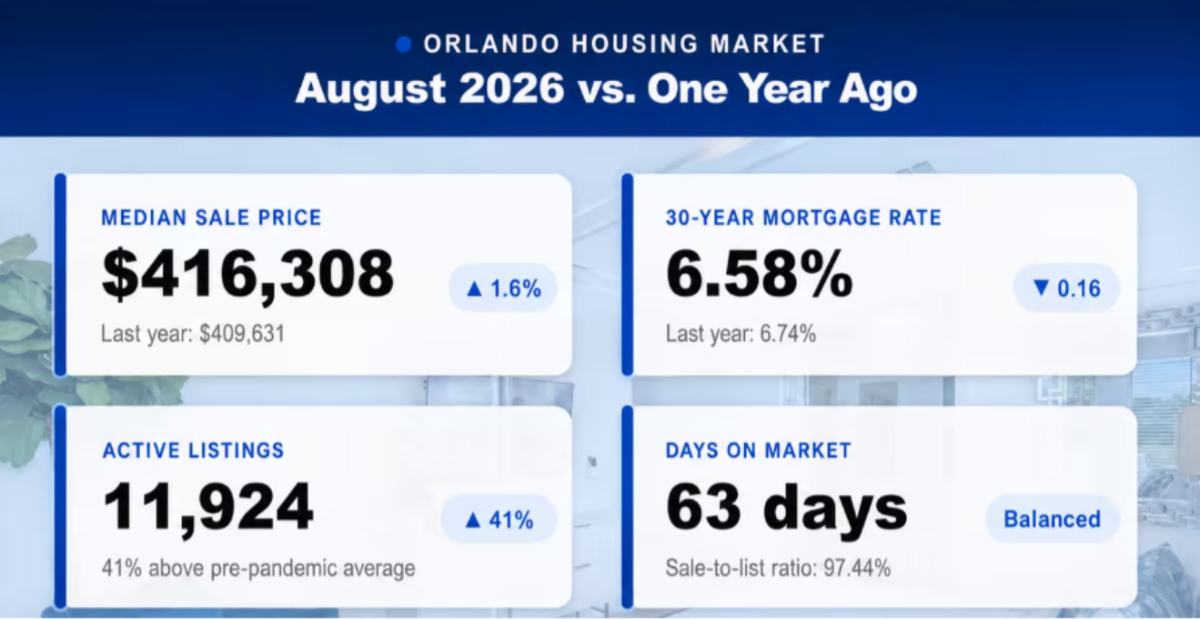
Current inventory illustrates that shift. According to the Orlando Regional REALTOR® Association, Orlando-area inventory reached 12,144 homes in August 2026, with 4.9 months of supply, up from 4.4 months in July. While that remains below the six-month level ORRA uses as a benchmark for a balanced market, buyers have considerably more choice than during the inventory-constrained years earlier in the decade. ORRA also notes that buyers have become more selective as borrowing costs remain elevated, giving sellers another reason to compete on pricing, condition, and presentation.
For homeowners preparing to list, that means population growth should be viewed as a source of underlying demand rather than a guarantee of a fast sale. A relocating family may be interested in Orlando, but once they begin searching, they can compare resale homes, recently renovated properties, condos, townhomes, and new-build communities across multiple Central Florida submarkets. Homes with similar square footage and price points may therefore compete directly even when they are located several neighborhoods apart.
Much of that competition begins online. The National Association of REALTORS® found that 43% of buyers started their home-buying process by looking for properties on the internet, while photos ranked among the most useful features on real estate websites. Earlier NAR generational research also found that photos were considered particularly useful by nearly nine in ten buyers age 58 and younger. For sellers targeting relocating households that may be hundreds or thousands of miles away, the digital listing often becomes the property's first showing.
That makes visual presentation increasingly important. Professional property photo editing can correct exposure, mixed-light color casts, window detail, perspective, and other technical issues while keeping the property natural and accurate. Consistency matters as well: a complete gallery with balanced brightness and color gives buyers a clearer understanding of the home than a collection of uneven images.
Vacant properties and new construction face a different challenge because empty rooms can be difficult to judge for scale and function. Virtual home staging can help buyers understand how a living room, bedroom, or flex space might be furnished, provided the digitally staged images are clearly disclosed and do not misrepresent permanent property features.
For Orlando sellers, the takeaway is straightforward: population growth creates opportunity, but increased buyer choice raises the standard for how listings compete. Pricing appropriately, preparing the property, and presenting it with strong visual media can determine which homes capture attention first. In a growing metro, demand matters, but when buyers have more options, differentiation matters just as much.
5. How Fotober helps Orlando listings compete in market growth
As Orlando population growth continues to expand the pool of buyers, the challenge for sellers is no longer simply getting a property in front of more people. It is making that property look clear, credible, and compelling enough to stand out against a larger field of resale homes, new construction, and professionally marketed listings. This is where post-production becomes part of the competitive strategy rather than just a finishing step.
Fotober supports that process by helping agents, photographers, and real estate teams turn raw listing media into polished, market-ready assets. For standard occupied homes, professional photo editing can correct exposure, white balance, vertical lines, window detail, and inconsistent lighting across a gallery. Those adjustments are especially important when buyers are comparing several properties side by side online, because visual inconsistency can make an otherwise strong listing feel less polished than competing homes in the same price range.

Vacant homes present a different problem. Empty rooms often make it difficult for buyers to understand scale, furniture placement, or the intended function of a space, which can be a disadvantage when competing against furnished model homes or recently renovated properties. Fotober’s virtual staging can add realistic furniture and décor to vacant interiors, helping buyers visualize how the home could be lived in without the cost and logistics of physical staging. The goal is not to change the property itself, but to make the existing space easier to understand.
For listings that need a stronger visual hook, Fotober can also support day-to-dusk conversion, object removal, floor plans, video editing, and other post-production services. These assets can be particularly useful for Orlando agents marketing homes to relocating buyers who may be evaluating the property remotely before deciding whether to schedule an in-person showing. A consistent set of photos, staged images, floor plans, and video gives those buyers more context and helps reduce uncertainty earlier in the decision process.
The workflow can also make sense for photographers and high-volume teams. Instead of spending additional hours editing after each shoot, they can keep capture in-house and outsource the production work to a dedicated editing team. That allows the photographer to maintain control over how the property is shot while Fotober handles the repetitive post-production needed to keep multiple listings consistent.
For sellers, the practical takeaway is simple. A growing Orlando market creates demand, but it also raises the standard for how properties are presented. Fotober does not replace correct pricing, property preparation, or local market expertise, but it can strengthen the visual side of the listing so the home has a better chance of earning attention when buyers are comparing more options. In a market shaped by migration, new construction, and expanding inventory, that first digital impression can become an important part of the selling strategy.
6. Frequently asked questions about Orlando population growth
How fast is Orlando's population growing in 2026?
Very fast. The Orlando–Kissimmee–Sanford metro was the fastest-growing in Florida in the latest Census data, adding about 37,690 residents in a year, and the City of Orlando has grown more than 10% since the 2020 census to around 340,000 people.
Who is moving to Orlando?
Historically, many of the people moving to Orlando came from other U.S. states, drawn by jobs, no state income tax, and affordability. More recently, international migration and natural increase have driven more of the growth, while net domestic migration has cooled, but overall the inflow remains strong.
How does population growth affect Florida housing demand?
Each wave of new residents creates new households that need homes, sustaining strong housing demand and keeping both for-sale and rental markets active. Because homebuilding hasn't fully kept pace, that demand supports prices and keeps the market competitive.
Is Orlando a good place for real estate investment?
Orlando real estate investment benefits from structural demand driven by population growth, a tourism economy, and a diversified job base, supporting rentals and long-term appreciation. However, stretched affordability and rising insurance costs mean investors should underwrite carefully.
7. Conclusion
Orlando population growth is the defining force in the region's housing market: the metro is the fastest-growing in Florida, adding tens of thousands of residents a year and fueling durable demand for homes and rentals. For buyers and investors, that growth signals opportunity backed by real fundamentals; for sellers, it signals competition, because a booming population means more listings fighting for the same attention. The homes that win in that environment are the ones that look their best online: bright, professionally edited, and well staged. If you're selling or marketing a property in the Orlando area, Fotober can help it stand out with professional photo editing and virtual staging. Reach us at [email protected] or the hotline below, and send your listing photos to see the difference, place an order or start a free trial today.
Connect with Fotober
- Facebook: fotobermedia.co
- YouTube Channel: Fotober
- TikTok Channel: @fotober
- Instagram: fotober_media
- Email support: [email protected]
- Hotline: +84 942 110 297
Related posts
San Antonio Housing Market Forecast 2026: Prices & Trends
October 30, 2026
What Drives Mortgage Rates? Explain The Forces Behind 2026's Numbers
October 29, 2026
Dallas vs. Los Angeles Housing Market: Comparing Prices & Supply
October 29, 2026
Cincinnati Housing Market 2026: What Should Buyers & Sellers Expect?
October 20, 2026
