




Pre-Construction Rendering: How Developers Sell Off-Plan Property

Share:
Table of Contents
- 1. What pre-construction rendering is and why it matters
- 2. The main types of pre-construction rendering
- 3. How pre-construction rendering drives off-plan sales
- 4. What it costs and how to brief a rendering team
- 5. In-house versus outsourced rendering for developers
- 6. Frequently asked questions about pre-construction rendering
- 7. Conclusion: turn plans into sales with the right renders
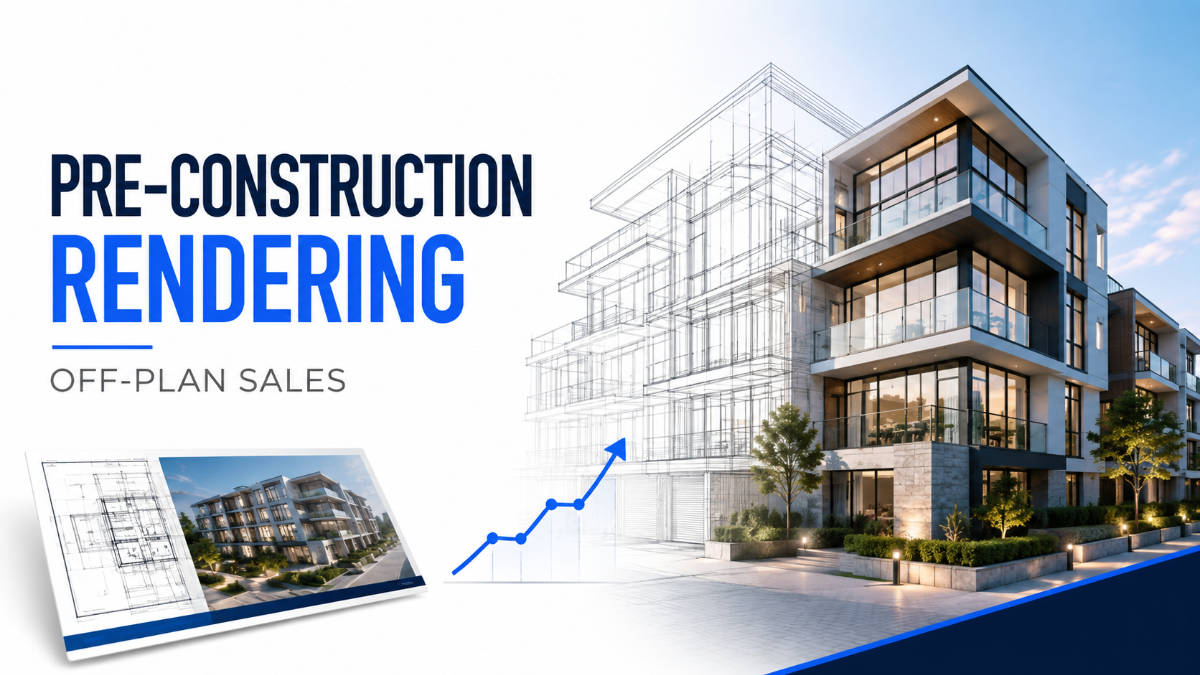
Pre-construction rendering gives developers a way to sell a building before it physically exists. Buyers and investors are often being asked to commit hundreds of thousands of dollars to little more than a construction site and a set of architectural drawings they may not fully understand. By turning those plans into photorealistic images, pre-construction renders bridge that gap and helps buyers visualize the finished property long before the concrete is poured. For developers marketing off-plan condos, master-planned communities, or spec homes, these visuals are not simply a nice-to-have, they are often the product buyers see first. Renderings appear in brochures, sales centers, paid advertising, websites, and listing portals, and their quality can directly influence how confidently buyers respond to a project. A flat or unrealistic image can undersell a premium development, while a well-executed render can make an unbuilt home feel tangible, desirable, and ready to own.
This guide explains how pre-construction rendering works and how developers can use it effectively, from choosing the right types of renders and supporting off-plan sales to understanding costs, briefing a 3D visualization team, and deciding whether to build the capability in-house or outsource production. It is written for developers, builders, agents, and marketers responsible for bringing new construction projects to market.
1. What pre-construction rendering is and why it matters
Pre-construction rendering is the creation of photorealistic 3D images of a property before it is built, generated from architectural drawings, floor plans, and material specifications. Instead of asking a buyer to interpret a 2D elevation, a render shows the finished building with real lighting, textures, landscaping, and furnishings, the way it will actually look on completion day. That single shift, from abstract plan to believable image, is what makes off-plan selling possible at scale.
It matters because new-home buyers rely heavily on visuals to make decisions, and the search starts online. The National Association of REALTORS® reports in its research that the vast majority of buyers begin their home search on the internet, where images do the heavy lifting; with new residential construction a significant share of the U.S. housing market per Census Bureau data, that's a large audience making decisions from renders. When the home itself can't be toured, the quality of the 3D rendering for pre-construction marketing becomes the deciding factor.
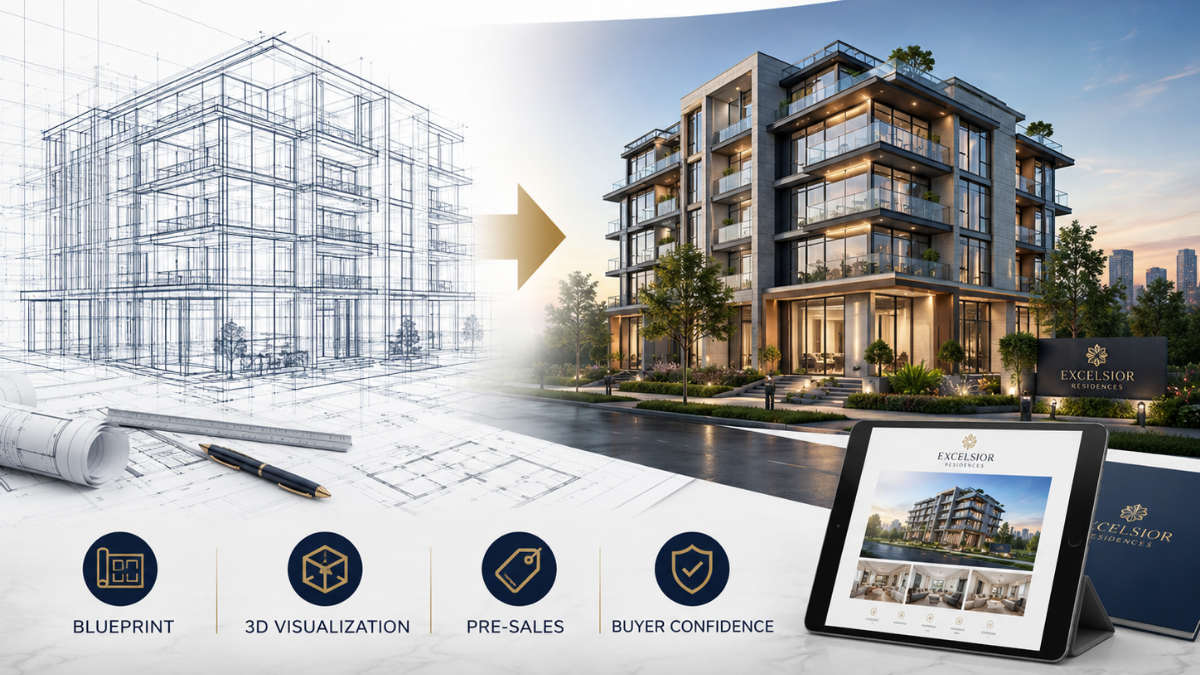
There's financial logic, too. Off-plan sales let developers secure pre-sales that de-risk financing and improve cash flow before completion, and strong visuals accelerate those reservations. A compelling pre-construction 3D architectural rendering shortens the leap of faith a buyer has to make, which typically means faster absorption and stronger pricing, the whole reason developers invest in visualization in the first place.
Industry context reinforces how central new construction is to housing supply. Builder activity tracked by the National Association of Home Builders shows that new homes account for a meaningful and growing share of what buyers consider, and much of that inventory is marketed and reserved before completion. In that environment, visualization isn't decoration; it's the primary way a developer communicates a product that a buyer physically cannot inspect, which is why rendering budgets have become a standard line item in new-development marketing plans rather than an optional extra.
2. The main types of pre-construction rendering
Developers typically commission four kinds of pre-construction renders, and most projects use a mix rather than a single type. Each answers a different buyer question, what does it look like, what's it like inside, where does it sit, and how does it flow, so a complete marketing set usually spans all four. Knowing the categories helps you brief a render team accurately and budget realistically.
2.1. Exterior renders
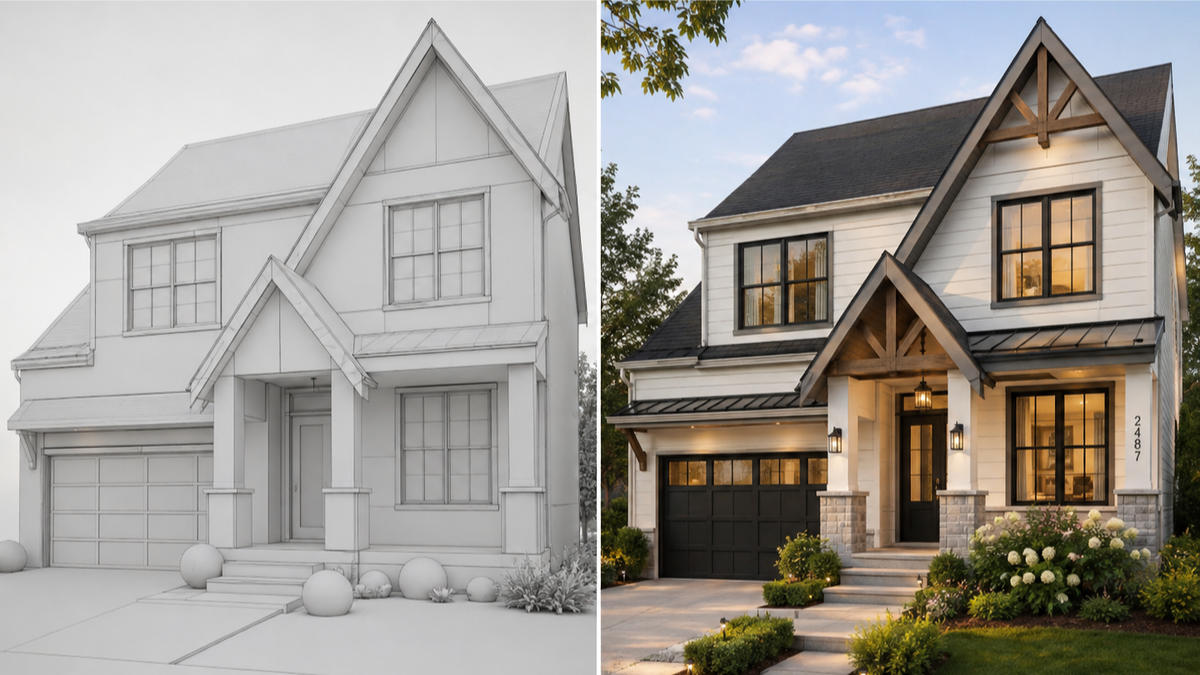
Exterior pre-construction renderings show the building's facade, entrance, and street presence, and they're the hero images for most off-plan campaigns. A good exterior render places the building in a believable context, the right sky, mature landscaping, cars and people for scale, and lighting that flatters the architecture. For a condo tower or a spec home, this is the image that stops the scroll and anchors the brochure cover.
2.2. Interior renders
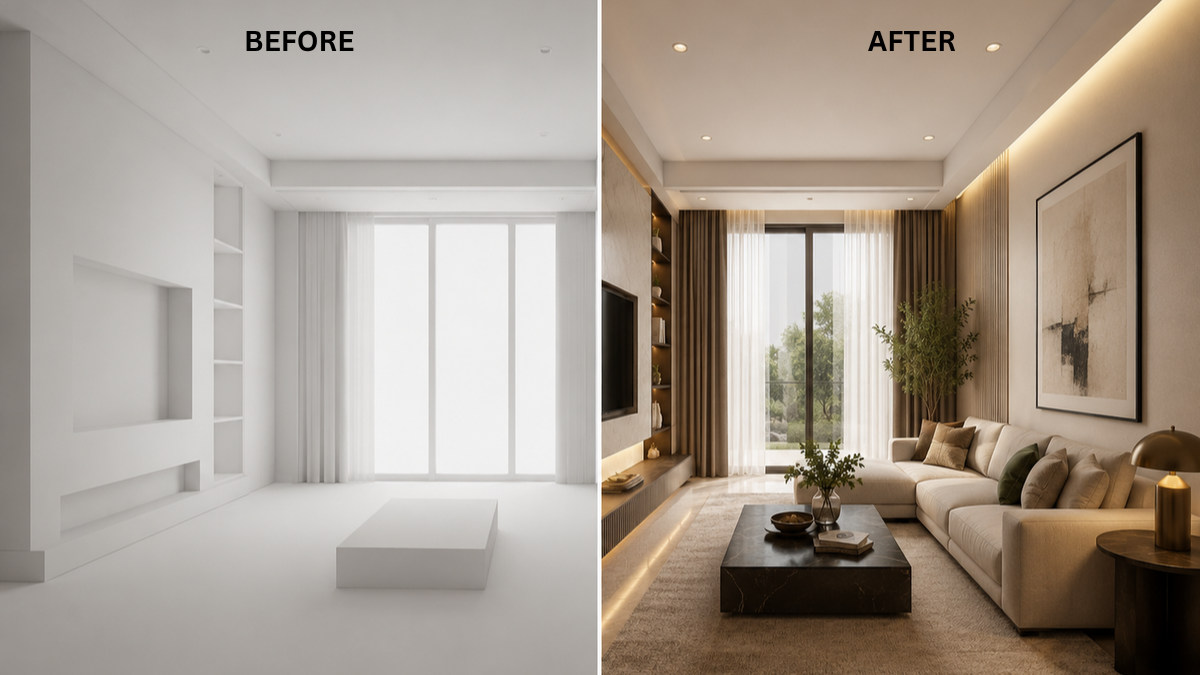
Interior renders sell the lifestyle inside the unit: the kitchen finishes, the living-room light, the primary suite. Because buyers of off-plan homes are really buying a feeling, interior renders are where material choices, furniture styling, and warm lighting do the emotional work. A developer offering multiple finish packages can render each option so buyers see exactly what they're choosing.
2.3. Aerial and site-plan renders
Aerial and site-plan renders show how a project sits within its lot or community: building placement, amenities, green space, parking, and proximity to roads or water. For master-planned communities and multi-building developments, these bird's-eye views communicate scale and lifestyle that ground-level shots can't. They're also essential for illustrating phasing in a larger build-out.
2.4. 3D floor plans
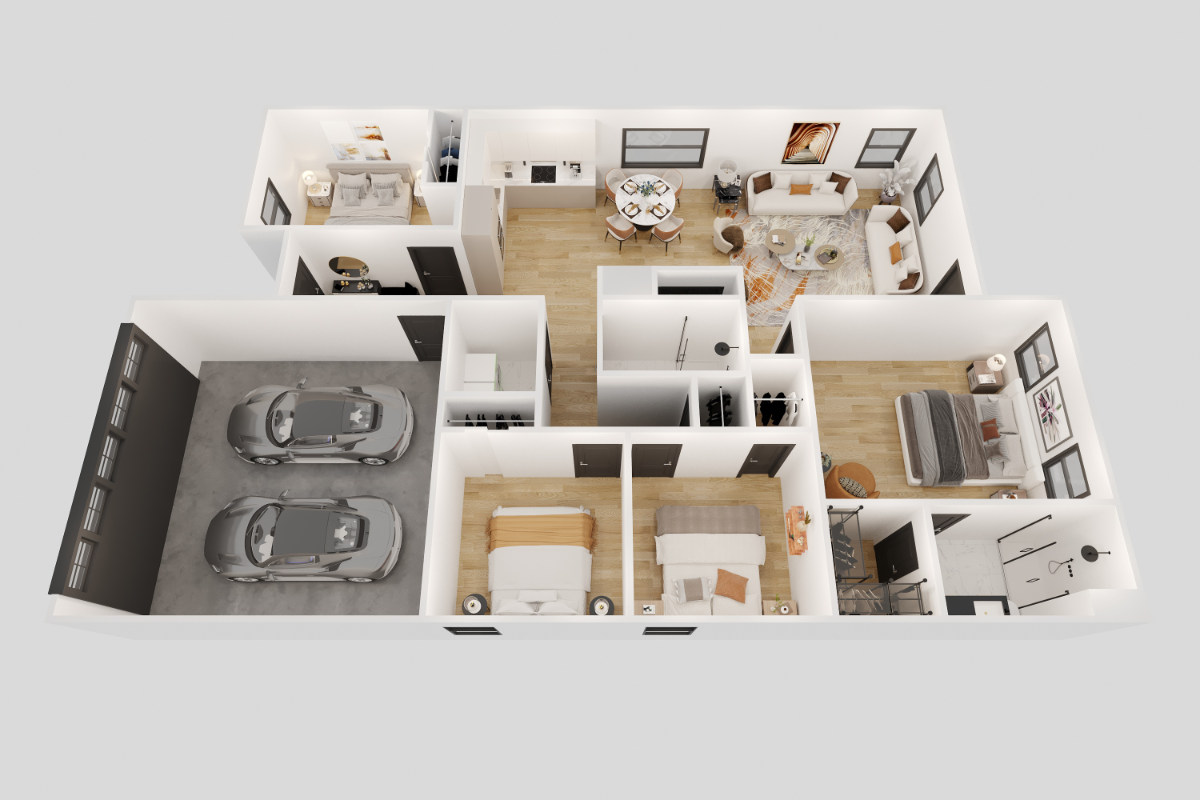
3D floor plans convert flat architectural plans into furnished, dollhouse-style views that buyers instantly understand. They bridge the gap between a technical 2D drawing and a full interior render, helping buyers grasp room flow, proportions, and how their furniture might fit. For off-plan property 3D rendering, a clear 3D floor plan often does more to close a hesitant buyer than any single glamour shot.
What separates a believable render from an obviously fake one, across all four types, is restraint and realism. The best pre-construction visuals use accurate materials pulled from the real finish schedule, physically plausible lighting for the building's actual orientation, and context, trees, sky, neighboring structures, that matches the site. Renders that oversaturate colors, invent impossible views, or stage a unit larger than it is may look impressive on screen but set up disappointment when the building is delivered, and disappointed early buyers become the reviews that stall a project's later phases. Matching the render honestly to the finished product protects both the sale and the developer's reputation.
3. How pre-construction rendering drives off-plan sales
Pre-construction rendering drives sales by removing uncertainty at every stage of the buyer journey, from the first ad impression to the signed reservation. Because there's no physical home to visit, the render is the showroom, the model unit, and the sales brochure rolled into one, and it works across every channel a developer uses. Used well, a single strong visualization set carries a campaign from launch to sell-out.
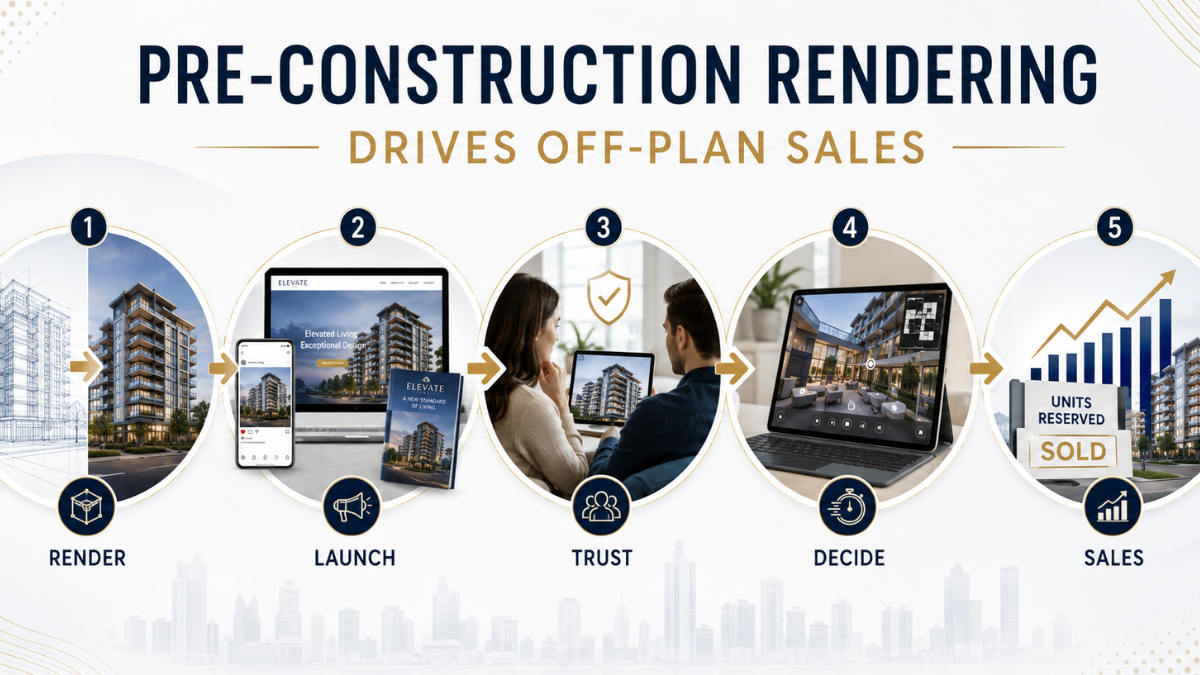
Consider an illustrative scenario, a hypothetical developer launching a 40-unit off-plan condo in a competitive metro. Before breaking ground, the marketing team commissions a full set of renders: an exterior hero shot, three interior scenes per floor plan, an aerial of the site with amenities, and 3D floor plans for each layout. Those images populate the sales-center displays, the project website, the paid social ads, and the email campaign, so a buyer who sees an ad on Monday and visits the sales center on Saturday encounters the same polished, consistent vision throughout. That coherence builds confidence, and confidence is what turns interest into deposits.
The channel math is compelling. The same 3D rendering for pre-construction marketing that appears on a billboard can be resized for Instagram, embedded in a virtual tour, and printed in a luxury brochure, so the cost is amortized across the entire campaign. Developers who invest early in high-quality visualization also protect their pricing: when the visuals look premium, buyers accept premium prices, whereas weak imagery invites discounting. In a slow market, that difference can decide whether a project sells out on schedule or stalls with unsold inventory.
Rendering also compresses the sales cycle in ways a physical model unit never could. Building a furnished model unit costs tens of thousands of dollars and can only be shown in one place; a render set travels everywhere at once and updates in days when a finish package or layout changes. For international or out-of-state investors, a large segment in many pre-sale markets, the renders and a virtual walkthrough may be the only "tour" they ever take before wiring a deposit. That reach is precisely why developers front-load visualization spend at launch, when momentum and early reservations matter most for the project's financing narrative.
4. What it costs and how to brief a rendering team
Pre-construction rendering is priced per image or per scene, and costs vary widely with complexity, resolution, and revisions. A single still exterior or interior render commonly ranges from a few hundred dollars for straightforward work to over a thousand for highly detailed, large-format hero images; aerials and animated walkthroughs cost more. Because pricing is per image, a developer can scale a package up or down to match the marketing budget and the number of unit types being sold.
The quality of your render depends heavily on the quality of your brief, so invest time there. Provide the render team with complete architectural drawings and elevations, material and finish schedules, site and landscaping plans, and reference images for the mood and style you want. Specify the camera angles, time of day, and season, and flag which images are heroes versus supporting shots. The more precise the brief, the fewer revision rounds you'll pay for and the faster the finished off-plan property 3D rendering comes back.
Beyond still images, developers increasingly commission motion and interactive assets from the same source files. Animated flythroughs, 360-degree panoramas, and interactive virtual tours cost more than stills but reuse the 3D model already built for the renders, so the incremental cost is lower than starting from scratch. For a flagship launch, one or two animations alongside a strong still set can lift a campaign from ordinary to memorable, especially on social channels where motion outperforms static images.
Turnaround is worth planning around. A typical still render takes a few business days to a week depending on complexity and revision cycles, so build rendering into your marketing timeline rather than treating it as a last-minute task. Agree on the number of included revisions up front, since scope creep on changes is the most common source of budget overruns in visualization projects. A good practice is to lock finishes and layouts before rendering begins, because late design changes force re-renders that cost both time and money.
5. In-house versus outsourced rendering for developers
Most developers outsource pre-construction rendering rather than build an in-house 3D team, and for good reason. A skilled architectural visualization artist commands a high salary, needs powerful workstation hardware, and only has enough work to stay busy on a continuous pipeline of projects, which most developers don't have. Outsourcing converts that fixed overhead into a per-project cost you pay only when you're actively marketing a development.
Outsourcing also gives you access to specialists and surge capacity. A dedicated studio like Fotober offers a professional 3D rendering service staffed by artists who render buildings all day, and it can ramp up to deliver a full set of images for a launch, then scale back down between projects. The same partner can usually handle the different types of 3D rendering a campaign needs: exterior, interior, aerial, and floor plan and produce a polished photorealistic rendering of a modern house or an entire condo tower with consistent quality across the set.
If you do outsource, choose the partner on more than price. Look at their portfolio for projects similar to yours; a studio strong on single-family homes may not shine on a high-rise, and check that their materials and lighting look convincingly real rather than cartoonish. Ask about turnaround, the number of revisions included, and how they handle source files if you need updates later. A partner who understands pre-construction rendering as a marketing tool, not just a technical exercise, will push back on briefs that would produce misleading images and steer you toward visuals that actually convert.
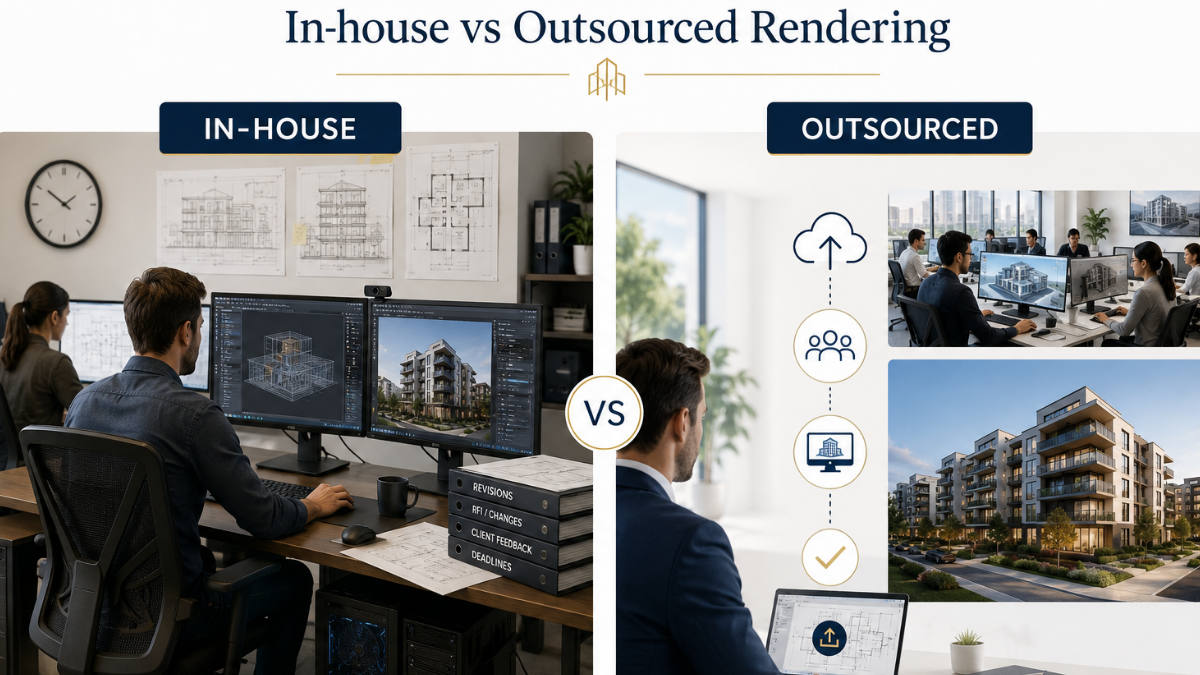
The case for in-house is narrow but real. Very large developers with a constant pipeline of projects sometimes justify an internal visualization team for the control and speed it provides, keeping iteration tight during design. For everyone else, regional builders, boutique developers, and the agents marketing new construction, outsourcing delivers better images at lower total cost with none of the hiring and hardware burden. The pragmatic middle ground many teams use is to outsource the heavy production while keeping one internal person to manage briefs and quality.
6. Frequently asked questions about pre-construction rendering
How much does pre-construction rendering cost?
Pricing is per image and varies with complexity, from a few hundred dollars for a simple still to over a thousand for a detailed large-format hero render; aerials and animations cost more. Because it's per image, you can size a package to your marketing budget and the number of unit types you're selling.
How long does a pre-construction render take?
A typical still render takes a few business days to about a week, depending on complexity and how many revision rounds are needed. Build rendering into your marketing timeline early rather than treating it as a last-minute task, and agree on included revisions up front.
What do I need to provide to get an accurate render?
Supply complete architectural drawings and elevations, material and finish schedules, site and landscaping plans, and reference images for the style you want. Specify camera angles, time of day, and which shots are heroes. A precise brief reduces revision rounds and speeds delivery.
Is 3D rendering for pre-construction marketing worth it for smaller developers?
Yes. Even a modest set of renders lets a small builder market off-plan units professionally and compete with larger developers. Because rendering is priced per image, a boutique developer can start with a few key visuals and expand as the campaign proves out.
Can renders be used across different marketing channels?
Absolutely. One high-quality render can be resized and repurposed for brochures, websites, social ads, email, and sales-center displays, so the cost is spread across the whole campaign. Consistent imagery across channels also builds buyer confidence in an off-plan project.
7. Conclusion: turn plans into sales with the right renders
Pre-construction rendering is the engine of off-plan sales; it lets developers market and sell a building that exists only on paper by making it feel real, desirable, and inevitable to buyers. From exterior hero shots to 3D floor plans, a well-planned visualization set carries a campaign across every channel and protects both your absorption pace and your pricing. The developers who sell out fastest are rarely the ones with the biggest ad budgets; they're the ones whose imagery made an unbuilt home impossible to ignore. Treat visualization as core marketing infrastructure, not an afterthought.
The most reliable way to get that quality without the overhead of an in-house team is to work with a specialist. Fotober produces photorealistic pre-construction renders for developers, builders, and new-construction marketers: exterior, interior, aerial, and floor plan, with per-image pricing and fast turnaround, so your next launch looks sold-out before ground even breaks. Share your plans and see the building come to life. Place an order or start a free trial today.
Connect with Fotober
- Facebook: fotobermedia.co
- YouTube Channel: Fotober
- TikTok Channel: @fotober
- Instagram: fotober_media
- Email support: [email protected]
- Hotline: +84 942 110 297
Related posts

Modern Luxe Interior Design: Elements, Style Guide and How to Stage It
October 10, 2026

Minimalist Interior Design: Characteristics, Style Guide, and Staging
October 8, 2026

Coastal Interior Design: Style Definition & Staging Guide
September 30, 2026

Contemporary Interior Design: Key Elements and How to Stage This Style
September 30, 2026
