




3D Rendering of a Modern House: Essential Assets for Pre-Selling Homes

Share:
Table of Contents
- 1. Understanding 3D rendering of a modern house
- 2. Core types of 3D rendering of a modern house
- 3. Popular styles of 3D rendering of a modern house
- 4. Why is modern home architectural rendering essential for modern real estate?
- 5. Step-by-step: The process of modern home architectural rendering
- 6. Key factors that define high-quality architectural 3D rendering
- 7. Cost analysis and the business impact of 3D rendering of a modern house
- 8. How to choose the right partner for 3D rendering of a modern house
- 9. Fotober portfolio: Excellence in architectural visualization
- 10. Conclusion
In today’s fast-paced architectural landscape, traditional 2D blueprints are no longer enough to captivate sophisticated clients. High-quality 3D rendering of a modern house has become an essential tool, bridging the gap between abstract concepts and tangible reality. Through advanced modern house 3D visualization, architects and developers can now present immersive environments that evoke emotion and build trust. Whether it is a detailed exterior house rendering showcasing sleek facades or a comprehensive modern home architectural rendering highlighting interior flow, these digital masterpieces allow stakeholders to "step inside" their future home before a single brick is laid.
1. Understanding 3D rendering of a modern house
A 3D rendering of a modern house is the digital process of transforming two-dimensional architectural drawings, CAD files, and design blueprints into three-dimensional, photorealistic computer-generated imagery (CGI). Unlike traditional architectural sketches, modern rendering utilizes sophisticated software and rendering engines to simulate real-world physics. It accurately models how sunlight refracts through expansive glass panels, how shadows are cast across cantilevered concrete structures, and how internal ambient lighting interacts with textured wood cladding.
1.1. What makes professional 3D house rendering different?
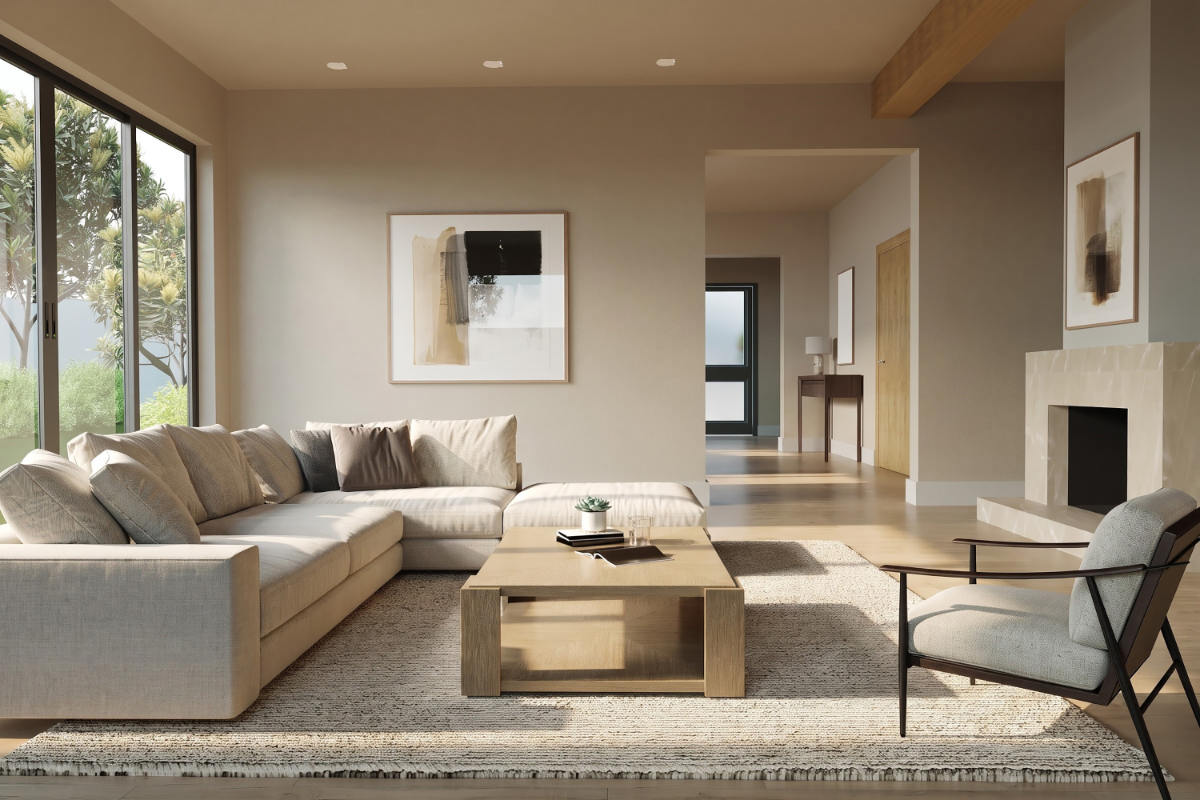
It is critical to distinguish between basic 3D block modeling and high-end photorealistic architectural visualization. Basic 3D modeling merely establishes the spatial geometry and structural wireframe of a home. In contrast, high-end 3D rendering of a modern house layers hyper-realistic material textures, realistic depth of field, physical camera angles, and atmospheric context (such as surrounding landscaping, weather, and custom lighting setups). The final result is a visual asset that is often indistinguishable from high-resolution professional photography.
1.2. Evolution from 2D blueprints to 3D CGI
For decades, 2D blueprints, line drawings, and black-and-white site plans served as the primary tools for presenting architectural concepts. While these technical schematics remain essential for construction engineers, they carry severe limitations when communicating with buyers, investors, and clients. 2D plans require spatial imagination and technical reading skills that most non-industry stakeholders lack. Consequently, flat line drawings fail to evoke emotional connection, convey true scale, or illustrate material quality.
This is where modern house 3D visualization transforms the real estate landscape. By translating complex technical CAD data into vivid, highly detailed visual formats, 3D CGI bridges the communication gap between designers and clients. Buyers no longer need to guess how an open-concept living area will look or how natural light will enter a space. Instead, CGI converts abstract architectural ideas into clear, engaging visual realities, eliminating ambiguity and fostering immediate buyer confidence.
2. Core types of 3D rendering of a modern house
Architectural visualization is not a one-size-fits-all medium. Depending on your marketing objectives, target audience, and project phase, different CGI formats are required to convey a project's full potential. Understanding the core categories of modern house 3D visualization allows architects, developers, and real estate marketers to build a comprehensive visual campaign that engages buyers from every perspective.
2.1. Exterior house rendering
An exterior house rendering serves as the primary visual hero asset for any property marketing campaign. Modern home designs typically feature distinct architectural signatures: clean lines, floor-to-ceiling glass panels, cantilevered structures, and a blend of natural materials like wood cladding, raw concrete, and stone. High-end 3D exterior rendering accurately captures these structural nuances under various atmospheric conditions:
- Daylight views: Highlight structural geometry, material contrast, and outdoor landscaping under crisp, natural sunlight.
- Dusk/twilight renderings: Emphasize internal lighting, exterior landscape fixtures, and dramatic sky colors to create an emotional, luxurious ambiance.
- Nighttime renderings: Showcase custom accent lighting and indoor warmth, presenting a dramatic view of the home after dark.
2.2. Interior 3D visualization
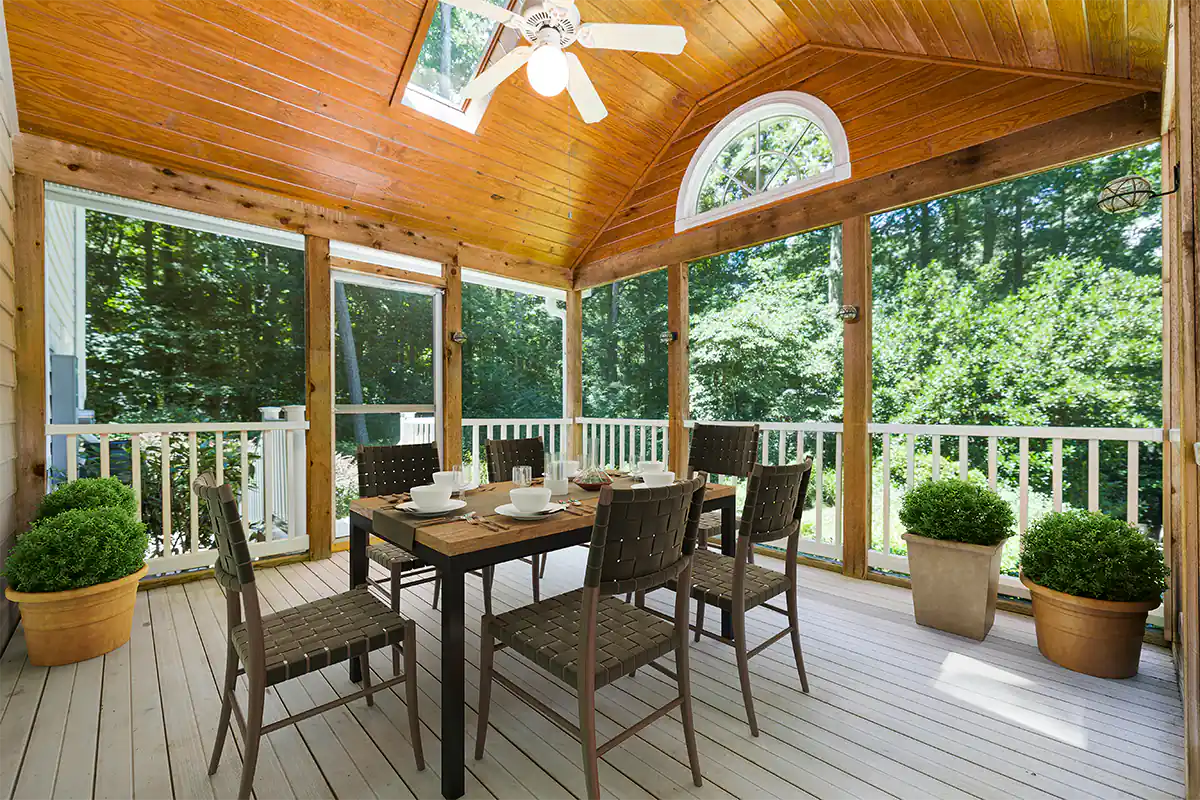
While exterior visuals capture initial attention, interior 3D renderings establish the emotional connection needed to close a deal. Modern interior CGI focuses heavily on open-concept layouts, material textures, and spatial flow. CGI artists simulate how natural light cascades through expansive modern windows onto various surfaces, such as polished concrete floors, matte metal fixtures, and marble countertops. By incorporating photorealistic furniture and decor, interior visualization allows clients to step inside and experience the lifestyle offered by the space long before construction starts.
2.3. 3D floor plans and isometric cutaways
Traditional 2D blueprints can be technical and difficult for non-industry buyers to interpret. 3D floor plans and isometric cutaways solve this by converting flat drawings into intuitive, three-dimensional models. Cutaway renderings deliver a "dollhouse" perspective, clearly illustrating wall heights, room dimensions, traffic flow, and layout connections. This provides buyers with an effortless understanding of spatial organization within the overall modern home architectural rendering.
2.4. Aerial and drone CGI integration
For high-end modern homes, site location and natural surroundings are key selling points. Aerial CGI composites combine high-resolution drone photography with 3D computer-generated building models. By seamlessly embedding the rendered house into real-world aerial footage, developers can showcase the property’s precise positioning, property boundaries, and surrounding views (such as ocean vistas, mountain backdrops, or city skylines). This environmental context is invaluable for selling luxury hillside or coastal properties off-plan.
2.5. Interactive 3D virtual tours and VR walkthroughs
To maximize buyer engagement, static images are increasingly complemented by interactive experiences. 360-degree virtual tours and Virtual Reality (VR) walkthroughs grant prospective buyers complete freedom to navigate through the modern property at their own pace. Remote buyers and international investors can explore room transitions, inspect design details from any angle, and gauge spatial proportions accurately, delivering an immersive experience that significantly boosts buyer confidence and conversion rates.
3. Popular styles of 3D rendering of a modern house
A 3D rendering of a modern house is the digital process of transforming architectural blueprints or 2D sketches into high-fidelity, photorealistic images or animations of a contemporary residence. Essentially, the rendered version acts as a "digital twin." It allows architects to validate design choices before construction begins and enables real-estate marketers to sell a luxury lifestyle to potential buyers long before the first stone is laid.
In the realm of modern house 3D visualization, the style affects every aesthetic choice and defines the project’s visual identity. Different architectural movements require unique approaches to lighting, texturing, and environment building. Understanding these styles allows visualization artists to create a 3D rendering that resonates deeply with the target audience.
3.1. Minimalism: The art of "less is more"
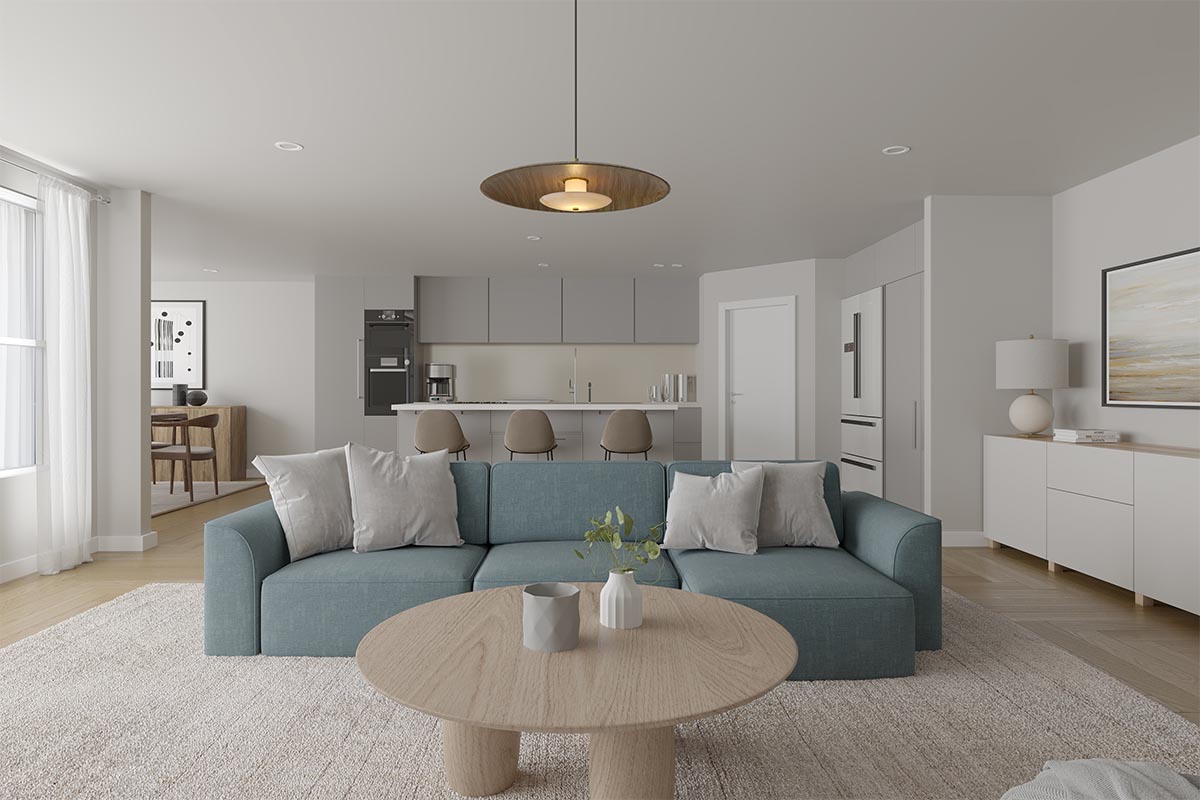
Minimalism remains the most dominant force in contemporary architecture. A modern home architectural rendering of a minimalist house focuses on clean lines, monochromatic color palettes, and open-plan layouts. The challenge in 3D visualization is to make "simplicity" feel "luxurious." Artists achieve this by focusing on the play of natural light on smooth surfaces and the subtle textures of premium materials like white marble or polished concrete. Every shadow and reflection must be calculated to emphasize the sense of serenity and space.
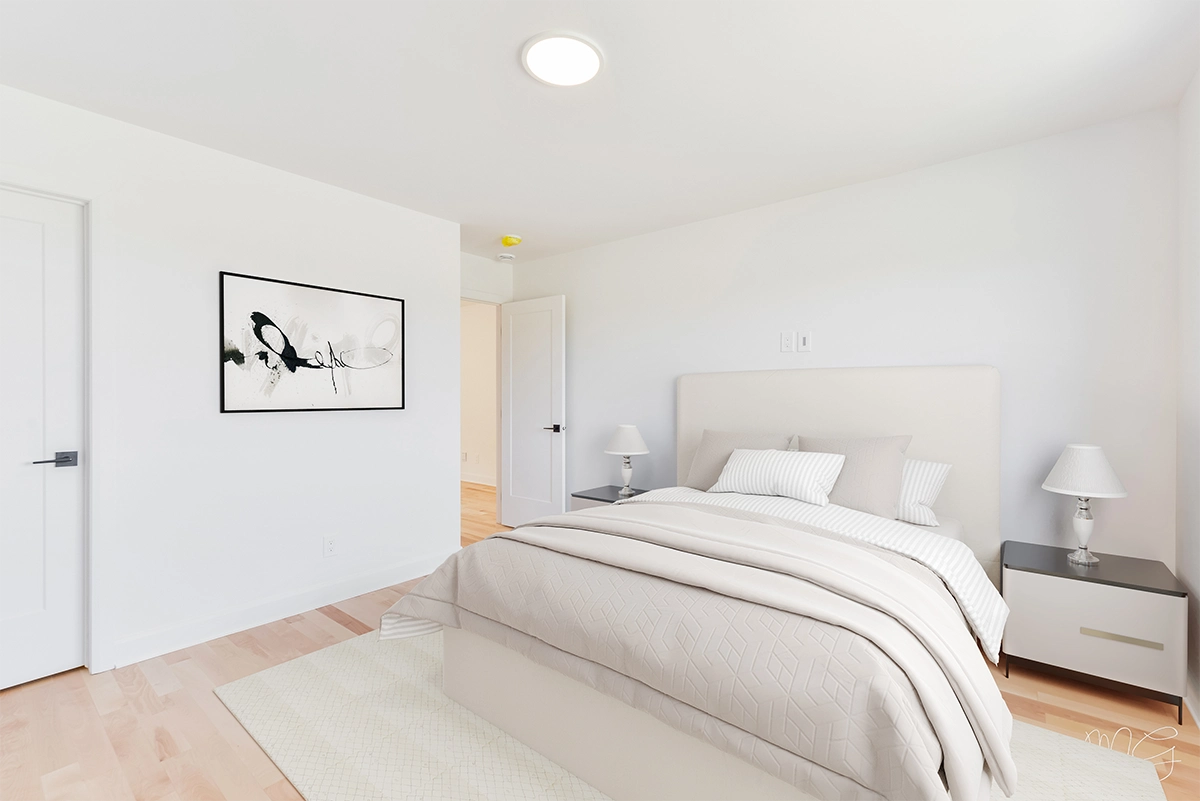 Minimalism brings clean design into the living space.
3.2. Industrial modern: raw and refined
For those seeking a bolder, more urban aesthetic, Industrial Modern is a top choice. This style is characterized by exposed structural elements such as steel beams, reclaimed wood, and brickwork. In an exterior house rendering of an industrial-style home, the focus shifts to material accuracy. A high-quality render must capture the "imperfections" of these materials, like the slight rust on a metal joint or the grainy texture of weathered timber, to provide a truly photorealistic experience that feels grounded and authentic.
 Industrial style focuses on functionality with more rugged and exposed structural elements.
3.3. Mid-century modern: A timeless fusion
Characterized by flat roofs, geometric shapes, and an emphasis on bringing the outdoors in, Mid-century modern is witnessing a massive resurgence. When creating a modern house 3D visualization for this style, designers often focus on "walls of glass" and clerestory windows. The 3D rendering must highlight the seamless transition between the interior living space and the exterior landscape, often featuring iconic "post-and-beam" structures and organic shapes that sit in harmony with nature.
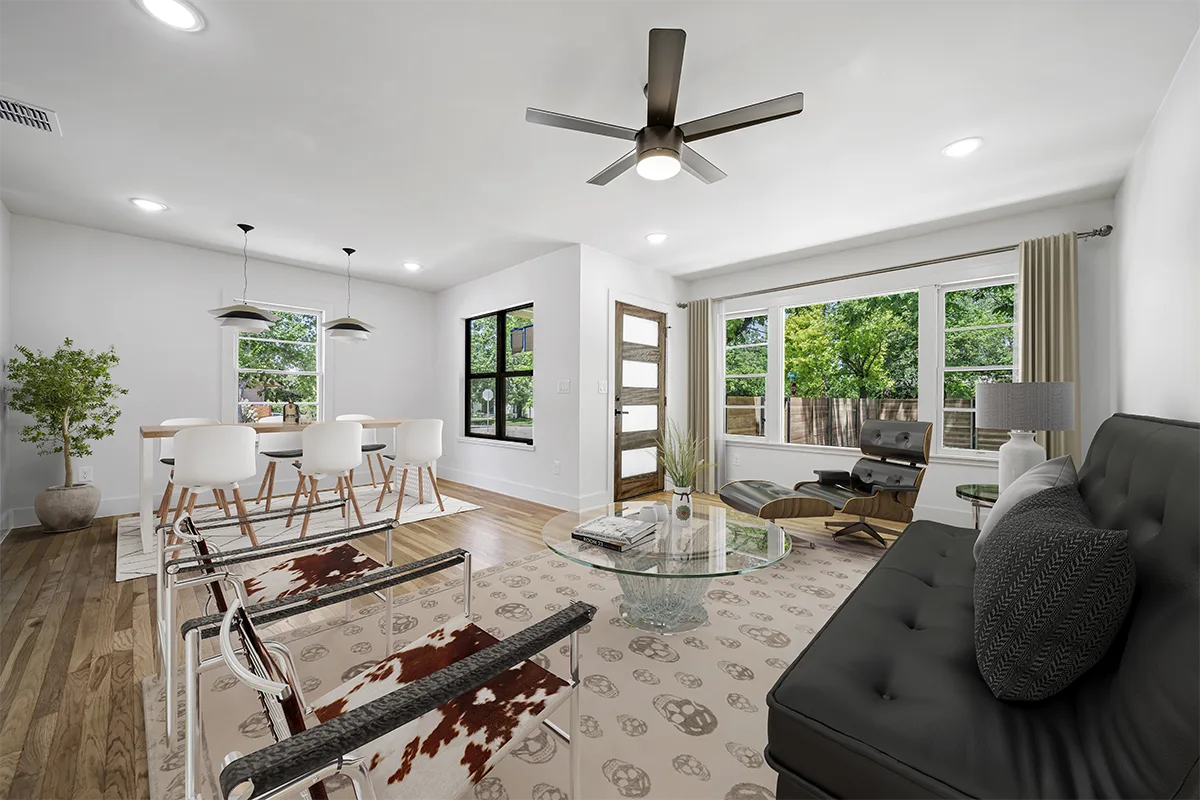 Mid-century style uses more prominent architectural elements.
3.4. Sustainable and green modern: The future of living
Modern architecture is increasingly defined by its ecological footprint. A modern home architectural rendering in this category showcases "passive house" features, such as solar arrays, vertical gardens, and high-efficiency insulation systems. Visualization allows architects to prove that "green" technology can be visually stunning, using 3D renders to simulate how sunlight interacts with solar panels or how lush greenery breathes life into a concrete facade.
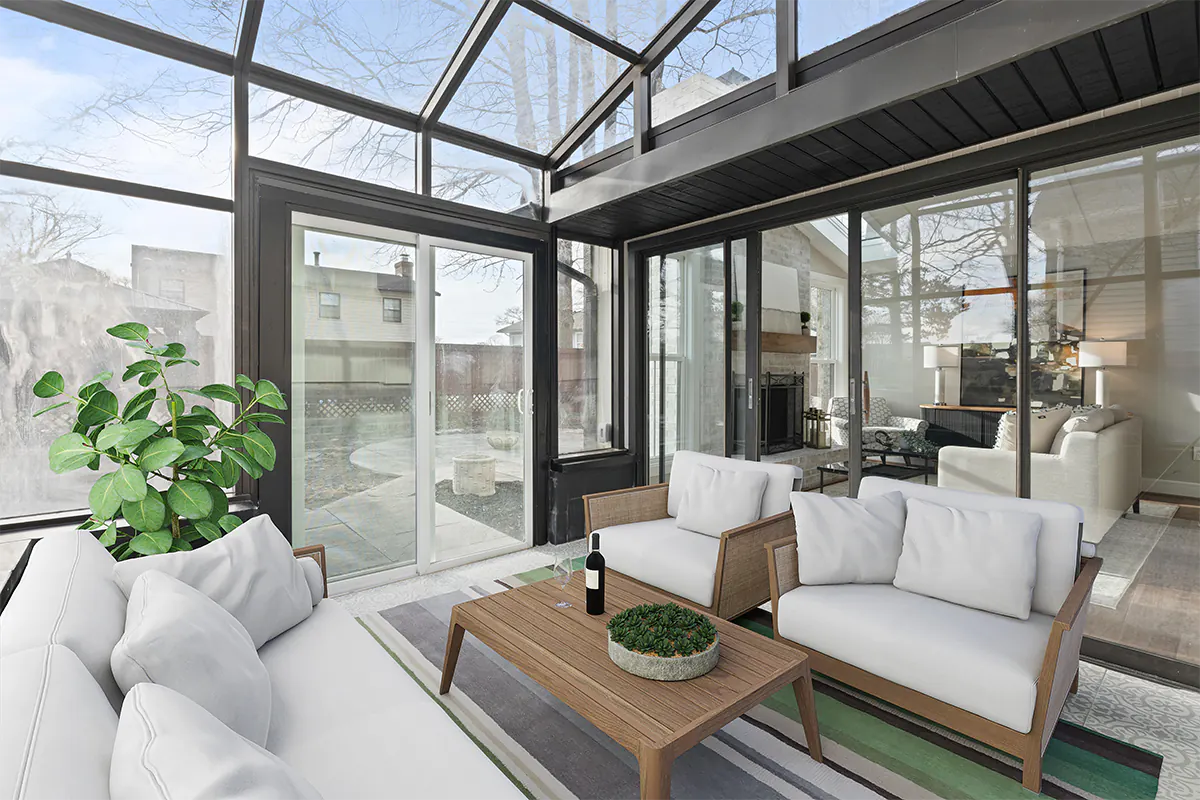 Architecture that makes better use of natural light and energy is more favorable in 2026.
By choosing the right style at the visualization stage, developers can ensure their project speaks the right "visual language" to potential buyers long before the first stone is laid.
4. Why is modern home architectural rendering essential for modern real estate?
In today's fast-paced property market, visual clarity dictates commercial success. High-end modern home architectural rendering has evolved from an optional design luxury into a foundational business necessity for real estate developers, architects, and brokers.
4.1. Accelerating pre-construction sales
The primary commercial advantage of 3D visualization is its ability to drive off-plan pre-sales long before ground is broken. Selling unbuilt residential properties traditionally relied on buyer imagination, which created hesitation and prolonged sales cycles. Photorealistic CGI eliminates this friction by providing tangible, high-impact visual proof of the finished home. Prospective buyers can instantly envision their future lifestyle, enabling developers to secure early deposits, validate market demand, and meet pre-sale benchmarks significantly faster. Furthermore, presenting ultra-realistic visual assets builds immediate credibility with commercial lenders and equity investors, streamlining bank financing approvals.
4.2. Streamlining client approvals and design revisions
Beyond front-end marketing, 3D visualization serves as an indispensable risk-mitigation tool during the design development phase. Translating technical blueprints into photorealistic models makes design intent crystal clear to custom home clients, planning committees, and approval boards. Clients can evaluate spatial layouts, material finishes, and architectural proportions in real-time. Identifying design flaws, color mismatches, or spatial conflicts digitally allows teams to execute adjustments effortlessly before construction begins, preventing costly on-site structural modifications, material waste, and project delays.
4.3. Versatility across digital marketing channels
A single high-resolution 3D rendering of a modern house delivers high marketing ROI through its multi-channel versatility. Once generated, these digital assets serve as the cornerstone for an entire omnichannel marketing campaign. They can be reused effortlessly across:
- Digital ads & web: High-converting website landing pages, search engine display ads, and email campaigns.
- Social media: Visual-first platforms like Instagram, Pinterest, and YouTube to capture organic buyer interest.
- Traditional print: High-resolution brochures, sales center displays, and large-format outdoor billboards.
Rather than waiting for construction completion to hire professional photographers, marketing teams can launch full digital campaigns months in advance, generating qualified leads early and building market momentum before launch day.
5. Step-by-step: The process of modern home architectural rendering
Creating a world-class 3D rendering of a modern house is a sophisticated fusion of art and technology. To ensure a photorealistic result, the process of modern house 3D visualization typically follows five critical stages.
Step 1: Data collection & briefing: The journey begins with gathering all technical data. Artists analyze CAD files, blueprints, and material mood boards. This ensures the modern home architectural rendering stays 100% true to the architect’s original vision and structural specifications.
Step 2: 3D modeling: In this phase, 2D lines are transformed into 3D volumes. Every structural detail, from the sleek cantilevered roofs to the thin window frames, is precisely built in a digital environment to establish the "geometry" of the house.
Step 3: Texturing and shading: Once the "skeleton" is ready, artists apply digital shaders to mimic real-world materials. This step is vital for a convincing exterior house rendering, as it defines how light will eventually interact with brushed aluminum, raw concrete, or oak timber.
Step 4: Lighting and camera setup: Artists set up virtual cameras and simulate natural sunlight. This is where the "mood" is created, choosing between a crisp morning glow or a dramatic "blue hour" sunset to highlight the building’s best features.
Step 5: Rendering and post-production: High-powered computers calculate millions of light rays to generate the final image. Finally, in post-production, artists fine-tune the colors and add "entourage," e.g., lush greenery, people, and vehicles, to bring the scene to life and maximize its emotional impact.
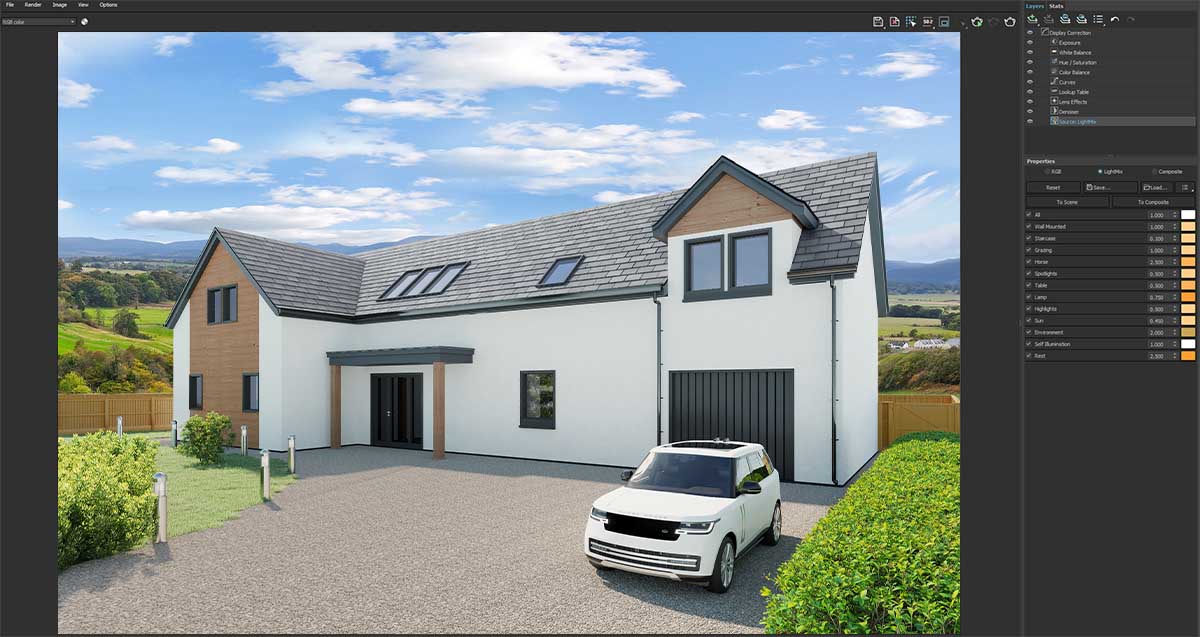 Typical rendering app interface and preview of a 3D render product.
6. Key factors that define high-quality architectural 3D rendering
Creating a photorealistic 3D rendering of a modern house requires far more than basic software skills. It demands a seamless blend of architectural accuracy, artistic composition, and advanced rendering technology. Several key technical and creative elements separate flat, artificial CGI from high-end, emotive architectural visuals that sell properties off-plan.
6.1. Photorealistic lighting and atmospheric depth
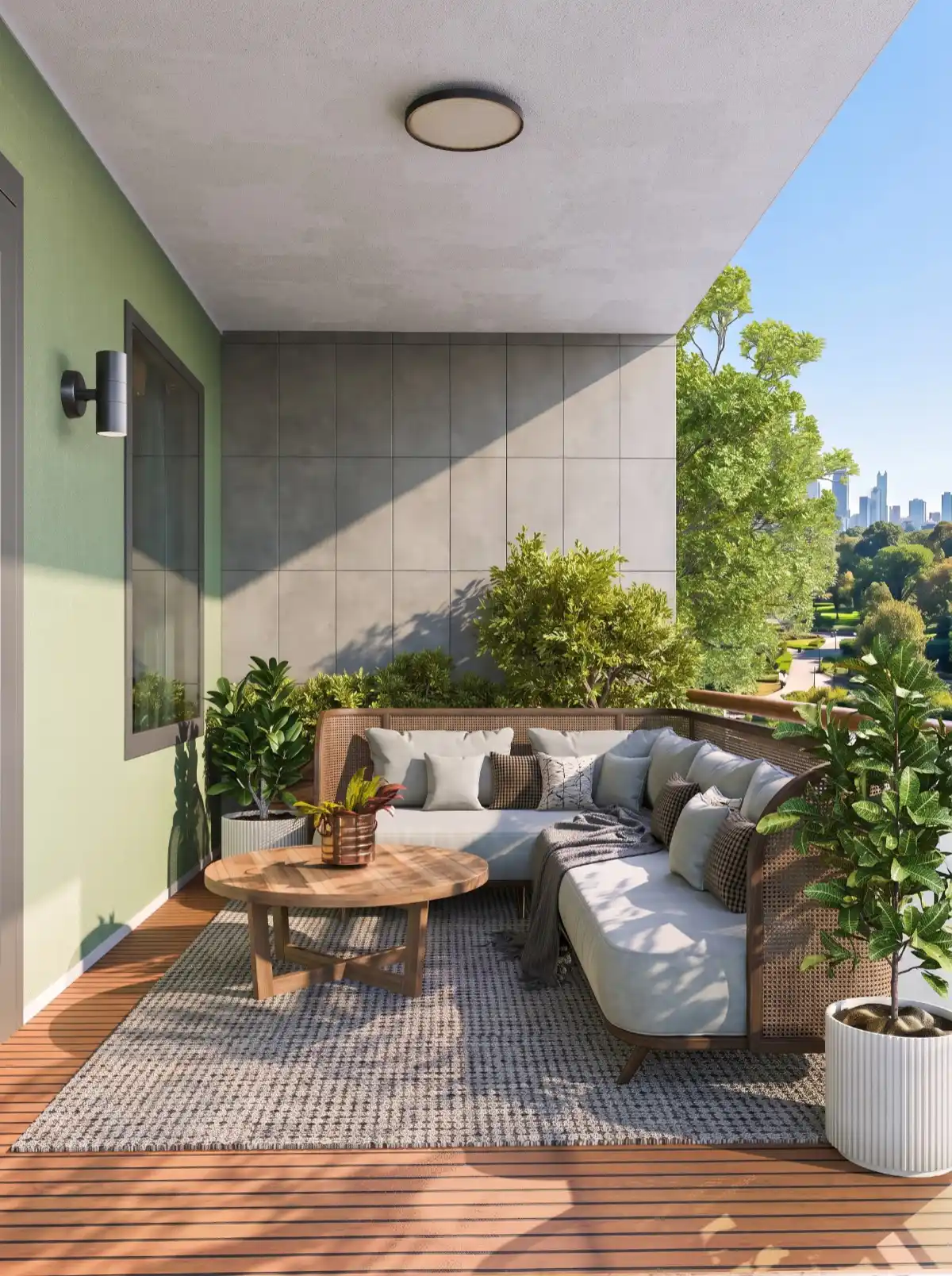
Lighting is the single most critical factor in successful modern house 3D visualization. High-end CGI uses Physically Based Lighting (PBL) algorithms to simulate real-world physics. how natural sunlight refracts through glass, reflects off polished concrete, and casts soft, realistic shadows. Whether setting up a crisp midday atmosphere or a dramatic twilight scene, accurate global illumination creates genuine depth and realism.
6.2. High-resolution PBR material texturing
Modern architecture relies heavily on contrasting material combinations: raw concrete, warm wood cladding, matte metal, and tinted glass. Superior exterior house rendering utilizes Physically Based Rendering (PBR) materials that include:
- Roughness & reflectivity maps: Controlling how light bounces off different surface textures.
- Bump & displacement maps: Adding physical depth to stone facades or brickwork.
- Micro-imperfections: Adding subtle natural flaws, such as faint glass reflections or subtle concrete texture variations, to prevent surfaces from looking unrealistically perfect or plastic.

6.3. Cinematic composition and focal framing
Just like professional architectural photography, compelling modern home architectural rendering depends on strategic camera placement. CGI artists employ cinematic framing rules, such as two-point perspective, the rule of thirds, and subtle depth-of-field effects. Choosing the right focal length highlights distinct architectural signatures, such as dramatic cantilevers, open-concept floor plans, or expansive outdoor living areas.
6.4. Natural environmental context and lifestyle entourage
A building never exists in a visual vacuum. Exceptional 3D renders seamlessly embed the house into its surrounding environment. This includes high-density 3D foliage (trees, grass, garden beds) tailored to the regional climate, realistic terrain, natural sky backgrounds, and lifestyle entourage like modern vehicles, patio furniture, and warm indoor interior lighting. This contextual integration grounds the home in reality and creates an immediate emotional connection with prospective buyers.
6.5. Common mistakes in 3D rendering (And how to avoid them)
Even cutting-edge CGI can fail to impress buyers if subtle visual errors break the illusion of reality. Avoiding these five frequent pitfalls ensures your modern house 3D visualization maintains professional credibility and high commercial impact.
- Unrealistic lighting and shadows: Flat artificial lighting or unnatural sun angles make scenes look washed out or synthetic. Solution: Utilize physically-based HDRI lighting setups to accurately mirror natural sunlight, realistic color temperatures, and soft ambient shadows.
- Low-resolution, repeating textures: Blurry wood grains, visible repeating tile patterns, or plastic-looking glass ruin photorealism instantly. Solution: Apply high-resolution PBR (Physically Based Rendering) materials equipped with customized roughness, reflectivity, and bump maps.
- Out-of-scale entourage and furniture: Oversized vehicles, miniature patio furniture, or incorrectly proportioned human figures distort spatial perception. Solution: Lock all 3D assets to true-to-life architectural measurements relative to the building structure.
- Ignoring contextual surroundings: Floating a modern design on a generic, featureless green lawn disconnects the property from its true environment. Solution: For high-impact exterior house rendering, integrate accurate regional foliage, realistic terrain elevation, nearby structures, and natural sky backdrops.
- The "too perfect" CGI effect: Flawless, hyper-clean surfaces lack human warmth and look artificial. Solution: Incorporate subtle micro-imperfections, such as delicate glass reflections, natural lawn variations, and organic surface textures, to give the render an authentic, lived-in quality.
Partnering with experienced 3D artists eliminates these technical blunders, ensuring every 3D rendering of a modern house conveys prestige and accelerates client buy-in.
7. Cost analysis and the business impact of 3D rendering of a modern house
Investing in a 3D rendering of a modern house requires understanding the pricing landscape. While costs vary based on project scope and technical specifications, architectural visualization should be evaluated as a high-return marketing asset rather than an overhead expense.
7.1. Key factors influencing pricing
Several technical and creative variables dictate the final cost of a modern home architectural rendering:
- Project complexity & scale: A simple single-story layout requires significantly fewer modeling hours than a multi-level luxury estate featuring complex geometric cantilevers, custom pool structures, and intricate landscaping.
- Resolution & output detail: Standard 2K HD renders for web listings cost less than 4K or 8K ultra-high-definition images intended for large print brochures, sales center displays, or outdoor billboards.
- Number of angles & views: Requesting multiple camera perspectives typically reduces the per-image cost because the primary 3D environment is already built.
- Turnaround time: Standard delivery schedules take 3 to 5 business days, whereas rush orders requiring overnight or weekend turnaround will incur expedited fees.
While custom quotes depend on specific project briefs, current industry price ranges generally fall into three tiers:
- Basic exterior house rendering: $300 – $800 per image. Ideal for straightforward residential properties, featuring standard materials, clean daylight setups, and basic landscape integration.
- High-end architectural CGI & luxury estates: $800 – $2,000+ per image. Designed for complex modern architecture, utilizing custom lighting (dusk/twilight), hyper-realistic material texturing, and rich environmental entourage.
- 3D animations & 360 virtual tours: $1,500 – $5,000+ depending on duration, frame rate, interactive features, and overall scene complexity.
7.2. The business impact: How 3D rendering of a modern house drives sales
In real estate development and architectural design, visual appeal must translate into measurable commercial outcomes. Utilizing high-quality modern house 3D visualization is far more than a creative luxury; it is a high-return marketing investment backed by hard industry data. Real estate developers, custom home builders, and brokerages leveraging photorealistic CGI consistently report faster transaction speeds, higher listing engagement, and superior revenue margins.
- Accelerated off-plan sales cycles: Selling unbuilt properties traditionally involved long sales cycles due to buyer uncertainty. Industry benchmarks indicate that pre-construction developments utilizing a high-resolution 3D rendering of a modern house sell up to 50% faster off-plan compared to campaigns relying exclusively on traditional 2D floor plans. High-impact CGI eliminates ambiguity, giving prospective buyers the confidence to commit to early deposits and allowing developers to meet bank-mandated pre-sale quotas in record time.
- Surging online inquiries and buyer engagement: In a digital-first property market, online visual appeal dictates listing performance. Real estate listings that incorporate high-end exterior house rendering assets and virtual tours generate up to 403% more buyer inquiries than listings featuring basic photos or non-visual descriptions. Photorealistic visuals dramatically increase click-through rates on digital advertising campaigns and extend time-on-page metrics, keeping potential buyers actively engaged with the listing.
- Elevating buyer confidence and commanding premium prices: Photorealism creates an emotional connection that elevates perceived property value. When prospective buyers can clearly observe premium architectural details, such as floor-to-ceiling glass, custom facade materials, and intricate landscaping, their willingness to invest increases. Studies show that buyers are prepared to pay a 10% to 15% price premium on pre-construction homes when presented with professional modern home architectural rendering packages, as full visual clarity mitigates perceived financial risk.
- Unmatched ROI compared to physical home staging: Physical home staging for completed builds often incurs thousands of dollars in monthly furniture rental fees, transportation, and logistics. 3D visualization delivers an agile, cost-effective alternative at a fraction of the cost. Digital rendering gives marketers total creative freedom to virtually stage interior spaces, adjust atmospheric lighting, and swap material finishes instantly, eliminating recurring physical staging fees while providing a vastly superior return on marketing investment (ROI).
8. How to choose the right partner for 3D rendering of a modern house
Selecting the ideal architectural visualization studio can make or break your property marketing campaign. With countless CGI providers available worldwide, real estate developers, builders, and architects need a clear framework to evaluate potential vendors. Here are the critical factors to consider when choosing a partner for your modern house 3D visualization projects:
- Evaluate portfolio quality and architectural specialization: Examine a studio’s portfolio for photorealism, lighting accuracy, and material fidelity. Ensure they have specific experience with modern architectural styles, demonstrating how effectively they handle floor-to-ceiling glass, complex cantilevered structures, and material combinations like concrete, wood cladding, and matte steel in exterior house rendering.
- Assess technical workflow and file compatibility: A professional rendering agency should integrate seamlessly into your existing architectural workflow. Verify that they support industry-standard CAD and BIM software formats (such as Revit, SketchUp, AutoCAD, and Rhino). Their team must be capable of interpreting technical blueprints, elevation drawings, and material schedules with minimal supervision.
- Review revision protocols and communication clarity: Design revisions are an inevitable part of real estate development. Look for a rendering partner with a structured, transparent feedback process, typically structured around key milestone check-ins (3D wireframe modeling, gray/clay renders, lighting/texturing drafts, and final high-res output). Clarify how many revision rounds are included in the original quote to avoid unexpected scope creep fees.
- Verify turnaround reliability and production scale: Real estate launches operate on strict marketing schedules. Confirm that the agency possesses adequate staffing and render-farm computing power to meet your deadlines without sacrificing quality. A dependable partner can scale effortlessly from a single 3D rendering of a modern house to complex, multi-view luxury developments.
- Demand transparent, itemized pricing: Avoid vague quotes or suspiciously low-cost services that often deliver flat, artificial CGI or charge heavy fees for standard revisions. Choose a vendor offering clear, itemized pricing based on camera angles, output resolution, and project scope.
Partnering with a specialized team that understands both architectural aesthetics and commercial real estate marketing ensures your visual investment produces immediate buyer engagement and measurable ROI.
9. Fotober portfolio: Excellence in architectural visualization
Fotober stands at the forefront of the industry, providing world-class 3D architectural rendering services to a global clientele. Our extensive portfolio is a testament to our versatility, featuring everything from minimalist urban dwellings to sprawling luxury estates. We specialize in creating a high-impact 3D rendering of a modern house, where every texture, light source, and environmental detail is meticulously tuned for maximum realism.
 Fotober provides 3D rendering services catered for real estate marketing.
Our team of expert artists understands that a successful exterior house rendering requires a keen eye for storytelling and atmosphere in addition to technical prowess. Whether you need a precise modern home architectural rendering for a design presentation or photorealistic marketing assets to drive pre-sales, Fotober delivers excellence with industry-leading turnaround times. By blending cutting-edge technology with artistic passion, we help architects and developers worldwide turn their most ambitious visions into breathtaking visual realities. Explore our gallery on Behance today and see the Fotober difference for yourself.
10. Conclusion
In conclusion, the era of static, uninspiring blueprints has officially come to an end. Embracing modern house 3D visualization is no longer a luxury but a strategic necessity for architects, developers, and homeowners alike. Whether through a breathtaking exterior house rendering or a highly detailed modern home architectural rendering, 3D technology empowers you to communicate complex designs with clarity and emotional resonance. A professional 3D rendering of a modern house serves as the ultimate bridge between an architect’s vision and a buyer’s reality. By investing in high-quality visualization, you ensure your project not only gets built but also is remembered, valued, and sold.
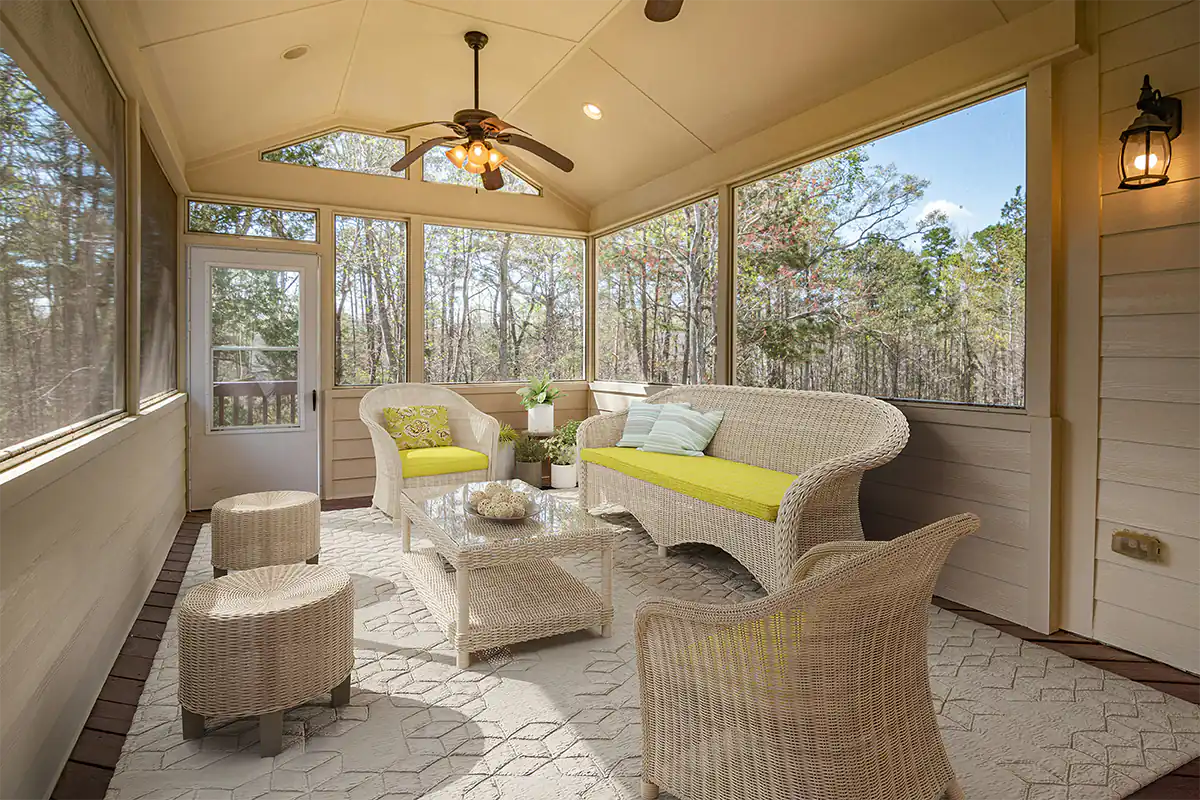
Isn’t a 3D render like this lovely? Contact Fotober to explore our full suite of 3D rendering services or request a custom quote for your next project. Follow us on social media to get more useful tips and in-depth analysis on real estate 3D rendering and up-to-date details of our services!
- Facebook: fotobermedia.co
- YouTube: Fotober
- TikTok: @fotober
- Instagram: fotober_media.
Related posts

Modern Luxe Interior Design: Elements, Style Guide and How to Stage It
October 10, 2026

Minimalist Interior Design: Characteristics, Style Guide, and Staging
October 8, 2026

Coastal Interior Design: Style Definition & Staging Guide
September 30, 2026

Contemporary Interior Design: Key Elements and How to Stage This Style
September 30, 2026
