




3D Interior Rendering to Shape Your Dream Home in 2026

Share:
Table of Contents
- 1. The art of the virtual lens: What is 3D interior rendering?
- 2. Deconstructing hyper-realism in 3D architectural interior rendering
- 3. Key spaces transformed by 3D interior rendering
- • 3.1. Living rooms: Perfecting the focal point of the home
- • 3.2. Kitchens and dining areas: Balancing function and luxury
- • 3.3. Master bedrooms and suites: Crafting comfort and mood
- • 3.4. Bathrooms and home spas: Mastered reflections and tile work
- • 3.5. Home offices and specialty spaces: Tailoring functional layouts
- 4. The power of 3D interior visualization across industries
- 5. The production bottleneck: Why editing and outsourcing are mission-critical
- 6. Why Fotober is the ultimate post-production and 3D interior rendering ally
- 7. Behind the scenes: The step-by-step collaborative workflow for making 3D interior rendering
- 8. Elevating your brand and ROI with premium 3D interior visualization
- 9. Conclusion
I’ll tell you this secret. Some of the most breathtaking, emotionally resonant, and commercially successful interior shots you see online are not actual photographs. That’s the magic of 3D rendering. It is the bridge between blueprint and emotion, between raw concrete and a warm, inviting home. In this introductory article, we will get through the depths of 3D interior rendering, analyze the mechanics of photorealistic 3D interior visualization, and discuss why outsourcing these complex workflows to dedicated experts like Fotober is the ultimate catalyst for scaling your business.
1. The art of the virtual lens: What is 3D interior rendering?
To the untrained eye, a digital render is just a computer-generated image. But to a seasoned photographer or architect, a premium render is a masterpiece of light simulation, spatial design, and material science.
[Blueprint / CAD File] ➔ [3D Modeling] ➔ [Material & Texturing] ➔ [Lighting & Composition] ➔ [Rendering Engine] ➔ [Post-Processing] ➔ [Photorealistic Masterpiece]
1.1. The intersection of photography and computer science
At its core, 3D interior rendering is the process of generating a two-dimensional image from a three-dimensional digital model of an indoor space. But to do this at a world-class level, one must think like a photographer.
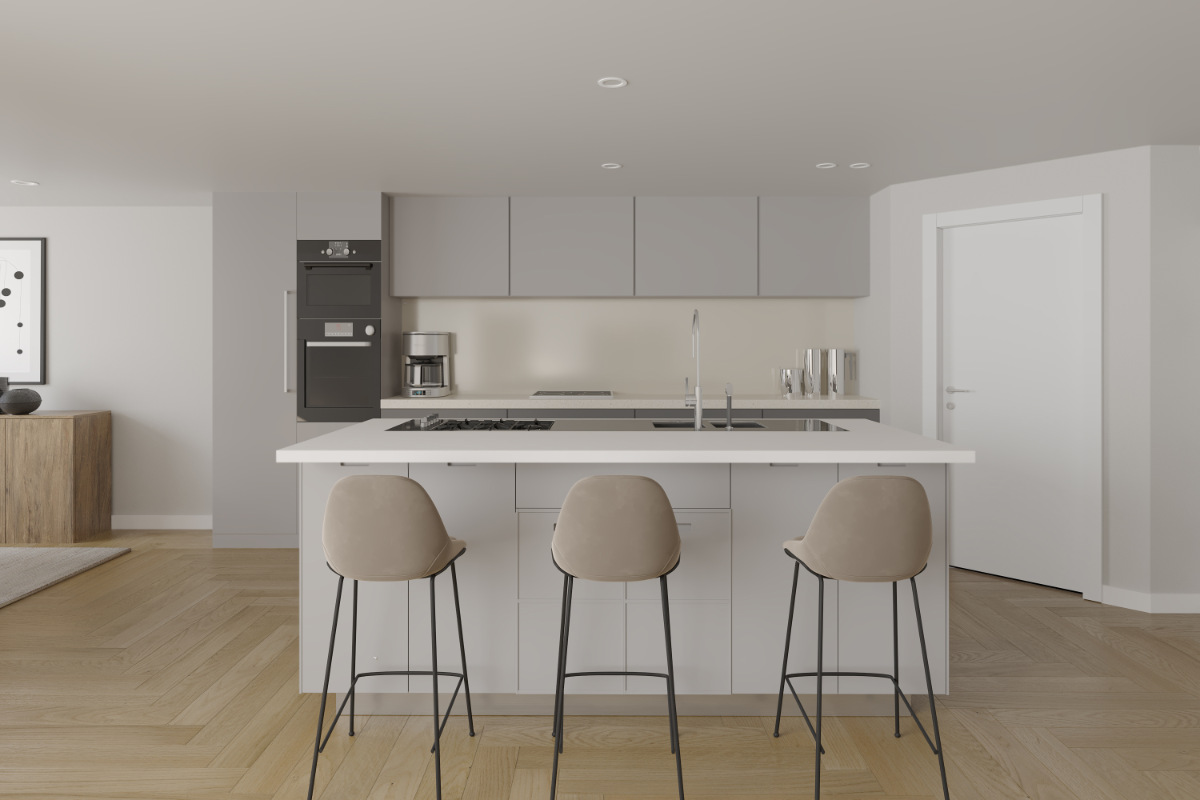 Rendering is the art of creating photorealistic visuals that surpass the limitations of traditional photography.
Just as in a physical shoot, a digital artist must place virtual cameras, choose focal lengths (such as a wide-angle 24mm for spatial context or a tight 50mm for intimate details), adjust the aperture to control depth of field, and place light sources to create depth, shadow, and mood.
1.2. The architectural blueprint meets creative vision
For architects and interior designers, 3D architectural interior rendering is more than just a marketing tool; it is an essential phase of the design process. It allows us to experiment with spatial layouts, test how natural daylight interacts with different finishes at 10:00 AM versus 5:00 PM, and verify that the flow of a room matches the original vision before a single brick is laid.
2. Deconstructing hyper-realism in 3D architectural interior rendering
What separates a mediocre, "plastic-looking" render from a hyper-realistic image that makes a luxury homebuyer say, "I want to live there"? It comes down to three crucial pillars: lighting, texturing, and storytelling.
2.1. The physics of light (Global illumination & ray tracing)
In traditional interior photography, we use bounce cards, strobes, and diffusers to tame the harsh sunlight streaming through a window. In 3D interior visualization, we replicate this using advanced mathematical algorithms like path tracing and global illumination.
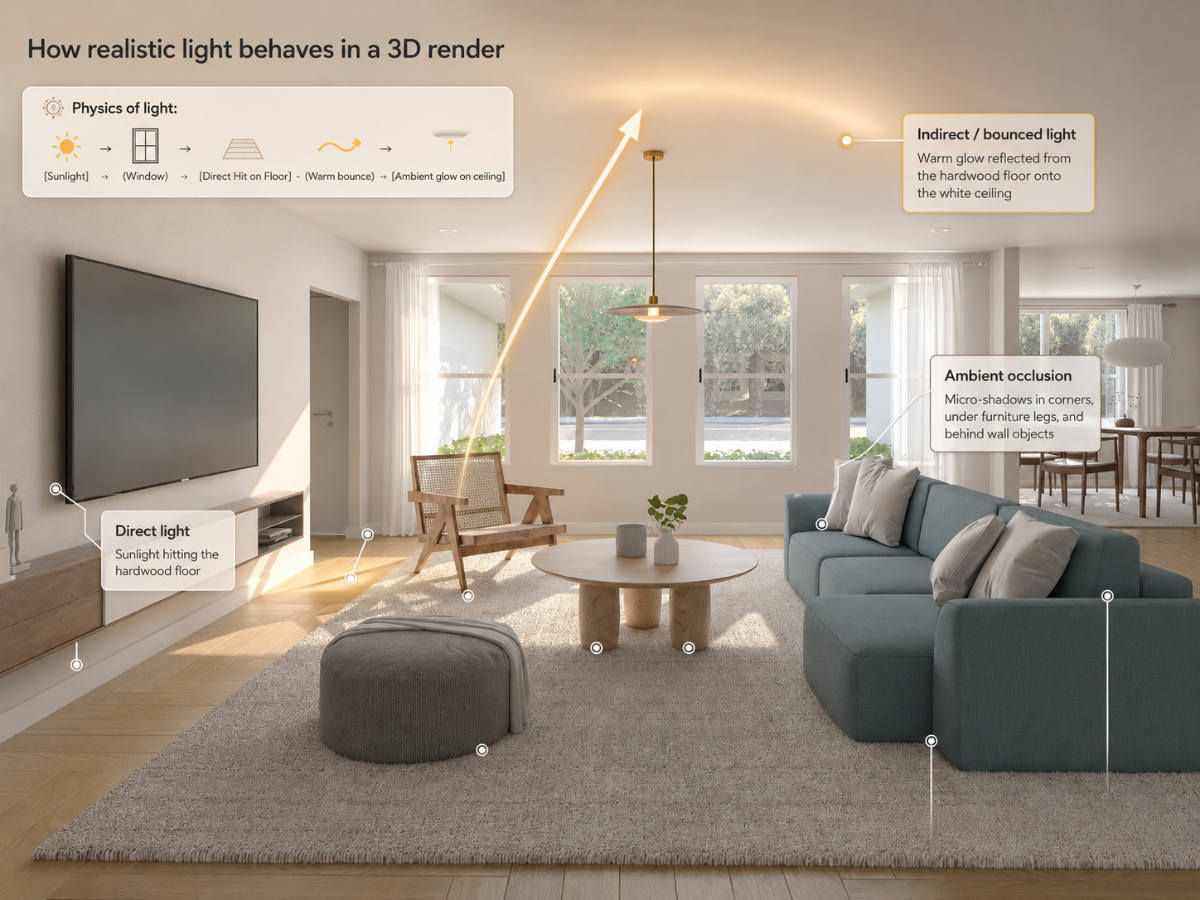 3D interior rendering aims to simulate light’s interactions with different materials in the real world.
True realism requires simulating how light behaves in the real world:
- Direct light: The sunlight hitting the hardwood floor.
- Indirect/bounced light: The warm glow that reflects off that hardwood floor onto the white ceiling.
- Ambient occlusion: The micro-shadows that form in corners, under furniture legs, and behind picture frames. Without these, a render looks floaty and artificial.
2.2. Materials and PBR textures
To deceive the human eye, surfaces must feel tactile. We achieve this through Physically Based Rendering (PBR) materials. A marble countertop shouldn't just look white and gray; it must reflect light with the exact specularity, roughness, and subsurface scattering of real Carrara marble. Velvet sofas must absorb light softly, while brass fixtures must reflect the room with subtle imperfection, complete with microscopic dust particles or slight fingerprints that denote real life.
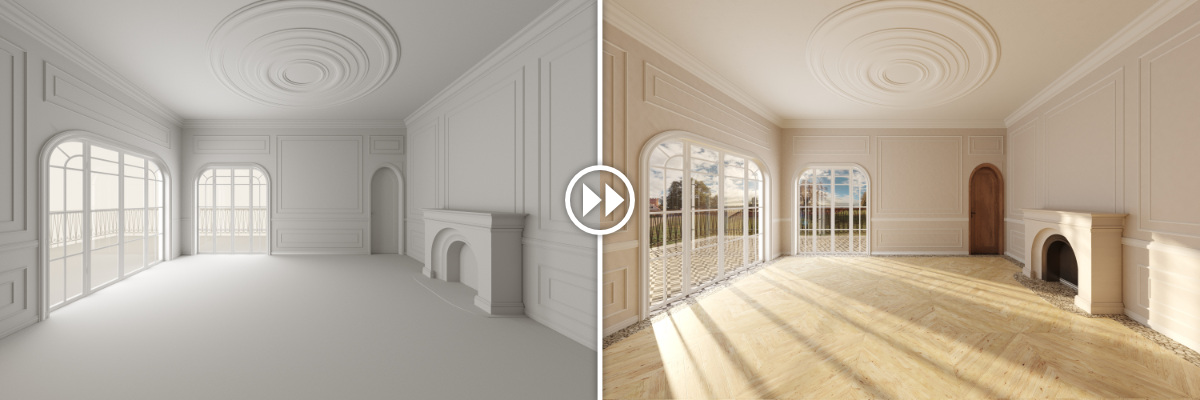 Materials play a significant role in determining the level of realism a rendered photo can achieve.
2.3. The subtle art of imperfection and composition
Perfect is the enemy of real. Real rooms have slight imperfections: a rumpled linen throw blanket on a sofa, a half-filled glass of water on a side table, a slight misalignment in the wooden floorboards, or a soft lens flare from a bright window. By introducing these organic elements, we transform a sterile CAD model into a living, breathing space.
3. Key spaces transformed by 3D interior rendering
Every room in a residential or commercial property has its own spatial logic, lighting requirements, and design challenges. Professional 3D interior rendering bridges the gap between conceptual layout and reality, allowing clients to visualize and fine-tune every room type before renovation or construction begins.
3.1. Living rooms: Perfecting the focal point of the home
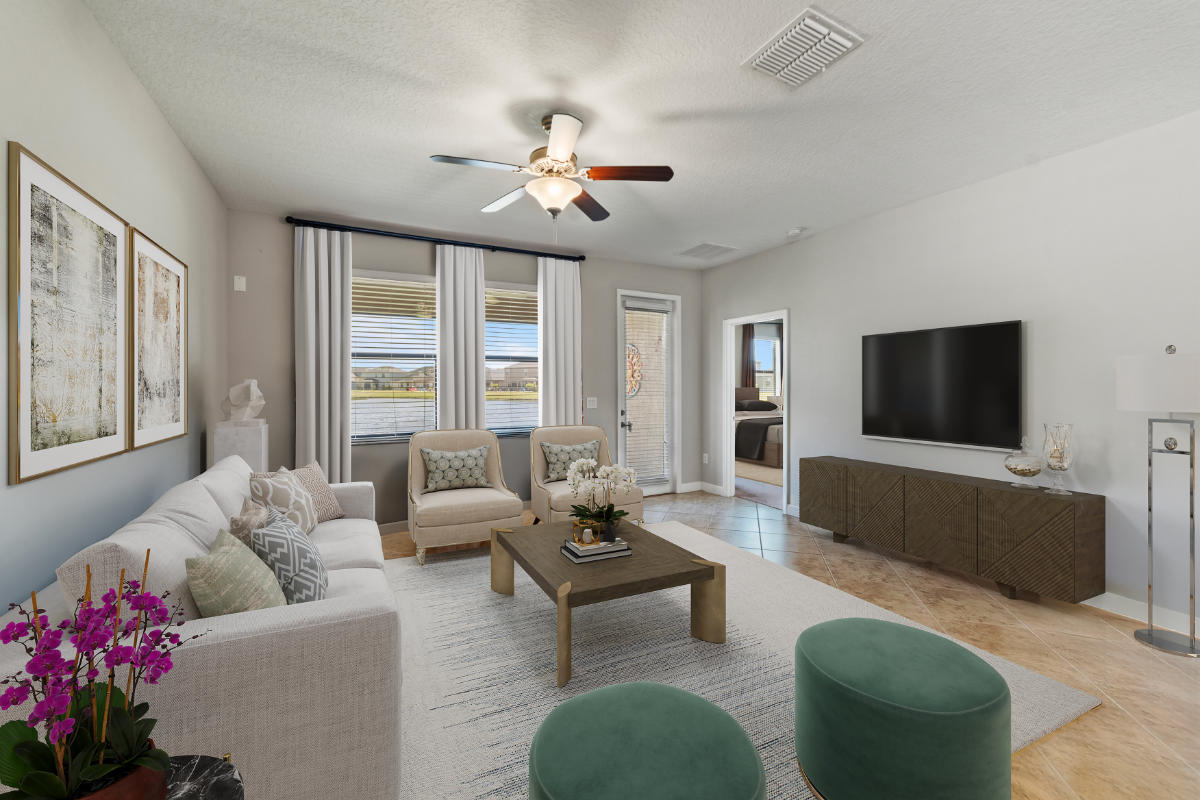
The living room is the heart of any residential project, a space defined by natural light, furniture proportion, and material interplay. With the power of rendering, designers and real estate developers can experiment with open-plan layouts, test feature wall accents, and balance ambient daylight with artificial fixture placement. Visualizing custom seating, entertainment units, and architectural features like fireplaces ensures the room feels both spacious and inviting.
3.2. Kitchens and dining areas: Balancing function and luxury
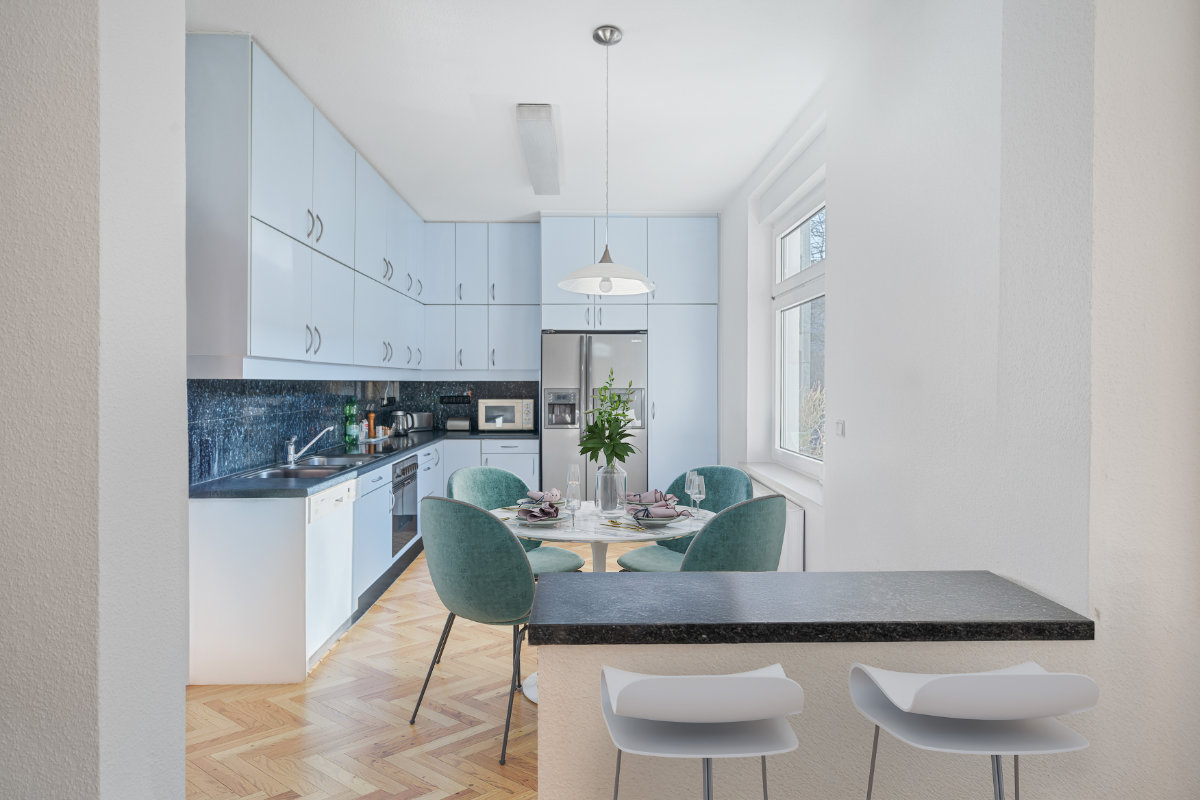
Kitchens involve complex custom millwork, expensive countertops, and detailed appliance integration where design mistakes can be costly. Utilizing 3D rendering allows homeowners and developers to preview cabinet finishes, backsplashes, waterfall island countertops, and hanging pendant light arrangements with photorealistic accuracy. Clients can easily swap out marble, quartz, or wood textures in real time to lock in the ideal aesthetic.
3.3. Master bedrooms and suites: Crafting comfort and mood
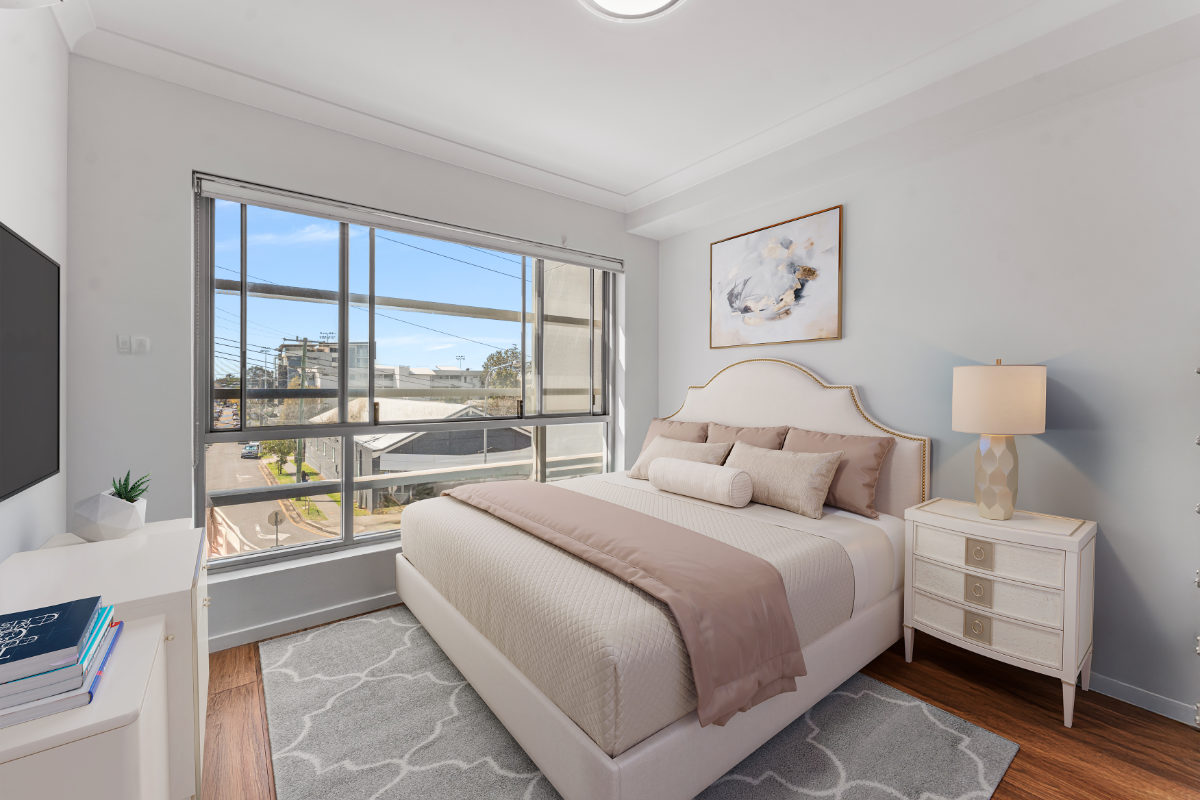
Bedrooms require a delicate touch when it comes to mood, lighting depth, and textile textures. 3D interior rendering brings these personal sanctuaries to life by accurately simulating soft materials like linen drapes, plush rugs, upholstered headboards, and warm recessed lighting. It also helps in planning walk-in closet layouts and en-suite bathroom transitions smoothly.
3.4. Bathrooms and home spas: Mastered reflections and tile work
Rendering bathrooms requires handling challenging optical elements such as reflective mirrors, glass shower enclosures, polished chrome or brass hardware, and intricate wall tiles. Advanced 3D interior rendering uses Physically Based Rendering (PBR) materials to realistically project how light reflects off glossy tiles and refracts through glass, turning compact or windowless spaces into high-end, spa-like visual experiences.
3.5. Home offices and specialty spaces: Tailoring functional layouts
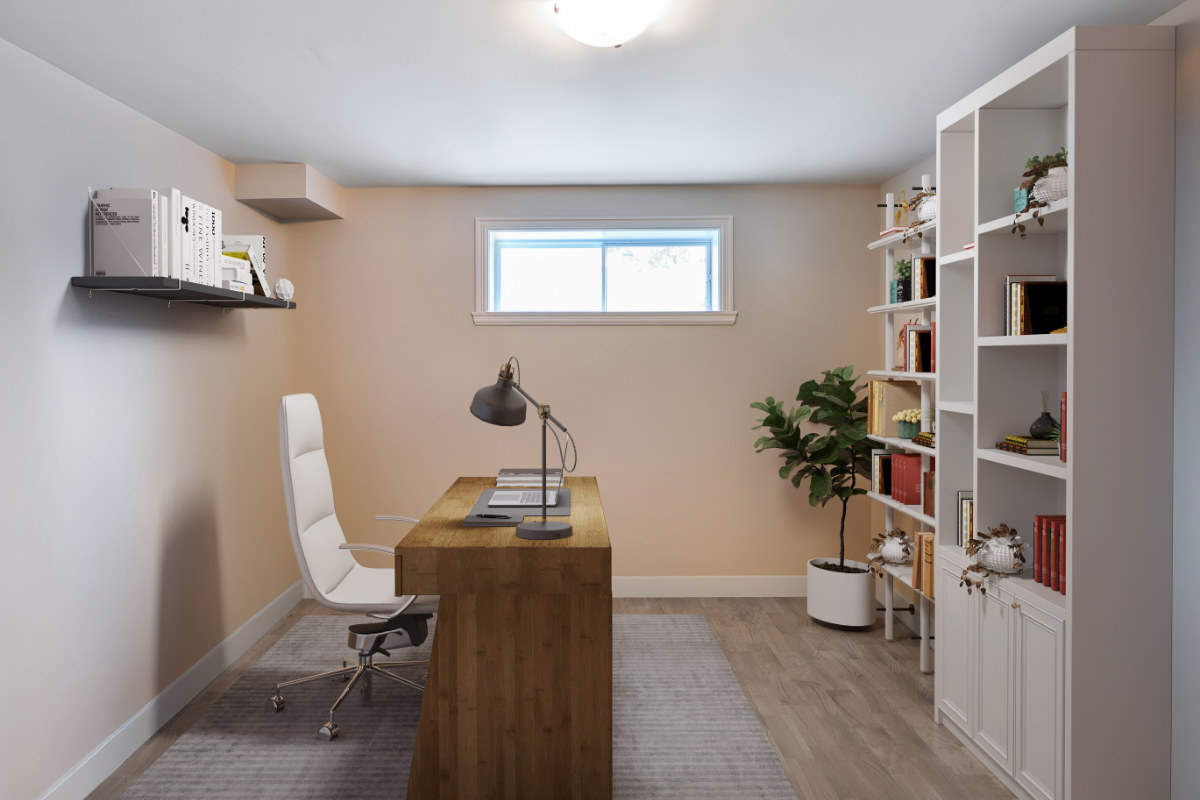
From ergonomic home offices and private libraries to luxury wine cellars, home theaters, and gyms, niche spaces demand tailored design solutions. With rendering, you can optimize storage systems, verify acoustic wall padding placement, and adjust task lighting to create high-performing, functional environments tailored to modern lifestyles.
4. The power of 3D interior visualization across industries
Whether you are selling a luxury penthouse in Manhattan, designing a boutique hotel in Paris, or photographing high-end estates, digital visualization has become the standard medium of communication.
|
Industry segment |
Primary value proposition of 3D interior rendering |
|
Real estate |
Sells unbuilt/renovated properties months ahead of schedule. Eliminates the high physical costs of luxury home staging. |
|
Photographers |
Upsells clients with virtual twilight & renovation concepts. Expands service portfolio without expensive camera gear. |
|
Architects |
Speeds up client approvals by eliminating design ambiguity. |
4.1. For real estate agents and developers: Selling the dream
In real estate, we don't sell square footage; we sell a lifestyle.
- Virtual staging and pre-sales: Trying to sell a multi-million dollar property that is currently a messy construction site or a vacant concrete shell is incredibly difficult. With 3D interior visualization, you can show potential buyers a fully realized, beautifully staged home, complete with premium furniture, curated art, and cozy lighting.
- Unlocking emotional connections: A high-quality render allows buyers to see themselves pouring coffee in that kitchen or watching the sunset from that living room. It turns an abstract floor plan into an emotional reality, accelerating decision-making and driving up property values.
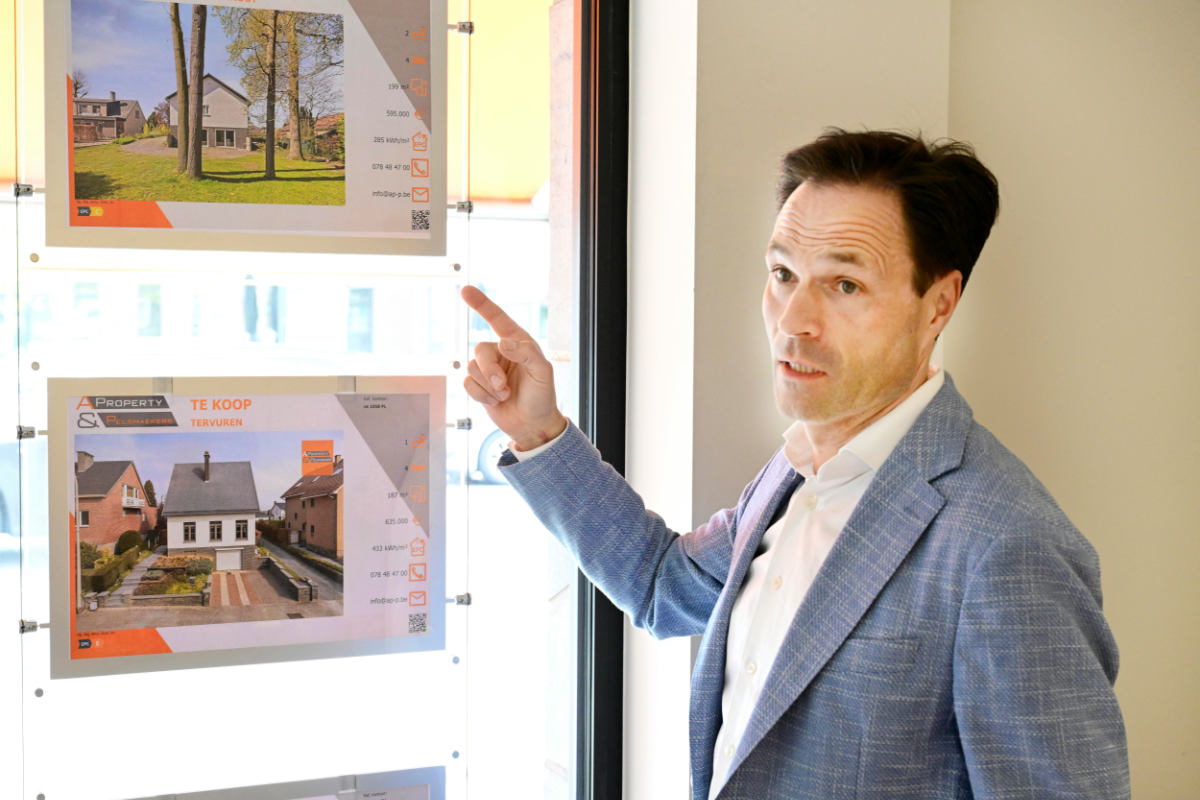 Home builders and realtors can now showcase the property’s potential to investors.
4.2. For professional photographers and videographers: Expanding the toolkit
As photographers, we are often limited by physical constraints: bad weather, poor interior design, cramped spaces, or tight budgets that don't allow for pro styling.
- A hybrid future: Forward-thinking photographers are no longer viewing 3D rendering as a threat, but as an extension of their studio. By offering hybrid services, such as combining real-life exterior photography with beautifully crafted 3D interior renders of unbuilt additions, photographers can double their average order value.
- Creative freedom: No more waiting for the perfect "golden hour" or dealing with color-cast issues from mismatched light bulbs. With 3D visualization, you have absolute control over every photon in the room.
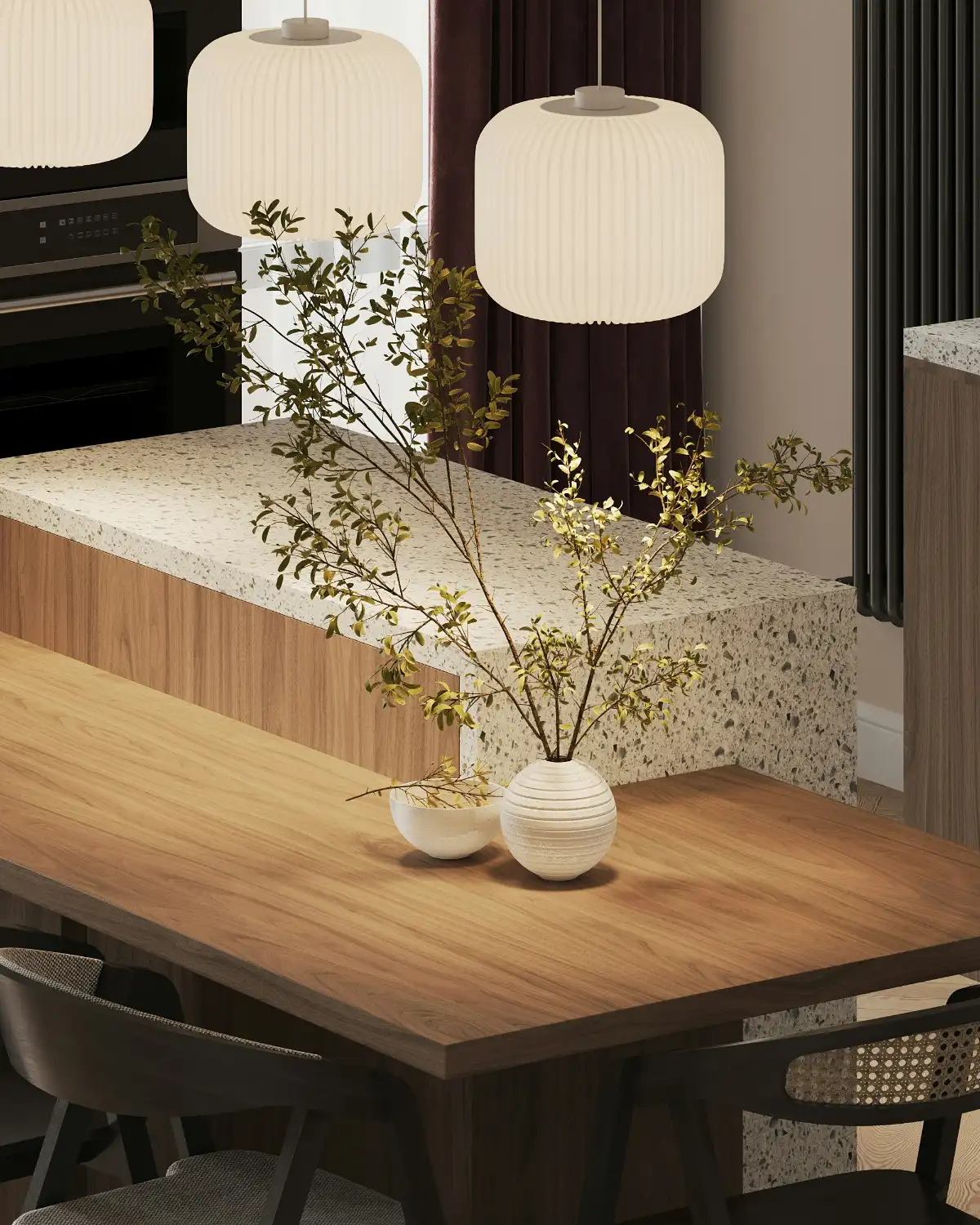 With 3D rendering, photographers and videographers can provide a new kind of visual to enrich the listings.
5. The production bottleneck: Why editing and outsourcing are mission-critical
While the creative potential of 3D interior rendering is limitless, the technical and operational realities of producing these assets in-house can quickly become a business bottleneck.
5.1. The hidden costs of in-house 3D production
To produce world-class renders, a studio needs:
1. Expensive hardware: Top-tier workstations equipped with high-end GPUs and massive RAM pools.
2. Costly software licenses: Annual subscriptions for 3ds Max, Maya, Corona, V-Ray, and Adobe Suite.
3. Time-consuming render times: A single, high-resolution, photorealistic image can take hours to compute, completely locking up a designer's computer.
4. Specialized talent: Finding artists who possess both technical 3D skills and an artistic eye for interior design and photography is rare and expensive.
5.2. The opportunity cost for creatives and realtors
If you are a photographer, your most profitable hours are spent shooting on-site, building client relationships, and directing creative visions. If you are a realtor, your time is best spent networking, closing deals, and negotiating.
Every hour you spend wrestling with 3D rendering software, adjusting texture maps, or waiting for a render queue to finish is an hour of lost revenue.
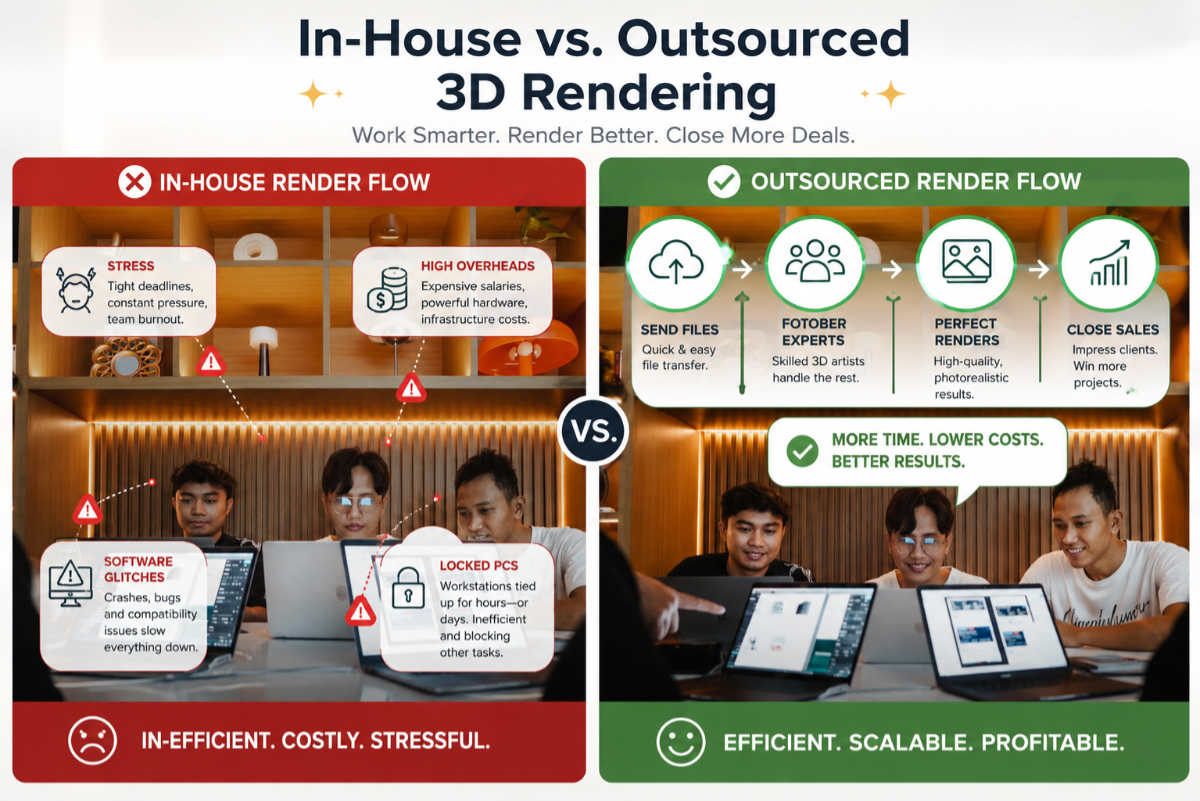 Outsourcing architectural rendering can save studios immense time and costs.
This is why outsourcing and professional editing are not luxuries; they are fundamental scaling strategies. By outsourcing the heavy computing and meticulous modeling tasks to a dedicated team, you free up your intellectual capital to focus on what actually moves the needle for your business.
6. Why Fotober is the ultimate post-production and 3D interior rendering ally
In the crowded landscape of digital outsourcing, finding a partner who speaks the language of both art and business can be challenging. Many outsourcing factories produce sterile, flat images that lack soul.
Fotober stands out because it was built from the ground up by professionals who understand photography, architectural flow, and real estate marketing dynamics.
|
The Fotober edge |
|
Photographer’s eye: Understands lighting, composition & depth. |
|
Tailored for media: Perfect alignment of stills, video & 3D |
|
Scale & speed: Overcome hardware limits with speed. |
6.1. We see the world through a photographer’s lens
At Fotober, we do not just click buttons in a software program. We understand light direction, exposure values, color theory, and composition. When we work on your 3D architectural interior rendering projects, we treat the digital viewport exactly like a physical camera. We ensure that the shadows fall naturally, the reflections are crisp but realistic, and the color temperature of the interior lamps matches the twilight sky outside the window.
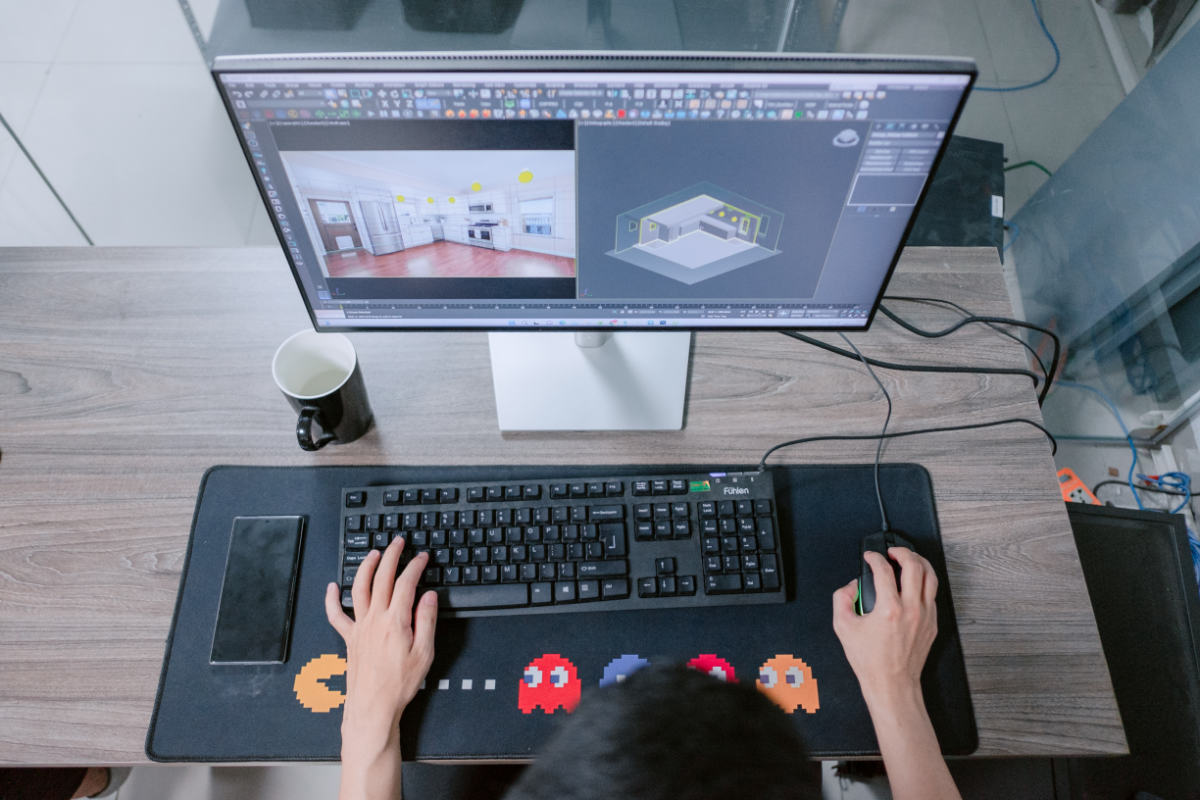 Fotober understands the intricacies of real estate visuals to provide the finest architectural rendering.
6.2. Tailored solutions for photographers, videographers, and realtors
We know that every creative professional has a unique workflow and a distinct brand voice.
- For photographers & videographers: We act as your silent back-office production team. Send us your basic floor plans, CAD drawings, or raw room photos, and we will return stunning, high-resolution renders that seamlessly match the style of your existing portfolio. This allows you to scale your agency's offerings overnight without hiring a single full-time employee.
- For realtors and developers: We help you build jaw-dropping marketing collateral. From single-room virtual staging to complete 3D interior rendering packages for luxury developments, we deliver assets that look beautiful on listing portals, social media, and high-gloss print brochures.
6.3. Unmatched speed, scalability, and cost-effectiveness
By partnering with Fotober, you gain access to a massive infrastructure of high-performance rendering networks and a team of seasoned 3D artists. You no longer have to worry about system crashes, software updates, or missed deadlines. We handle the technical heavy lifting, offering rapid turnaround times and rigorous quality control, so you always look like a superstar to your clients.
7. Behind the scenes: The step-by-step collaborative workflow for making 3D interior rendering
How does a collaboration with Fotober work? We have designed a streamlined, frictionless process that ensures your creative vision is translated perfectly onto the digital canvas.
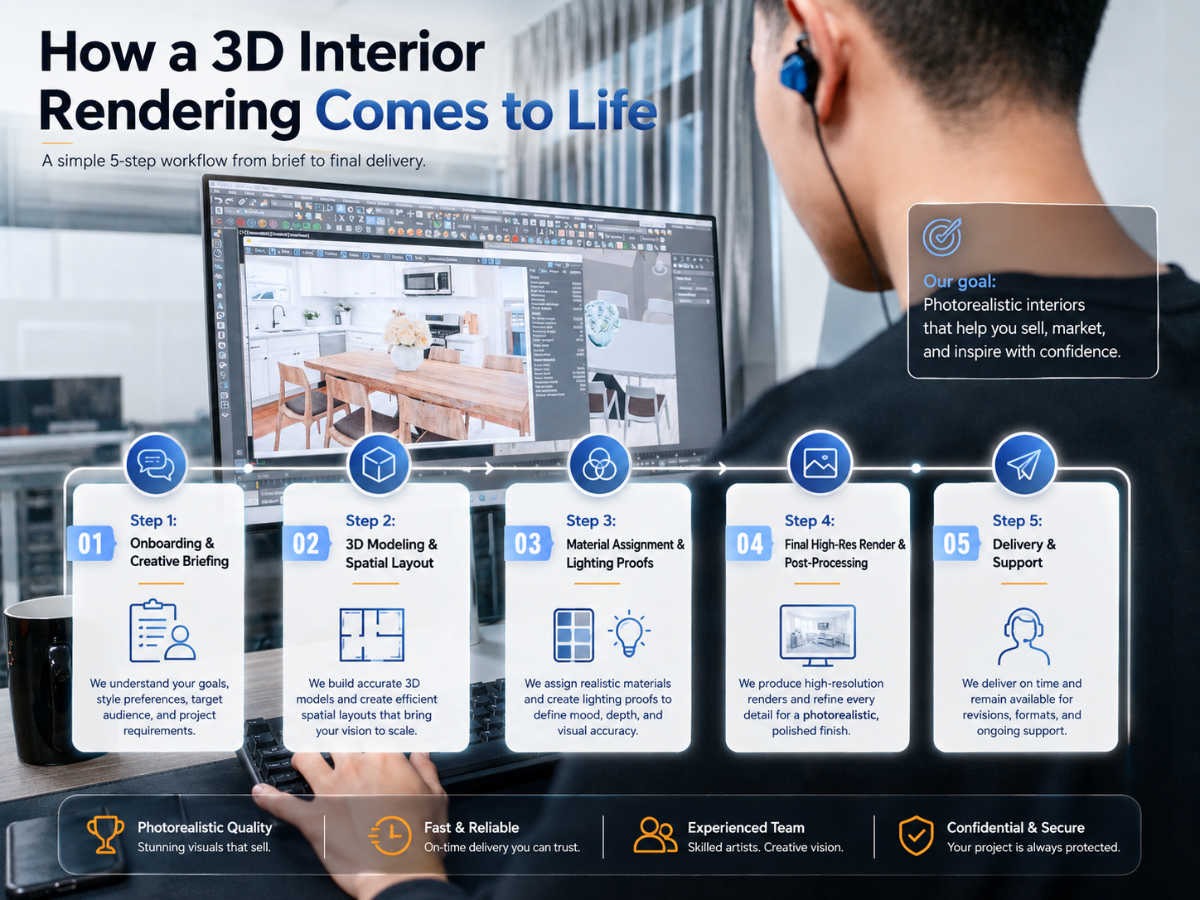 The Fotober workflow to bring your vision to life.
Step 1: Onboarding and creative briefing
You send us the project files. This can include 2D architectural blueprints, CAD files, hand-sketched floor plans, or even reference photos of the style and mood you want to emulate. You can specify the furniture style (e.g., Mid-Century Modern, Japandi, Industrial Loft), color schemes, and time of day.
Step 2: 3D modeling and spatial layout
Our artists build the physical geometry of the interior space. We ensure that all architectural details, such as moldings, window frames, door heights, and structural columns, are geometrically perfect and accurate to your specifications.
Step 3: Material assignment and lighting proofs
We apply high-definition PBR textures to the walls, floors, and furniture. We then set up the virtual lighting scheme. Before we run the final high-resolution render, we send you low-resolution "grayscale" or basic color previews to ensure the layout, furniture placement, and overall lighting direction match your expectations.
Step 4: Final high-res render and post-processing (The Fotober touch)
Once you approve the layout, we send the project to our high-performance render network. After the raw image is generated, our expert post-production team steps in. We fine-tune the color balance, enhance contrast, adjust the highlights, and add those subtle, cinematic touches that turn a good render into an extraordinary work of art.
Step 5: Delivery and support
You receive the gorgeous, high-resolution final assets, ready to be uploaded to your website, presented to your clients, or shared across your marketing channels.
8. Elevating your brand and ROI with premium 3D interior visualization
In today's fast-paced digital economy, attention is the most valuable currency. A buyer scrolling through a real estate portal or an investor reviewing an architectural pitch will decide in less than three seconds. Low-quality images, empty rooms, or amateurish renders will cause them to keep scrolling
|
The impact of value | |
|
Standard listing: Empty/flat photo -> Low interest -> Price drop |
Premium listing: [Fotober 3D render] -> High clicks -> Fast sale |
By investing in elite 3D interior rendering, you are investing in the perceived value of your brand. You are positioning yourself as a premium player in your market who values precision, beauty, and cutting-edge technology.
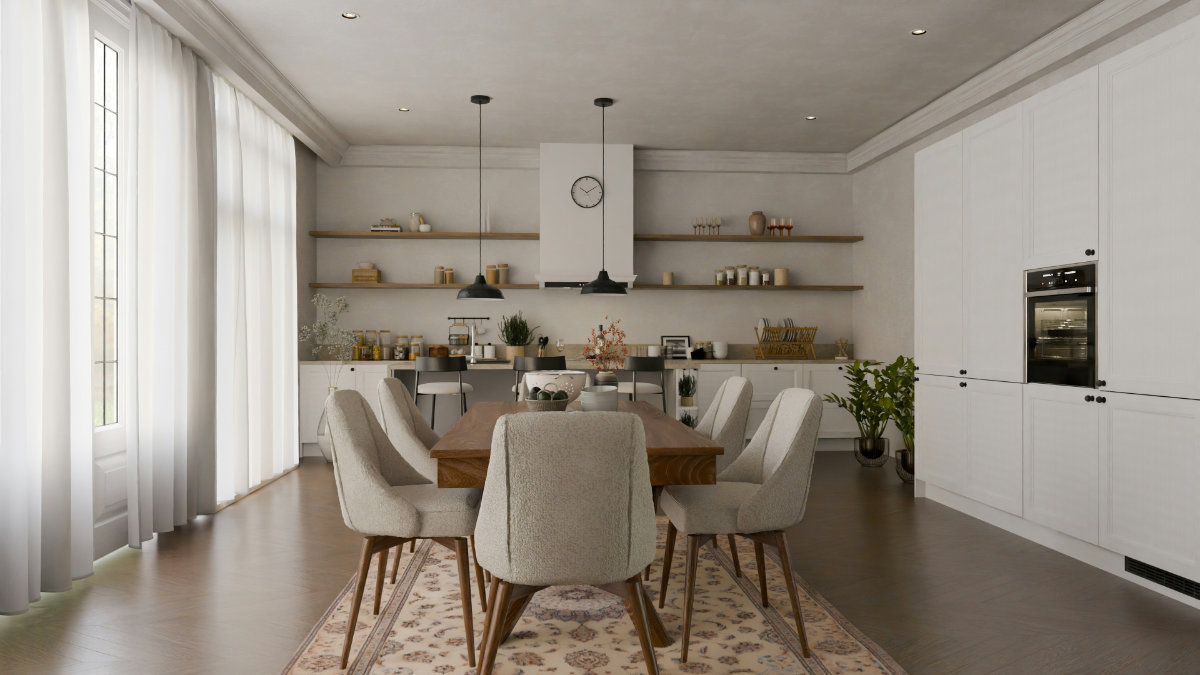 High-quality 3D rendering is now the indicator of a premium project.
The return on investment (ROI) is clear:
- Properties sell up to 50% faster when staged or rendered professionally.
- Architects win more pitches by removing the guesswork and letting clients see the final product beforehand.
- Creative agencies increase their margins by outsourcing time-consuming post-production, allowing them to take on 2x to 3x more client projects simultaneously.
9. Conclusion
The line between the physical world and the digital canvas has permanently blurred. 3D interior rendering is no longer just a trend; it is the cornerstone of modern architectural design, real estate marketing, and visual content production.
But to stand out in a crowded market, you need more than just software. You need an artistic partner who understands the nuance of light, the texture of fabric, and the business metrics of your industry.
Let Fotober be your creative engine. Whether you want to elevate your real estate listings, expand your photography studio’s service menu, or bring your architectural blueprints to life, our team of world-class digital artists and editors is ready to support you.
Are you ready to transform your visual presentation and scale your business? Contact Fotober today to discuss your next project, and let’s create something breathtaking together.
Also follow us on social media to stay updated with the latest visualization services to make the most out of your property.
- Facebook: fotobermedia.co
- YouTube: Fotober
- TikTok: @fotober
- Instagram: fotober_media.
Related posts

Cincinnati Housing Market 2026: Prices, Trends, and What It Means for Buyers, Sellers, and Investors
October 20, 2026

Modern Luxe Interior Design: Elements, Style Guide and How to Stage It
October 10, 2026

Minimalist Interior Design: Characteristics, Style Guide, and Staging
October 8, 2026

Coastal Interior Design: Style Definition & Staging Guide
September 30, 2026
