




Finest 3D Architectural Rendering Software to Bring Blueprints to Life
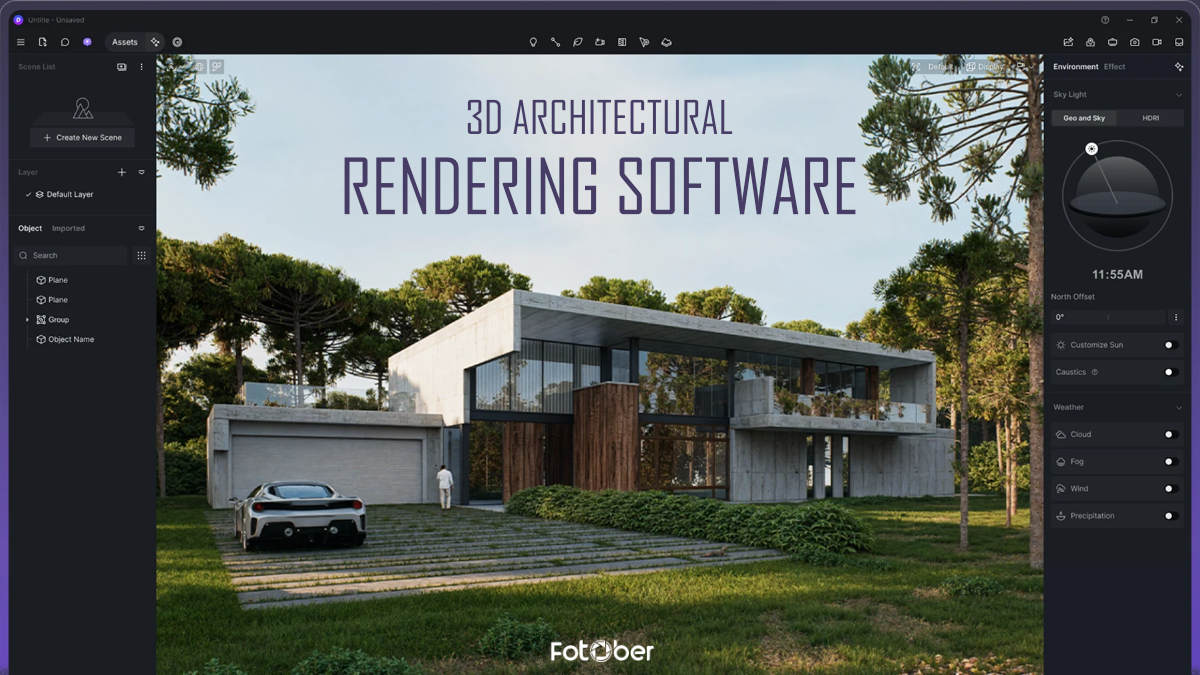

Share:
Table of Contents
- 1. Why high-growth markets demand specialized 3D architectural rendering software
- 2. Top 8 best 3D rendering software for architecture: Strengths, weaknesses, and pricing
- 3. How to choose the right 3D architectural rendering software for your projects
- 4. The missing link: Why raw 3D renders still require expert post-processing (editing)
- 5. Why Fotober is the ultimate outsourcing partner for realtors, developers, and architects
- 6. Conclusion
In the high-stakes worlds of luxury real estate, architectural design, and commercial development, a single image can be worth millions of dollars. As professional photographers, videographers, and real estate experts, we know that capturing a property isn't just about documenting a space; it’s about selling a lifestyle, an emotion, and a future. But what happens when the property doesn't exist yet? What if it is still a skeleton of steel and concrete, or merely a blueprint in an architect’s mind?
This is where rendering software bridges the gap between imagination and reality, allowing realtors to pre-sell luxury condos and helping architects secure municipal approvals long before the first brick is laid. In this comprehensive guide, we will analyze the unique demands of fast-growing real estate markets, explore the best 3D architectural rendering software, evaluate free alternatives, and explain why even the most advanced raw renders still require the touch of expert post-processing.
1. Why high-growth markets demand specialized 3D architectural rendering software
To understand the power of visualization, we must look at the regions driving today's architectural innovation. Consider high-growth coastal and Sunbelt metropolitan areas, such as Miami, Florida, Southern California, and Austin, Texas.
These regions are characterized by:
- High-rise luxury condominiums: Shimmering glass towers that redefine city skylines.
- Waterfront mansions: Ultra-luxury estates where indoor-outdoor living must be seamlessly integrated.
- Rapid master-planned communities: Massive suburban developments replacing open land at lightning speed.
In these markets, real estate is fast-paced, highly competitive, and driven by international capital. Buyers from New York, South America, and Europe are purchasing multi-million dollar properties sight unseen. Therefore, developers cannot afford to wait for construction to finish before they begin marketing. They must sell the dream immediately.
In a market saturated with luxury listings, standard 2D floor plans are no longer enough. Buyers demand immersive, photorealistic experiences. Specialized 3D architectural rendering software is essential in these regions for several key reasons:
1.1. Overcoming the "pre-construction" hurdle
Selling pre-construction requires an immense amount of trust. A high-quality render acts as a visual contract. It shows the exact angle of the afternoon sun hitting the marble kitchen island, the reflection of the ocean in the floor-to-ceiling windows, and the precise texture of the European oak flooring.
1.2. Navigating strict zoning and environmental standards
In coastal areas like Florida or California, environmental impact and structural zoning are highly scrutinized. Developers use advanced renderings to present realistic impact assessments to local planning boards, proving that their designs harmonize with the local ecosystem and existing skyline.
1.3. Appealing to high-net-worth individuals (HNWIs)
Affluent buyers do not buy property; they buy curated experiences. To capture their attention, marketing materials must rival the quality of high-fashion editorials or cinematic films. The lighting must be perfect, the shadows soft, and the atmosphere inviting, elements that only elite rendering tools can produce.
 Architectural rendering is one efficient approach to impress high-profile investors right from the pre-build phase.
2. Top 8 best 3D rendering software for architecture: Strengths, weaknesses, and pricing
To help you navigate the crowded market, here is an expert breakdown of the top 8 rendering solutions used by leading global studios.
2.1. V-Ray (By Chaos Group)
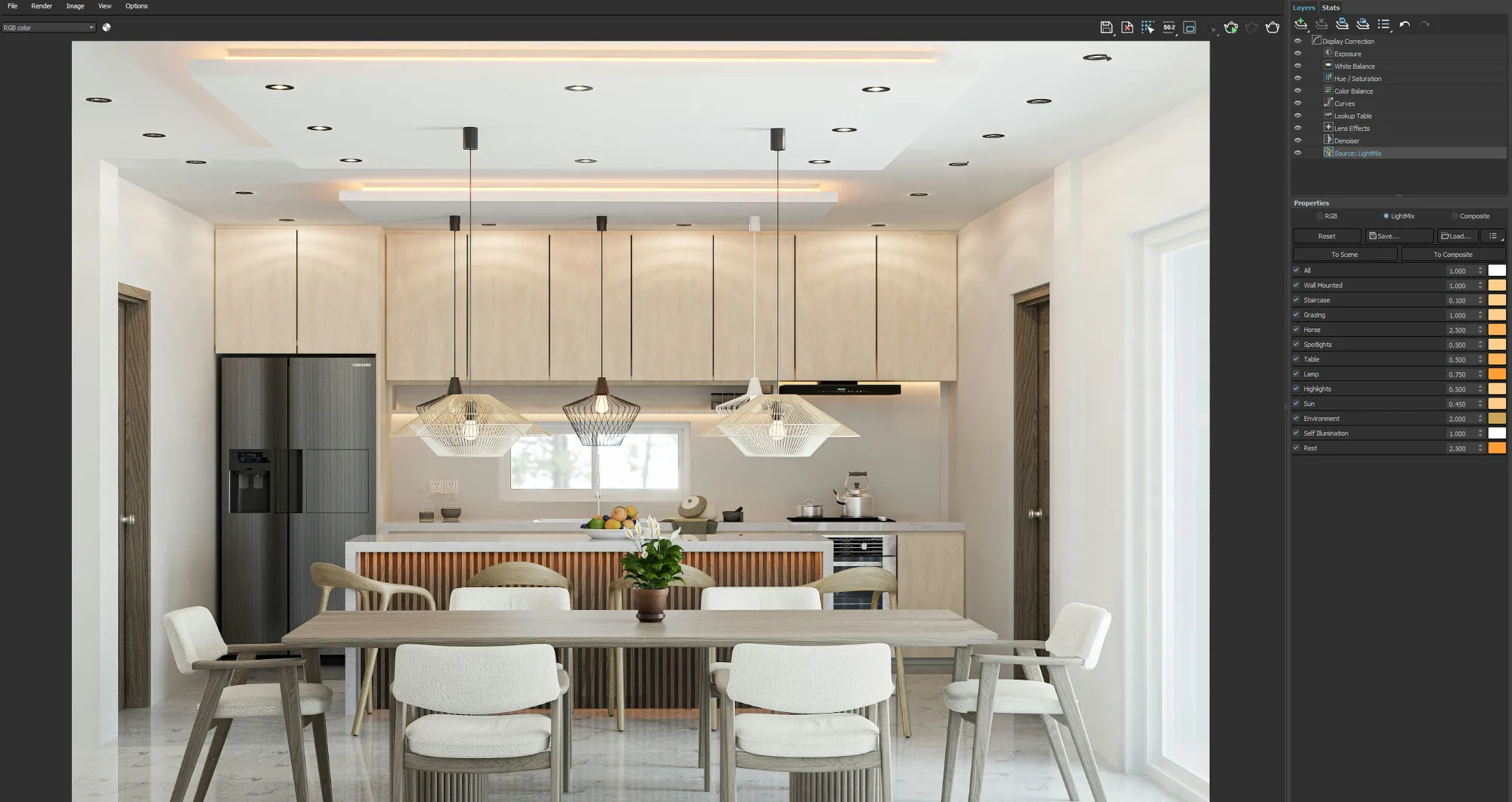 V-Ray: The industry standard for photorealism
V-Ray is legendary in the architectural visualization industry. It is a CPU/GPU bi-biased rendering engine that plugs seamlessly into major modeling software like SketchUp, Rhino, Revit, and 3ds Max.
- Strengths: Unmatched realism, incredible global illumination, highly customizable material settings, and a massive community of users.
- Weaknesses: Steep learning curve; rendering times can be slow on mid-range computers.
- Pricing: Subscription starts at approximately 38-85USD per month (billed annually), depending on the tier.
2.2. Lumion
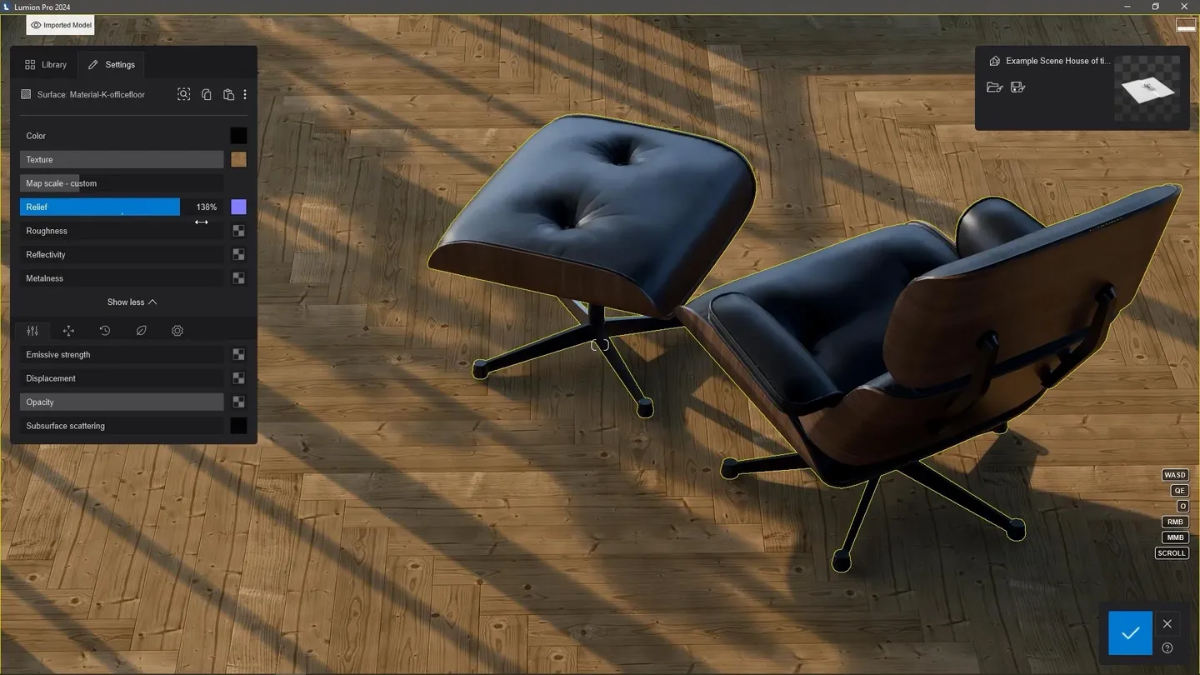 Lumion: The speed and landscape king
Designed specifically for architects, Lumion excels at transforming CAD models into vibrant, living environments within minutes. It is famous for its massive library of high-quality trees, plants, cars, and human figures.
- Strengths: Extremely fast rendering times, intuitive user interface, excellent wind and weather effects, and an extensive asset library.
- Weaknesses: Requires a high-end graphics card (GPU); indoor lighting can sometimes look slightly artificial compared to V-Ray.
- Pricing: Perpetual licenses or annual subscriptions start around $749/year for the Standard edition.
2.3. Twinmotion (By Epic Games)
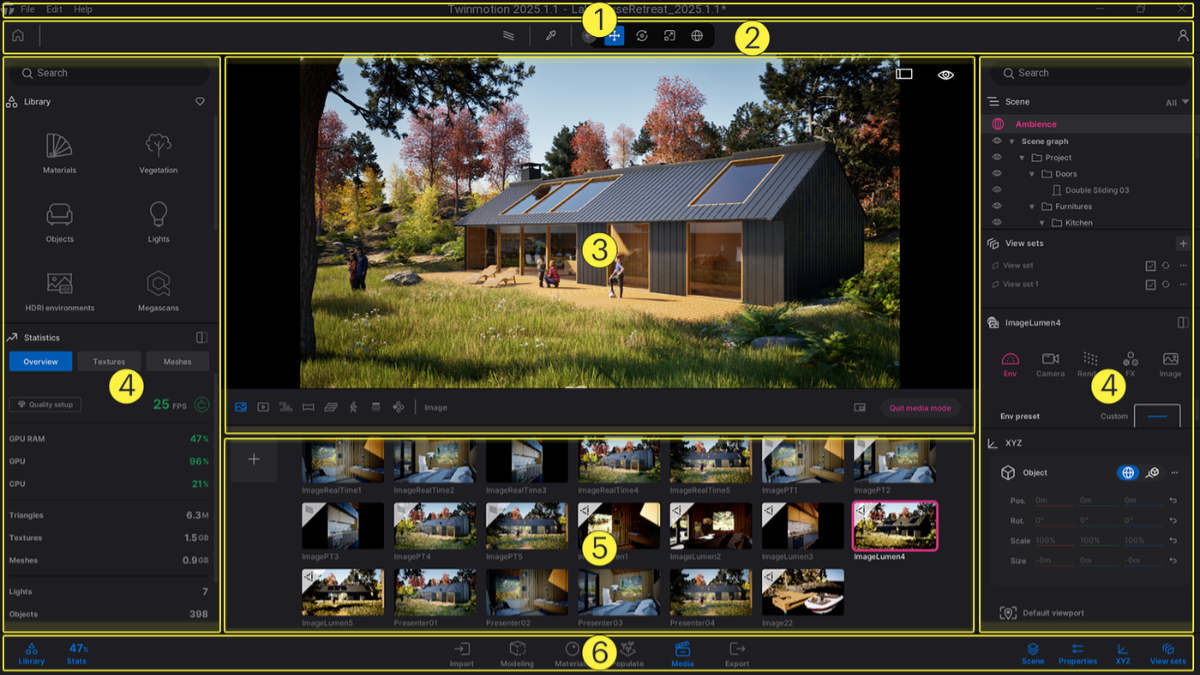 Twinmotion: Real-time immersion powered by Unreal Engine
Twinmotion offers an incredibly fast, real-time visualization workflow. Owned by Epic Games, it utilizes the raw power of the Unreal Engine to create instant, high-quality stills, animations, and VR presentations.
- Strengths: Seamless synchronization with Revit, SketchUp, and Archicad; excellent weather and seasonal controls; direct integration with Quixel Megascans (photorealistic materials).
- Weaknesses: Can occasionally crash with extremely heavy, unoptimized geometry.
- Pricing: Free for educational use; commercial licenses start at $449 (perpetual license with upgrades).
2.4. Blender (With Cycles/Eevee Engines)
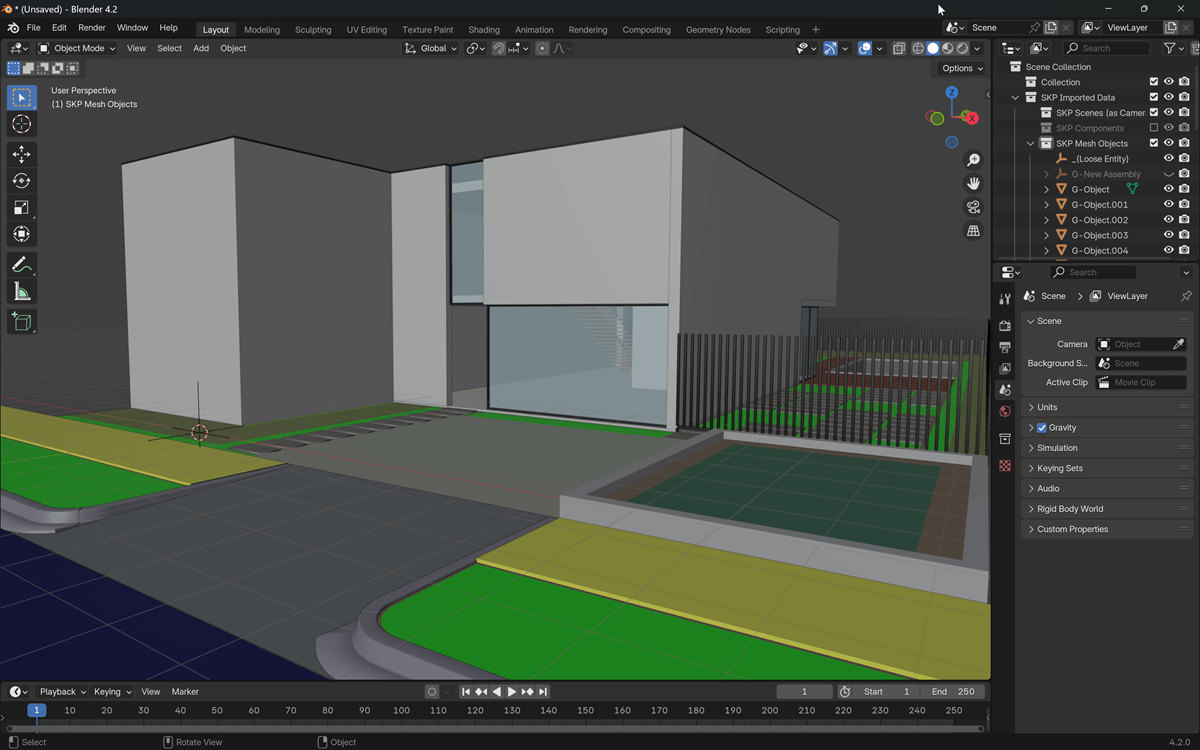 Blender: The ultimate free powerhouse
If you are looking for a 3D architectural rendering software free of licensing fees, Blender is the undisputed champion. It is an open-source, fully integrated 3D creation suite that rivals expensive commercial software.
- Strengths: 100% free; incredibly powerful Cycles (ray-tracing) and Eevee (real-time) render engines; massive community support and endless free add-ons.
- Weaknesses: Very steep learning curve; does not natively integrate with standard BIM software like Revit without intermediate file conversions.
- Pricing: Free (Open Source).
2.5. Enscape
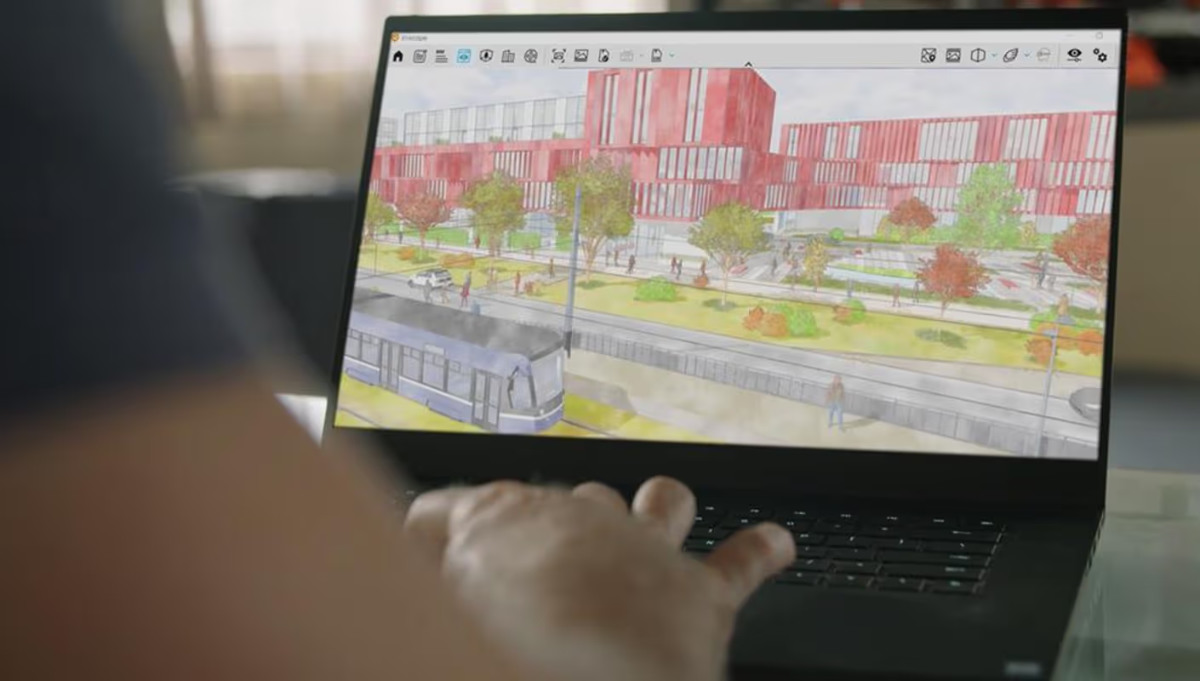 Enscape: The best for real-time design integration
Enscape is a real-time rendering plugin that integrates directly into your modeling software (Revit, SketchUp, Rhino). It allows architects to walk through their designs live as they are drafting them.
- Strengths: Instant feedback; great for client presentations during the design phase; easy VR integration.
- Weaknesses: Lacks the deep photorealistic fine-tuning capabilities of V-Ray or Corona.
- Pricing: Around 45-75USD per month (billed annually).
2.6. Corona Renderer (By Chaos Group)
 Corona: Unbeatable interior lighting and simplicity
Corona has gained a massive following for its ease of use and beautiful, natural light handling. This 3D architectural rendering software is highly favored by interior designers who specialize in complex indoor lighting setups.
- Strengths: Highly intuitive setup; gorgeous out-of-the-box lighting; powerful interactive rendering features.
- Weaknesses: Primarily CPU-based (though GPU features are developing); limited to 3ds Max and Cinema 4D.
- Pricing: Around 40-55USD per month.
2.7. Unreal Engine 5
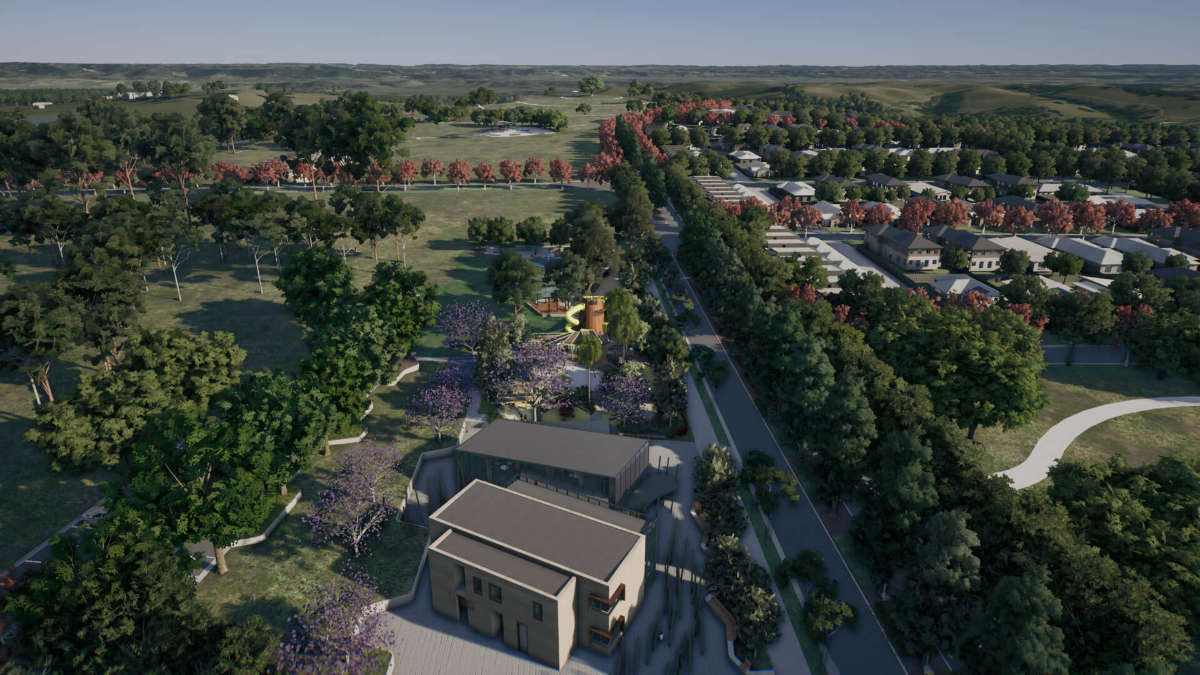 Unreal Engine: The future of interactive real estate
Unreal Engine 5 (UE5) has crossed over from the gaming industry into high-end real estate marketing. Using its revolutionary Lumen dynamic global illumination system, UE5 produces mind-blowing interactive walkthroughs.
- Strengths: Best-in-class real-time graphics, virtual reality readiness, and fully interactive environments (clients can change kitchen finishes with a click).
- Weaknesses: Extremely complex workflow; requires specialized knowledge in blueprint programming and game optimization.
- Pricing: Free to use; royalty fees only apply to commercial entertainment releases (not standard architectural services).
2.8. D5 Render
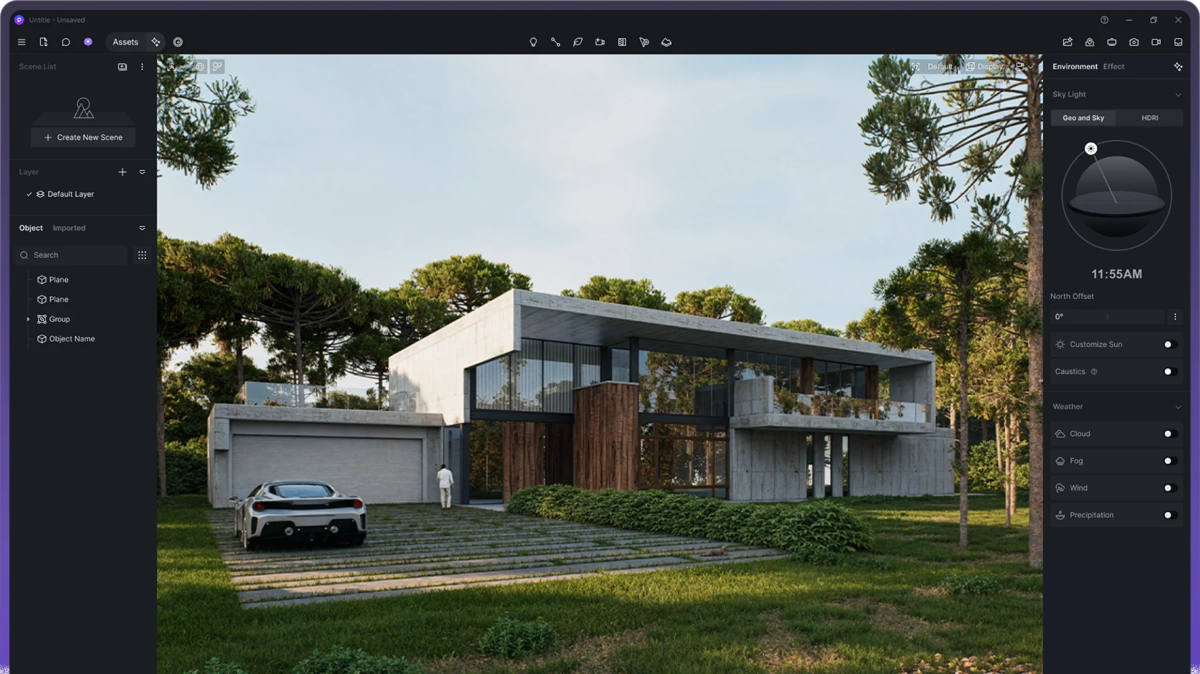 D5 Render: The rising star of real-time ray tracing
D5 Render is a relatively new player that has taken the industry by storm. It leverages NVIDIA RTX hardware-accelerated ray tracing to deliver stunning real-time visualizations.
- Strengths: Beautiful, realistic reflections and lighting; very fast; user-friendly interface; generous free version.
- Weaknesses: Requires a modern, powerful NVIDIA RTX graphics card to function optimally.
- Pricing: Robust free community version; Pro version starts at $30/month to $360/year.
3. How to choose the right 3D architectural rendering software for your projects
When you ask “what is the best 3D rendering software for architecture?”, there is no one-size-fits-all answer. The "best" tool depends entirely on your specific goals: Are you looking for hyper-realistic still images, rapid real-time walkthroughs, or immersive Virtual Reality (VR) experiences?
For architects and real estate marketers, the ideal software must balance render speed, library assets (like furniture and vegetation), ease of use, and, most importantly, the quality of light and materials.
Choosing the right tool is a strategic decision that impacts your workflow, hardware budget, and client satisfaction. Consider the following matrix:
|
If your goal is... |
The best software choice is... |
Why? |
|
Ultra-luxury stills |
V-Ray or Corona |
Unparalleled control over light physics and custom textures. |
|
Fast turnaround & landscaping |
Lumion or Twinmotion |
Huge library of pre-made assets and instant rendering speeds. |
|
Zero budget / Startup |
Blender or D5 Community |
High-quality output with no licensing overhead. |
|
Interactive walkthroughs & VR |
Unreal Engine 5 |
The gold standard for real-time virtual staging and interaction. |
|
Live design presentations |
Enscape |
Integrates directly into your BIM model for real-time adjustments. |
4. The missing link: Why raw 3D renders still require expert post-processing (editing)
As seasoned photographers, we know that what comes straight out of the camera is rarely the final masterpiece. The same rule applies to 3D rendering for a modern house.
Even if you use the best 3D rendering software for architecture, a raw render often looks cold, clinical, and slightly artificial. It lacks the "soul" of a real photograph. To bridge the gap between "computer-generated" and "breath-takingly real," expert post-processing (editing) is absolutely key. In short, the flow looks like this:
[RAW 3D model render] -> [The editing phase] - (Color grading & white balancing) - (Realistic sky replacement & environmental blending) - (Imperfection Injection: Subtle lens flare, dust, shape deformities) - (People, vehicles & lifestyle asset integration) -> [Photorealistic marketing masterpiece].
Here is why post-processing is indispensable:
4.1. Adding the "human element" and lifestyle
High-end buyers buy into a story. Adding photorealistic human figures, pets, steam coming off a coffee cup, or realistic reflections in a puddle makes the space feel lived-in and desirable.
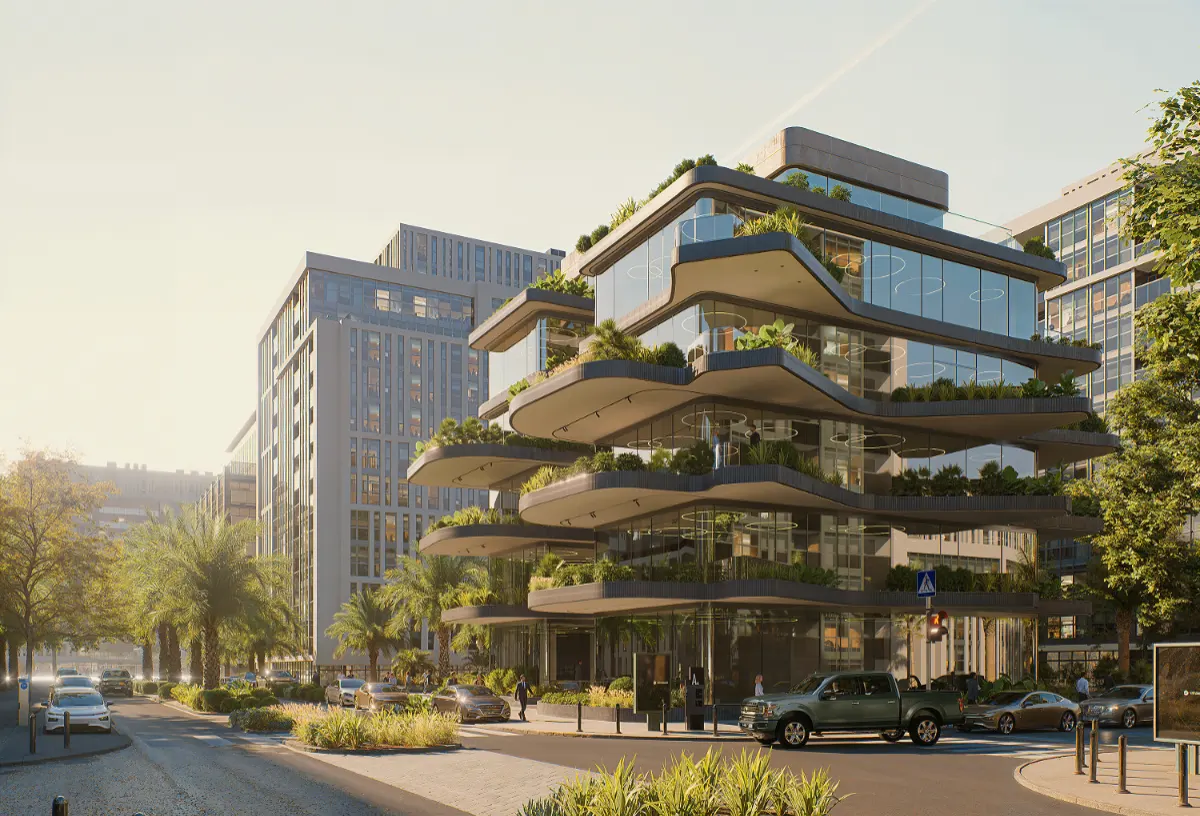 A touch of lifestyle will make a rendered image look more appealing.
4.2. Perfecting lighting and color grading
In a 3D architectural rendering software, matching the warm amber of a sunset with interior LED lighting can take hours of trial and error. In Photoshop or Lightroom, a skilled photo editor can adjust color curves, contrast, and highlights in minutes, ensuring the render matches the exact mood of a premium architectural photograph.
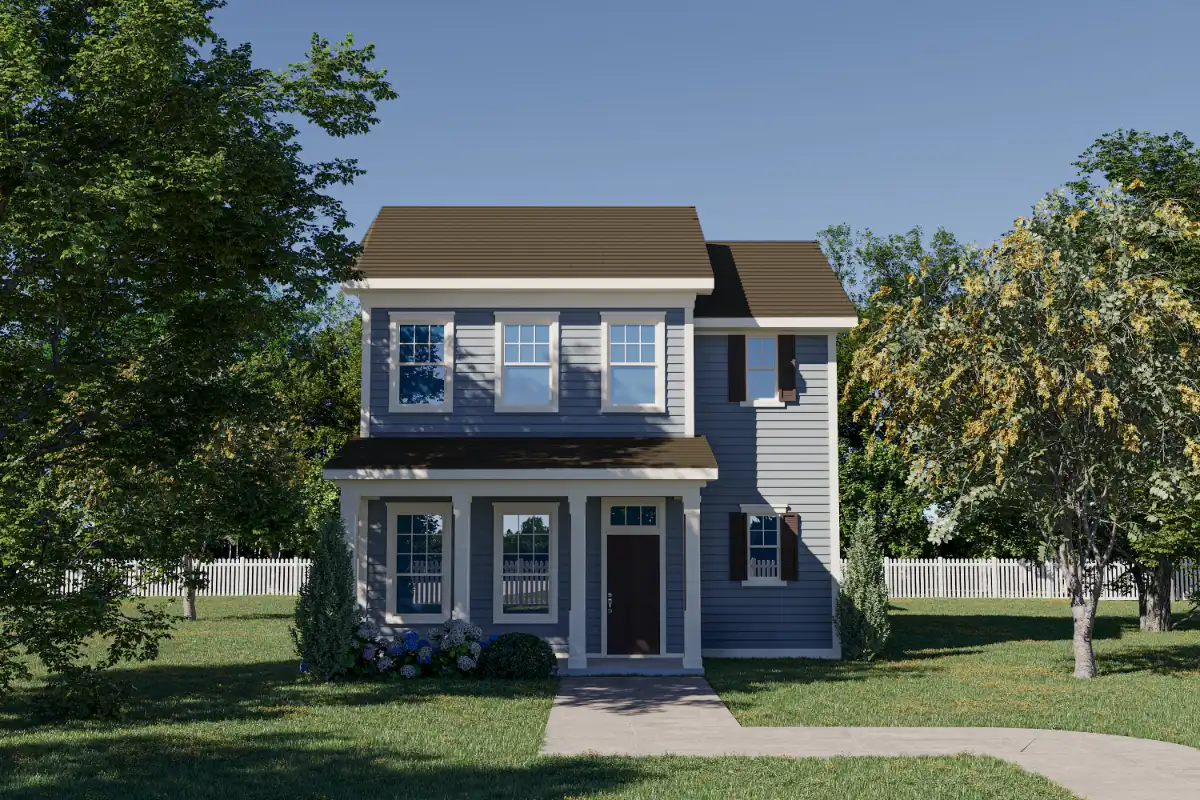 3D-rendered photos still benefit from distinct and consistent color grading.
4.3. Integrating real-world environments
Often, a luxury condo render must be placed within a real-world drone photograph of the city skyline. This requires advanced compositing skills to align perspectives, match light directions, and blend atmospheric haze seamlessly.
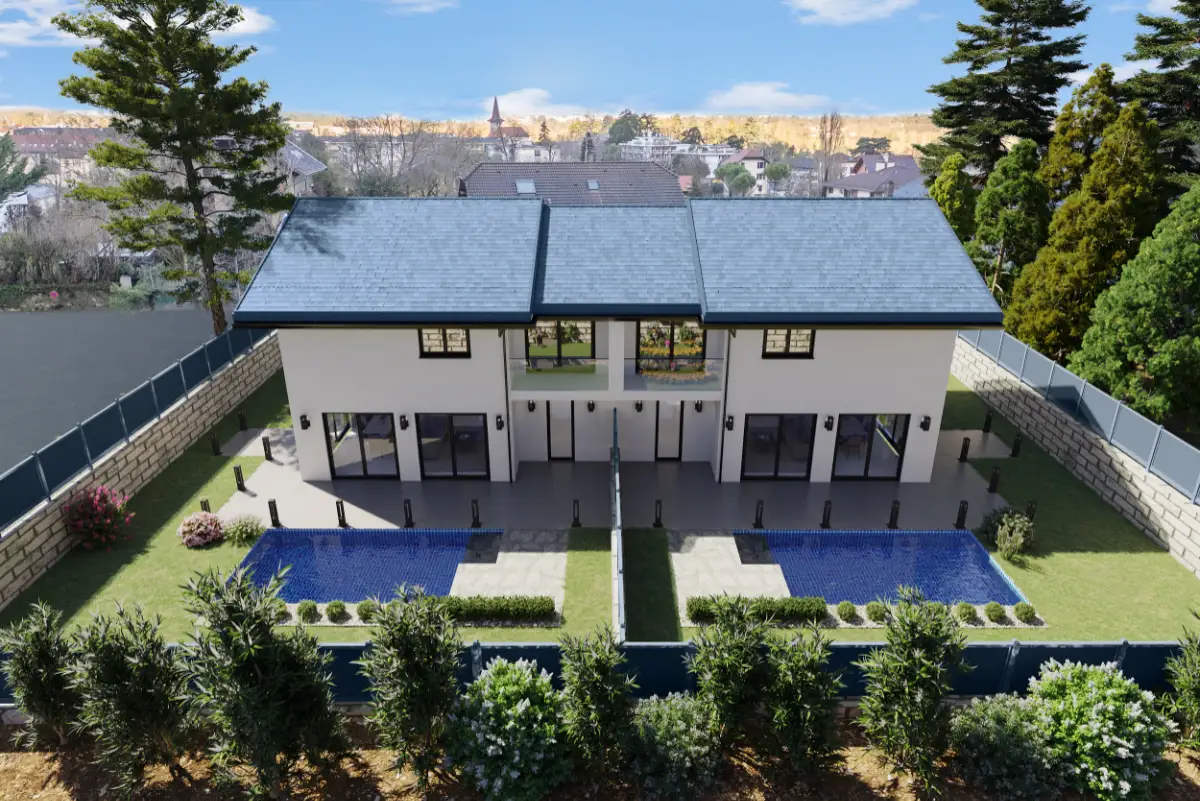 Putting a rendered asset into an image takes skill and calculation.
5. Why Fotober is the ultimate outsourcing partner for realtors, developers, and architects
Whether you are a real estate photographer looking to expand your services or a developer trying to meet a tight launch deadline, managing the rendering and editing workflow in-house can be an absolute bottleneck.
This is where Fotober steps in as your secret weapon.
|
Fotober as your co-pilot | |
|
For photographers |
For realtors |
|
Scale your services instantly No expensive hardware needed Perfect color-matched renders |
Pre-sell listings faster Immersive virtual staging Stunning day-to-dusk edtis |
5.1. Save on massive hardware and licensing costs
Running 3D architectural rendering software like V-Ray or Unreal Engine 5 requires multi-thousand-dollar workstations equipped with high-end GPUs. By outsourcing your post-production, virtual staging, and rendering enhancement to Fotober, you eliminate the need for expensive software licenses and hardware upgrades.
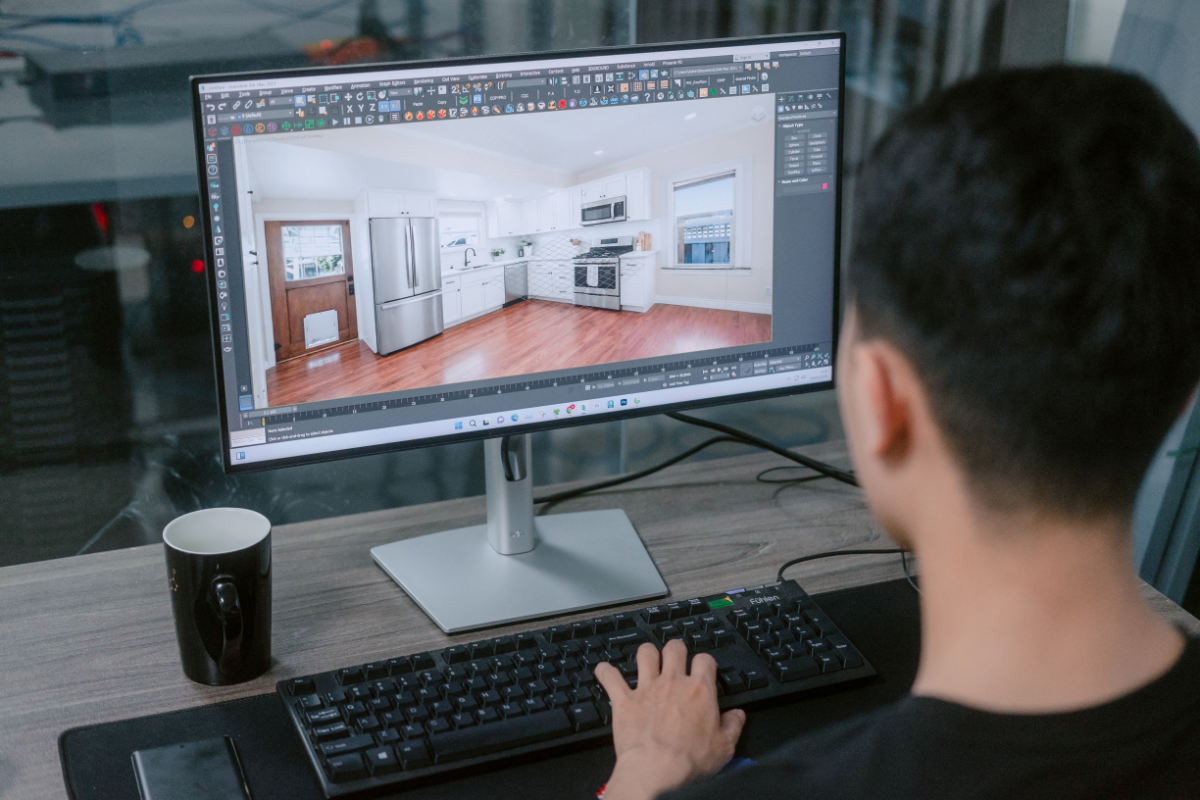 Let Fotober handle the tedious workload to make more room for your artistry and creativity to flow freely.
5.2. Scale your services overnight
If you are a photographer, you can now pitch high-end developer clients by offering full 3D architectural visualization services. You provide the drone backplates and raw ideas; Fotober’s expert post-production team handles the complex integration, rendering, and final cinematic polish.
5.3. Focus on what you do best
Realtors should be closing deals, and photographers should be behind the lens. Let Fotober handle the tedious hours of pixel-pushing, color-balancing, and atmospheric editing. We ensure your renders look less like video games and more like high-end editorial photographs.
6. Conclusion
The real estate market waits for no one. In dynamic, fast-paced regions, the ability to present stunning, photorealistic future spaces is the ultimate competitive advantage. By choosing the best 3D rendering software for architecture that fits your workflow, and pairing it with the world-class post-processing expertise of Fotober, you can create visuals that captivate buyers, impress stakeholders, and close deals faster.
Are you ready to elevate your real estate marketing assets? Partner with Fotober today to transform your raw renders and photographs into high-converting visual masterpieces. Contact us to get a free consultation and customized quote for your projects.
Also follow us on social media to stay updated with the latest visualization services to make the most out of your property.
- Facebook: fotobermedia.co
- YouTube: Fotober
- TikTok: @fotober
- Instagram: fotober_media.
Related posts

Cincinnati Housing Market 2026: Prices, Trends, and What It Means for Buyers, Sellers, and Investors
October 20, 2026

Modern Luxe Interior Design: Elements, Style Guide and How to Stage It
October 10, 2026

Minimalist Interior Design: Characteristics, Style Guide, and Staging
October 8, 2026

Coastal Interior Design: Style Definition & Staging Guide
September 30, 2026
