




3D Architectural Rendering Outsource: A Guide for Builders & Studios

Share:
Table of Contents
- 1. Key takeaways
- 2. Why architects, builders, and developers outsource 3D architectural rendering
- 3. How to outsource 3D architectural rendering: a step-by-step process
- 4. Benefits, trade-offs, and what it costs to 3D architectural rendering outsourcing
- 5. Frequently asked questions about 3D architectural rendering outsource
- 6. Conclusion: outsource smart, and let your team design
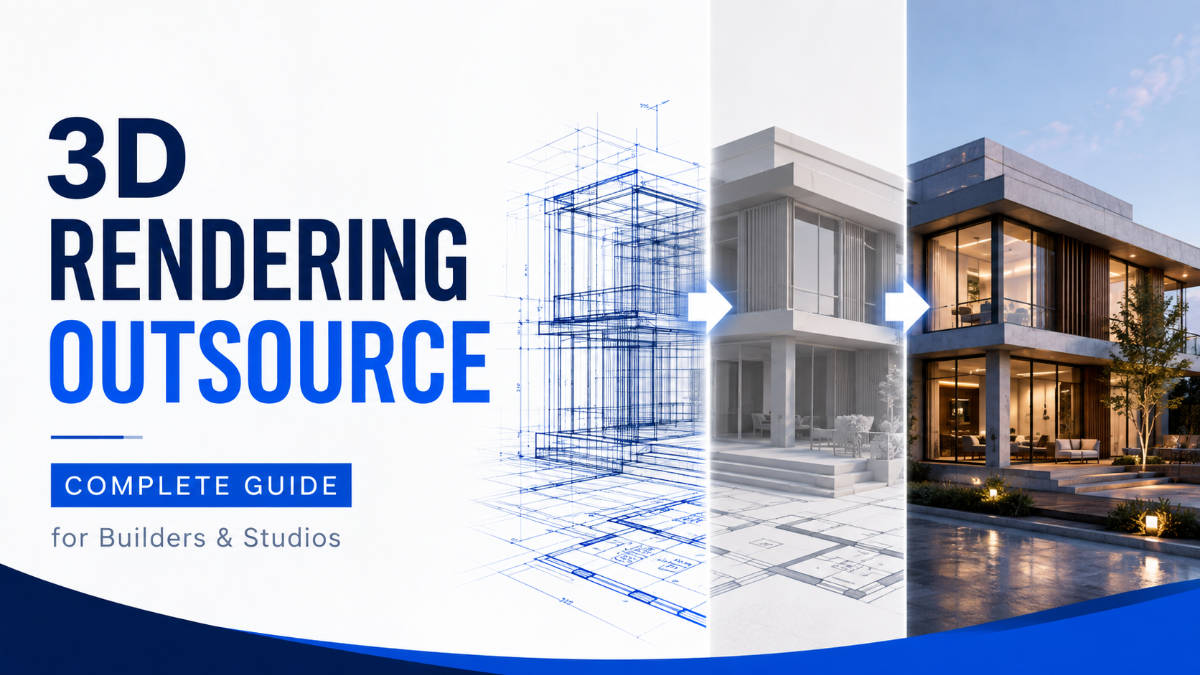
3D architectural rendering outsourcing helps architects, builders, and developers produce high-quality visuals without the cost of hiring in-house artists, buying powerful workstations, or maintaining expensive software. As projects become more complex and deadlines tighter, outsourcing allows design and sales teams to stay focused on their core work while experienced visualization studios handle the rendering.
When managed well, outsourcing can deliver photorealistic images faster and at a lower cost than building an internal rendering team. The key is choosing the right partner, providing a clear brief, and setting expectations for quality, revisions, and delivery from the start.
This guide explains why firms outsource 3D rendering, how the process works, the main benefits and drawbacks, typical costs, and what to look for in a reliable rendering partner. It is written for architects, builders, developers, and marketers who need professional visuals without turning their business into an in-house visualization studio.
1. Key takeaways
- The 3D architectural rendering outsourcing model converts the fixed cost of an in-house artist, hardware, and software into a flexible per-project expense.
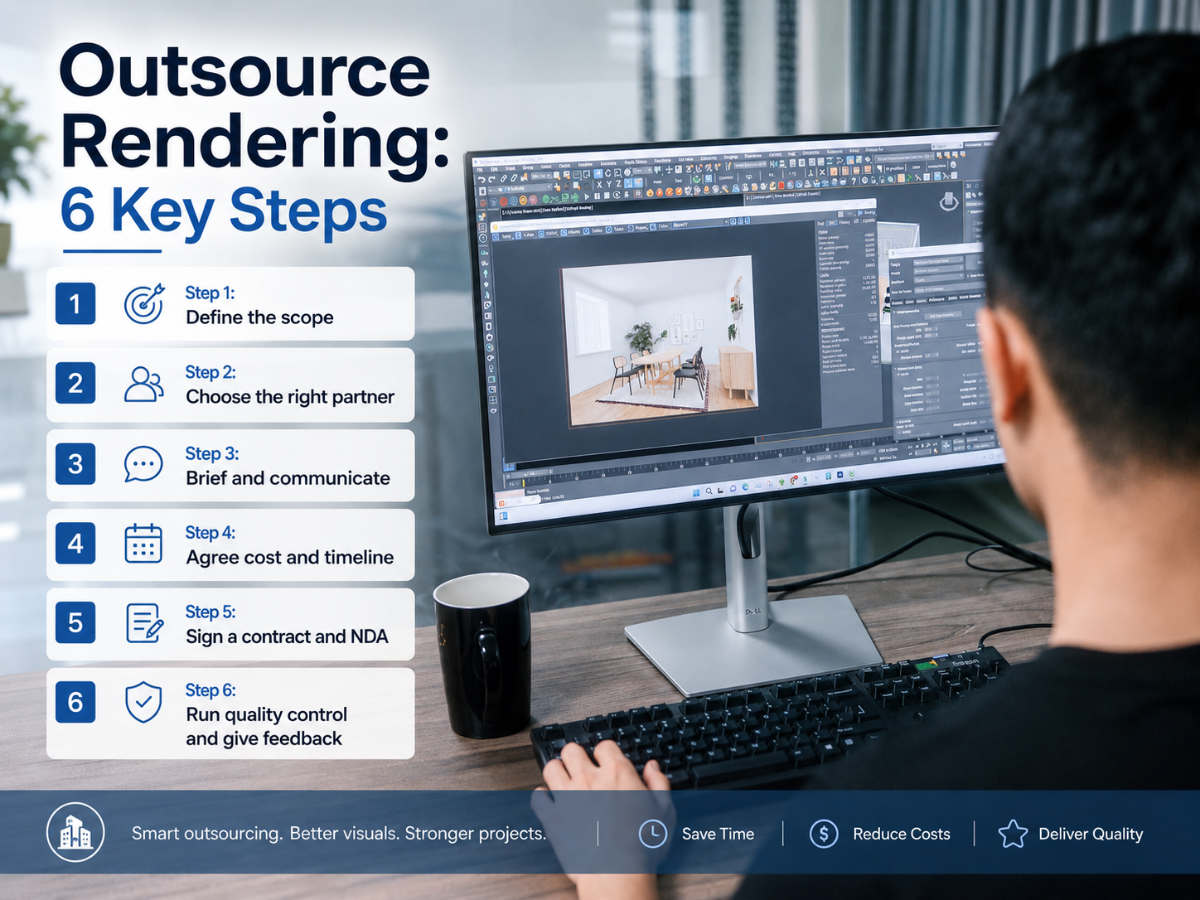
- A reliable process has six stages: define scope, choose a partner, brief and communicate, agree cost and timeline, sign a contract and NDA, then run quality control with clear feedback.
- Typical pricing runs roughly $200 - $1,500 per interior render and $500 - $3,000 per exterior, with a high-quality render often taking several days.
- The main trade-offs are less direct control and communication across time zones; a clear brief, a contract, and a small trial project keep quality consistent.
2. Why architects, builders, and developers outsource 3D architectural rendering
Architectural firms outsource 3D rendering because visualization is a specialized craft that rarely justifies a full-time hire, and the economics almost always favor delegation. Rendering isn't an architect's core responsibility; it's demanding, time-consuming, and requires software and hardware unrelated to design work. When you outsource 3D rendering, your architects and designers keep doing what they were hired for while a dedicated team turns their drawings into photorealistic images.
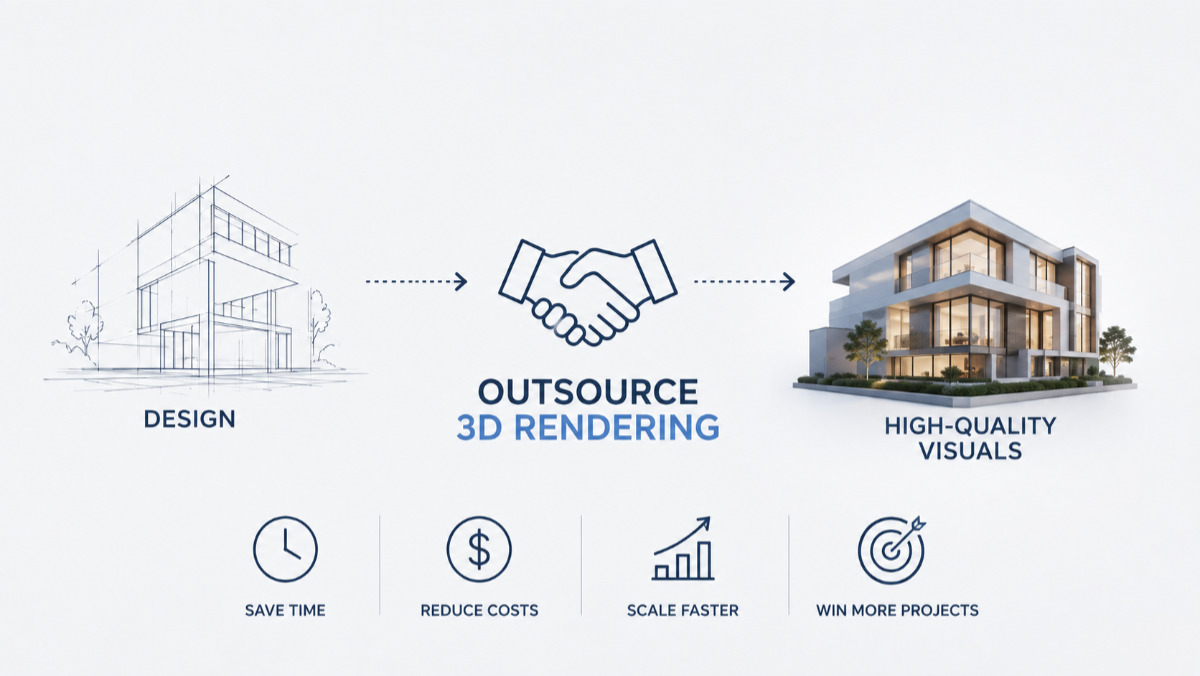
The cost logic is the clearest driver. Employing a full-time 3D artist is a significant salary commitment, and that's before you add a workstation and annual licenses for tools like Autodesk 3ds Max, whose subscription cost alone runs well over a thousand dollars a year per the Autodesk pricing pages. If your order flow is uneven, like a burst of renders at each project launch, then quiet stretches, that fixed overhead sits idle between projects. The 3D architectural rendering outsource approach replaces it with a cost you pay only when you actually need images.
Capacity and expertise round out the case. A studio can throw several artists at a rush job so a large project ships on time, which an in-house team of one simply cannot match. Because new residential construction is a substantial share of the U.S. housing market tracked by the Census Bureau, and builders reported by the National Association of Home Builders market much of that inventory before it's built, the demand for fast, high-quality renders is relentless — and specialists who render all day simply produce better work than a generalist squeezing it in between design tasks.
The firms that benefit most from a 3D architectural rendering outsource partner tend to share a profile: uneven project flow, small teams, and a need for premium visuals only at certain milestones. A boutique architecture practice, a regional home builder, or a real estate marketing team rarely has enough continuous rendering work to keep a full-time artist busy, yet each needs standout images the moment a project launches. Outsourcing fits that rhythm perfectly, and it also lets a small firm punch above its weight, presenting visuals as polished as those of a much larger competitor without the payroll to match.
3. How to outsource 3D architectural rendering: a step-by-step process
Getting great results from a 3D architectural rendering outsourcing partner is mostly about running the process deliberately rather than hoping for the best. The six steps below turn a loose "can you render this?" into a predictable, on-time, on-budget collaboration. Follow them in order and you avoid the two most common failure modes: vague briefs and unmanaged expectations. Treat the first engagement as setting a template you'll reuse, because once a good studio learns your standards, subsequent projects move far faster.
3.1. Step 1: Define the scope
Start by deciding exactly what you need before you contact anyone. Identify the number of renders, whether they're interior or exterior, the level of realism required, and their purpose, client presentation, investor pitch, or MLS marketing. A clear scope lets a studio quote accurately and prevents the scope creep that inflates both cost and timeline later. This is also where you decide which pieces are worth outsourcing versus handling in-house. A written scope, even a one-page list of views and deliverables, becomes the reference point everyone measures the final images against.
3.2. Step 2: Choose the right partner
Vet studios on portfolio, reviews, and relevance to your project type before anything else. Look for past work similar to yours, a studio strong on single-family homes may not excel at a high-rise tower, and assess the realism of their materials and lighting. Check client reviews and how quickly and professionally a project manager responds to your inquiry, since responsiveness predicts how the whole engagement will go. For a first collaboration, a small trial render is the cheapest way to test quality and communication before committing a full package to a reliable 3D architectural rendering company.
3.3. Step 3: Brief and communicate
Give the studio everything it needs to render accurately: architectural drawings and elevations, material and finish schedules, site and landscaping plans, and reference images for the mood you want. Hold a short kickoff to align on goals, deadlines, and specifics, and agree on how you'll communicate: email, a messenger, or the studio's project-management system. The more precise the brief, the fewer revision rounds you'll pay for, and understanding the different types of 3D rendering helps you request exactly the right deliverables.
3.4. Step 4: Agree cost and timeline
Lock the price and schedule in writing before work begins to avoid surprises and hidden fees. A straightforward project can be quoted in the first conversation; a complex one may need a day or two for the studio to scope. Be wary of a quoted turnaround that sounds too fast, because genuine photorealism takes time; a single high-quality render commonly takes several days. Agree how many revision rounds are included so later changes don't blow the budget.
3.5. Step 5: Sign a contract and NDA
Formalize the engagement with a contract covering cost, deadlines, revision policy, and deliverables, plus a non-disclosure agreement if your designs are confidential. An NDA protects your patented or copyrighted designs and, importantly, stops the studio from publishing your unreleased project in its own portfolio without consent. Reputable studios expect this and assign a project manager to keep the engagement transparent from here on.
3.6. Step 6: Run quality control and give feedback
Stay involved as the render develops rather than waiting for a final image you can't change. Good studios deliver interim drafts, typically a grayscale "clay" render, then a first color pass, then the final, and layer in quality checks from an art director and project manager. Give specific feedback ("the lighting reads too industrial; we want warm evening tones") rather than "I don't like it," note corrections in writing, and only approve the final when it truly matches the brief.
4. Benefits, trade-offs, and what it costs to 3D architectural rendering outsourcing
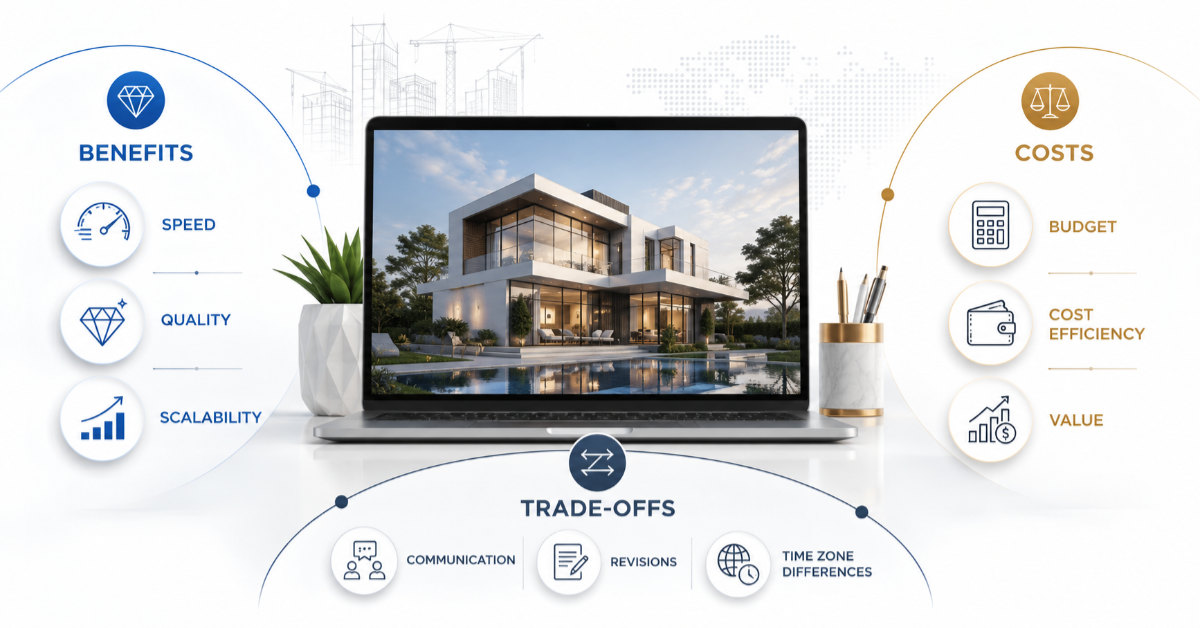
The 3D architectural rendering outsourcing model delivers real, measurable advantages, but it's worth going in with clear eyes about the trade-offs and the price. Understanding both sides lets you set up the engagement to capture the upside while managing the risks, and it keeps your budgeting realistic. Here's the honest balance sheet.
4.1. The benefits
The headline benefit is cost efficiency: you avoid an artist's salary, a workstation, and recurring software licenses, paying instead only for the renders you order. Speed is the next win, since a studio can assign multiple artists to hit a tight deadline and free your own team to keep designing. Scalability follows naturally: 3D construction rendering outsourcing arrangements let a firm take on more projects at once without hiring, flexing output up for a big launch and back down afterward. Finally, you get specialist quality: artists who do nothing but visualization, on powerful hardware, produce more convincing materials, lighting, and composition than a generalist can. Consistency is an underrated part of that quality; a studio that handles all your projects applies the same standard across every image, so your brand looks coherent whether you're marketing a single home or a whole community. Over time, a good partner effectively becomes an on-call visualization department you don't have to manage day to day, absorbing your style preferences and delivering renders that feel unmistakably yours without the cost and supervision an internal hire would demand.
4.2. The trade-offs
The honest downsides are control and communication. With an external team, you have less immediate oversight of every detail, and feedback loops can take longer across time zones, so a rushed comment on Friday might not be actioned until Monday. Quality can also vary between vendors, and an untested studio carries the risk of work that misses your standard. All three risks shrink dramatically with the safeguards above: a clear brief, a contract, an NDA, and a small trial before you commit to a large 3D home builders rendering outsource package.
The time-zone gap is worth planning around rather than fearing, because it can actually work in your favor. Many established studios sit in regions like Southeast Asia and Eastern Europe, where a brief sent at the end of your workday is worked on overnight and waiting for you the next morning, effectively extending your production day. The trick is to batch feedback into clear, complete rounds instead of drip-feeding comments, and to use a shared project board or CRM so everyone sees the same status. Handled that way, distance becomes a scheduling advantage instead of a friction point.
Data security deserves a mention too. Handing designs to an outside team introduces a small risk of misuse, which is precisely what the contract and NDA exist to contain. Work only with studios that have a track record and references, keep your own secure backups of source files, and clarify up front that your project won't appear in anyone's portfolio without written consent. These are routine steps for professional studios and shouldn't be a sticking point with a reputable partner.
4.3. What it costs and how long it takes
Pricing is per image and scales with complexity, resolution, and revisions. As a rough guide, interior renders commonly run around $200 to $1,500 each, while exteriors range from about $500 to $3,000, with aerials and animations costing more. Turnaround for a single high-quality still is typically several days rather than hours, so build rendering into your marketing timeline rather than treating 3D architectural rendering outsourcing as a last-minute task. Because everything is priced per render, you can size any package to your budget and the number of unit types you're marketing.
Put those numbers next to the in-house alternative and the case sharpens. A full-time 3D artist's salary runs into six figures in many markets, and that's before a workstation and annual licenses for tools like 3ds Max and a renderer such as Corona or V-Ray. Unless you have a steady, year-round pipeline that keeps that artist busy, the per-project math of a 3D architectural rendering outsource arrangement wins comfortably: a handful of renders per launch, paid for only when you need them, rarely approaches the cost of a salaried hire plus overhead. That's the core reason the outsource model has become the default for all but the largest, highest-volume developers.
4.4. Where Fotober fits into the outsource model
For architects, builders, developers, and visualization studios that need additional production capacity, Fotober can work as an external rendering team rather than simply a one-off vendor. The workflow can begin with architectural drawings, CAD files, floor plans, sketches, material references, and preferred camera angles, which are then developed into finished interior or exterior visuals through modeling, texturing, lighting, rendering, and post-production. This makes Fotober particularly useful for firms that want to keep design direction and client communication in-house while outsourcing the production-heavy part of the visualization process.
The main advantage is flexibility. Instead of adding permanent staff and hardware every time project volume increases, a 3D architectural rendering outsourcing partner such as Fotober lets a studio scale production according to its current workload, from a few marketing images for a single property to larger batches for developments with multiple unit types or viewpoints. A staged review process also allows feedback to be handled before the final high-resolution output, helping keep materials, lighting, composition, and architectural details aligned with the original brief.
Fotober can also support recurring production for firms that need a more consistent long-term workflow. Over time, sharing the same reference standards, preferred styles, file structure, and feedback process can reduce briefing time and make outsourced production feel more like an extension of the internal team. For companies considering outsourcing for the first time, starting with a small test project is a practical way to evaluate communication, visual quality, revision handling, and overall fit before moving larger volumes of work.
5. Frequently asked questions about 3D architectural rendering outsource
Q: What does it cost to outsource 3D architectural rendering?
A: Pricing is per image and depends on complexity, resolution, and revisions. Interior renders commonly run roughly $200–$1,500 and exteriors about $500–$3,000, with aerials and animations higher. Because it's per render, you can scale a package to your budget and the number of views you need.
Q: How long does an outsourced render take?
A: A single high-quality still typically takes several days, not hours, moving through a clay draft, a color pass, and a final. Be cautious of studios promising near-instant turnaround, since genuine photorealism takes time. Studios can assign multiple artists to speed up large jobs.
Q: How do I choose a rendering studio?
A: Review the portfolio for work similar to your project, read client reviews, and judge how quickly and professionally the project manager responds. Confirm turnaround, revision policy, and whether they sign an NDA. A small trial render is the safest way to test quality before committing.
Q: Is outsourcing cheaper than hiring an in-house 3D artist?
A: For most firms, yes. An in-house artist means a full salary plus a workstation and recurring software licenses, which only pays off with constant work. The outsource model converts that fixed cost into a per-project expense, so you pay only when you have renders to produce.
Q: How do I protect my designs when outsourcing?
A: Sign a contract and a non-disclosure agreement before sharing files. The NDA protects your copyrighted designs and prevents the studio from displaying your unreleased project publicly. Work only with reputable studios and keep source files backed up securely.
6. Conclusion: outsource smart, and let your team design
The 3D architectural rendering outsourcing model works because it matches a specialized, bursty need with a flexible, specialized supply; you get premium visuals exactly when a project demands them, without carrying an artist, a workstation, and software licenses year-round. The firms that get the most from it aren't the ones chasing the lowest price; they're the ones who define scope clearly, vet a partner properly, and manage the brief and feedback with discipline. Do that, and outsourcing consistently beats in-house on cost, speed, and quality. Approached with a little discipline, a 3D architectural rendering outsourcing relationship stops being a one-off transaction and becomes a dependable extension of your team.
Fotober is built for exactly this. As a rendering partner for architects, home builders, and developers, we turn your drawings into photorealistic exteriors, interiors, aerials, and floor plans, including a polished photorealistic rendering of a modern house, with per-image pricing, clear timelines, and dedicated artists who hold your style across a whole project. Send us your next set of plans and see the difference place an order or start a free trial today.
Connect with Fotober
- Facebook: fotobermedia.co
- YouTube Channel: Fotober
- TikTok Channel: @fotober
- Instagram: fotober_media
- Email support: [email protected]
- Hotline: +84 942 110 297
Related posts

Modern Luxe Interior Design: Elements, Style Guide and How to Stage It
October 10, 2026

Minimalist Interior Design: Characteristics, Style Guide, and Staging
October 8, 2026

Coastal Interior Design: Style Definition & Staging Guide
September 30, 2026

Contemporary Interior Design: Key Elements and How to Stage This Style
September 30, 2026
