




The Impact of War on Housing Pricing in the U.S


Share:
Table of Contents
- 1. How war impacts housing pricing globally
- 2. The Syria war and housing market effects (2011–2025)
- 3. The Ukraine war and U.S. housing pricing trends (2022–2026)
- 4. The Iran conflict and the 2026 U.S. housing market slowdown
- 5. U.S. housing pricing forecast during future geopolitical conflicts
- 6. How real estate professionals are adapting to war-driven market shifts
- Conclusion
The impact of war on housing pricing has become one of the most important economic discussions in today’s real estate market. Global conflicts are no longer isolated political events that only affect governments or international trade. In an increasingly interconnected economy, wars now influence inflation, energy prices, supply chains, mortgage rates, migration trends, and ultimately housing affordability itself. Over the past decade, conflicts in Syria, Ukraine, and Iran have demonstrated how geopolitical instability can reshape investment behavior and housing markets worldwide, particularly in the United States.
1. How war impacts housing pricing globally
Modern housing markets react to geopolitical instability much faster than they did decades ago. Financial markets, commodity prices, and investor sentiment are now deeply interconnected, meaning wars can influence local housing conditions even when conflicts occur thousands of miles away.
1.1. Energy shocks and mortgage rate increases
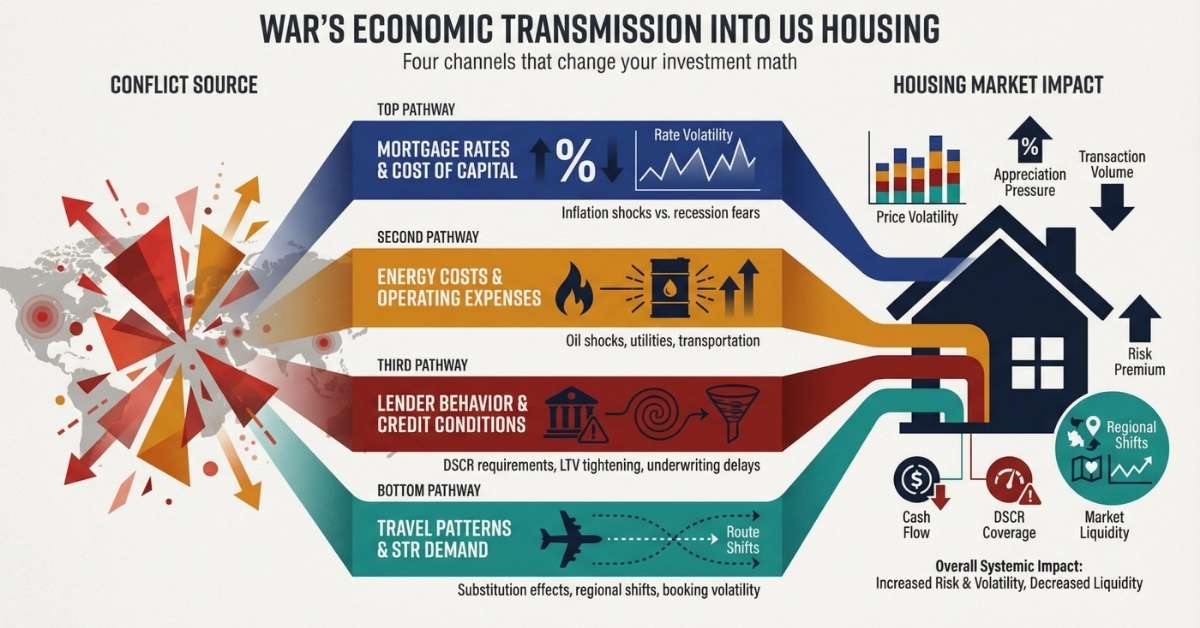
One of the most immediate ways wars affect housing prices is through energy markets. Conflicts involving oil-producing regions or critical shipping routes often trigger rapid increases in global fuel prices. When oil becomes more expensive, transportation, manufacturing, and utility costs rise across nearly every industry. This contributes directly to inflation, which then forces central banks to respond with higher interest rates.

The mortgage affordability
The U.S. housing market is especially sensitive to interest rate changes because mortgage affordability plays a major role in buyer activity. Even relatively small increases in mortgage rates can significantly reduce purchasing power. For example, a buyer who could comfortably afford a $750,000 home at a 5% interest rate may suddenly qualify for a substantially lower-priced property if rates increase above 6.5%. This pattern became highly visible after the Russia–Ukraine conflict began in 2022. Energy prices surged globally, inflation accelerated, and the Federal Reserve responded aggressively with interest rate hikes. Mortgage rates climbed to levels not seen in years, causing many buyers to pause purchasing decisions or reduce their budgets.
The same concerns reappeared during the 2026 Iran-related tensions, where fears surrounding oil transportation disruptions immediately affected financial markets. These situations clearly illustrate the impact of war on housing pricing, particularly through the relationship between inflation and borrowing costs.
1.2. Investor fear and safe-haven real estate markets
Wars also reshape global investment behavior. During periods of geopolitical instability, investors tend to move capital away from volatile regions and into markets perceived as safer and more stable. Historically, the United States has remained one of the world’s largest safe-haven real estate markets.
This trend becomes especially visible in luxury housing sectors. International investors often purchase high-end real estate in cities such as Miami, New York, Los Angeles, and Austin as a form of long-term wealth preservation during uncertain periods. In highly competitive luxury markets, premium listing presentation has also become increasingly important, especially through services such as virtual staging and cinematic property visualization. Unlike traditional homebuyers, many of these investors rely less on financing and are therefore less affected by rising mortgage rates. As foreign capital enters U.S. real estate markets, housing prices in premium areas can remain elevated even when domestic demand slows. In some cases, this additional investment activity creates affordability pressure for local buyers who are already facing higher borrowing costs.
The psychological aspect of investing also matters. During geopolitical uncertainty, tangible assets such as real estate are often viewed as more secure than volatile stock markets or unstable currencies. This continued demand can prevent large price declines in certain housing sectors despite broader economic slowdowns.
1.3. Supply chain disruption and construction cost inflation
Housing markets depend heavily on global supply chains, and wars frequently disrupt them. Construction materials such as steel, aluminum, copper, lumber, and fuel are all vulnerable to geopolitical instability. When conflicts interfere with production or transportation, development costs increase quickly.
Following the Russia–Ukraine war, global steel and energy prices rose sharply. Builders in the United States faced increased costs for materials, shipping, and labor. Many developers were forced to delay projects, reduce construction activity, or raise home prices to protect profitability. Supply chain disruptions also extended construction timelines. Projects that once took 12 months to complete often required significantly longer due to material shortages and logistical delays. This reduced the pace of new housing inventory entering the market at a time when demand remained relatively strong.
The result was a market imbalance where limited inventory continued supporting home prices despite weaker affordability conditions. In many regions, supply shortages prevented the dramatic price corrections some analysts initially expected. This demonstrates how the impact of war on housing pricing often extends beyond short-term economic reactions. Even temporary disruptions can create long-lasting inventory problems that affect affordability for years.
Read more: How Fed rate cuts affect home buyers in 2026
2. The Syria war and housing market effects (2011–2025)
The Syrian civil war became one of the clearest examples of how prolonged conflict can completely destabilize housing systems. While the direct destruction occurred within Syria, the broader economic and migration effects spread far beyond the region.
2.1. How the Syrian civil war collapsed local housing markets
The Syrian civil war caused catastrophic damage to residential infrastructure. Entire neighborhoods were destroyed, millions of homes became uninhabitable, and large urban areas lost basic public services. In many cities, the traditional housing market effectively stopped functioning. Property values collapsed in conflict-heavy regions because ownership security disappeared. Investors and homeowners were unwilling or unable to maintain real estate assets amid ongoing violence and economic instability. Hyperinflation, unemployment, and currency devaluation further reduced purchasing power and housing demand.

The Syrian civil war
Even properties located outside direct conflict zones suffered major value declines because the broader economic system deteriorated rapidly. Banks weakened, financing options disappeared, and reconstruction efforts faced enormous political and logistical obstacles. One important lesson from Syria is that housing markets rely heavily on long-term confidence. Once trust in political stability and economic security disappears, rebuilding a functioning housing market becomes extremely difficult.
2.2. Refugee migration and European housing demand
The Syrian war also created one of the largest refugee crises in recent history. Millions of displaced individuals moved into neighboring countries and Europe, especially Germany and Turkey. This sudden population growth increased demand for both rental housing and affordable residential units.
In many European cities, local governments struggled to expand housing supply quickly enough to meet rising demand. Rental prices increased, vacancy rates tightened, and affordable housing shortages became more severe. Some urban markets experienced long-term pressure as refugee populations continued growing over time. The migration wave also influenced construction activity and public housing policies. Governments invested more heavily in residential infrastructure, while developers attempted to respond to increased demand in high-growth urban areas.
This situation showed that wars do not only affect housing prices within conflict zones. Migration patterns caused by geopolitical crises can reshape housing demand across multiple countries simultaneously.
2.3. Lessons the U.S. market learned from Syria
Although the United States was geographically distant from the Syrian conflict, the war still influenced American housing discussions in several indirect ways. First, it highlighted how quickly migration and demographic shifts can affect housing supply and affordability. Second, it reinforced the importance of economic stability in maintaining healthy housing markets. Investors increasingly recognized that geopolitical risks could influence global real estate trends more directly than previously assumed.
The Syrian conflict also contributed to broader conversations around labor shortages and immigration-driven workforce changes. Construction industries in several countries became increasingly dependent on migrant labor, making housing development more sensitive to international policy and migration trends.
Over time, these lessons became part of the broader understanding of the impact of war on housing pricing in globally connected economies.
3. The Ukraine war and U.S. housing pricing trends (2022–2026)
The Russia–Ukraine war had one of the most immediate and visible impacts on global housing markets in recent decades. Unlike many previous geopolitical conflicts, its economic consequences spread rapidly through energy markets, inflation, and international investment flows.
The Russia–Ukraine war
3.1. How the Russia–Ukraine war triggered global inflation
When Russia invaded Ukraine in 2022, global commodity markets reacted almost immediately. Europe faced major energy supply concerns because of its dependence on Russian oil and natural gas exports. Fuel prices surged, manufacturing costs increased, and transportation expenses rose globally.
Inflation accelerated across multiple sectors, including food, construction materials, and consumer goods. In response, central banks implemented aggressive monetary tightening policies. The Federal Reserve raised interest rates repeatedly in an attempt to control inflation. These higher interest rates directly affected the housing market. Mortgage rates increased dramatically, reducing affordability for millions of buyers. Monthly payments became substantially more expensive compared to the ultra-low-rate environment during the pandemic years.
Housing activity slowed across many U.S. markets as buyers adjusted to new borrowing conditions. Home sales volume declined, bidding wars became less common, and some overheated markets experienced temporary price corrections. This period became one of the clearest modern examples of the impact of war on housing pricing, particularly because the economic effects spread so quickly across global financial systems.
3.2. Housing markets that benefited from the Ukraine conflict
Despite broader affordability challenges, some U.S. housing markets continued performing strongly during the Ukraine-related economic slowdown. States such as Florida, Texas, Arizona, and Tennessee continued attracting both domestic migration and international capital.
Several factors contributed to this resilience. Lower taxes, strong job growth, warmer climates, and business-friendly environments made these regions attractive to relocating buyers and investors. At the same time, global investors continued viewing American real estate as a relatively stable asset during international uncertainty. Luxury housing markets also remained surprisingly active in some areas. Wealthy buyers often prioritize long-term asset preservation over short-term financing costs, allowing high-end properties to maintain demand even as traditional homebuyers struggled with affordability.
Institutional investors also increased activity in rental housing markets. As mortgage rates climbed, more households delayed homeownership and remained renters for longer periods. This strengthened demand for multifamily developments and single-family rental properties.
3.3. Construction and material shortages after the Ukraine war
One of the most significant long-term effects of the Ukraine war involved construction supply chains. Russia and Ukraine both play important roles in global exports of raw materials used in construction and manufacturing. As sanctions, transportation disruptions, and energy shortages intensified, builders worldwide faced rising costs.
In the United States, developers struggled with increasing prices for steel, concrete, fuel, electrical equipment, and transportation services. Labor shortages also became more severe because inflation increased wage pressure across the construction sector. These conditions reduced the pace of new housing development. Some projects became financially unfeasible under original budgets, forcing developers to delay or cancel construction plans altogether.
The reduced housing supply helped support home prices even as mortgage affordability weakened. In many metropolitan areas, limited inventory continued creating competition among buyers despite slower overall sales activity.
This imbalance reinforced how the impact of war on housing pricing often works through both demand and supply simultaneously. Wars can reduce affordability while also restricting new construction, creating complex market dynamics rather than simple price declines.
4. The Iran conflict and the 2026 U.S. housing market slowdown
Recent tensions involving Iran introduced another wave of uncertainty into the global economy. Unlike some regional conflicts, concerns surrounding Iran carry major implications for global energy transportation and oil pricing.
4.1. Why the Iran war became a housing market issue
The Strait of Hormuz remains one of the world’s most critical oil transportation routes. Any threat to shipping activity in the region immediately affects global energy markets because a large percentage of the world’s oil supply passes through this corridor.

The Strait of Hormuz
As tensions escalated in 2026, oil prices became increasingly volatile. Financial markets reacted quickly, and inflation concerns returned after months of relative stabilization. Mortgage rates began rising again as investors anticipated additional economic pressure. For the U.S. housing market, this created another affordability challenge. Buyers who were already struggling with elevated home prices suddenly faced renewed uncertainty around borrowing costs and living expenses.
Consumer confidence also weakened. During periods of geopolitical instability, households tend to become more cautious about large financial commitments such as home purchases. This slowdown in buyer activity contributed to softer housing demand in several regions.
4.2. Which U.S. housing sectors are most affected
Different housing sectors respond differently to geopolitical instability. Affordable and middle-income housing markets often experience the greatest pressure because these buyers are most sensitive to mortgage rate increases and inflation.
Luxury markets may remain more stable because wealthier buyers typically have stronger financial reserves and lower dependence on financing. However, transaction volume can still slow if investor sentiment weakens significantly. Rental markets often strengthen during uncertain periods. Higher borrowing costs encourage many households to postpone homeownership decisions, increasing demand for apartments and single-family rentals instead.
Suburban housing markets may also react differently compared to urban centers. In some cases, buyers prioritize affordability and move farther from expensive city cores. In other situations, rising fuel prices make long commutes less attractive, strengthening demand in walkable urban areas.
4.3. The relationship between oil prices and home affordability
Oil prices affect housing affordability in multiple ways beyond mortgage rates alone. Higher fuel costs increase commuting expenses, utility bills, construction transportation costs, and household living expenses overall.
When households spend more on gasoline, electricity, and basic goods, they have less financial flexibility for mortgage payments. This reduces purchasing power even if home prices themselves remain stable. Builders also face increased operational costs during periods of high oil prices. Transportation expenses for materials rise, equipment operation becomes more expensive, and supply chain costs increase across the construction industry.
Historically, periods of energy-driven inflation often create housing market slowdowns because affordability weakens across multiple financial categories simultaneously. This relationship continues to demonstrate the impact of war on housing pricing in modern real estate markets.
5. U.S. housing pricing forecast during future geopolitical conflicts
As geopolitical instability becomes more frequent, the housing market is likely to remain increasingly sensitive to global events. Future conflicts may continue influencing housing affordability, investment patterns, and development activity across the United States.
5.1. Will wars continue to push U.S. home prices higher?
Wars do not always increase housing prices directly, but they often create conditions that support long-term price resilience. Rising construction costs and slower development activity frequently limit new housing supply, even when buyer demand weakens.
At the same time, inflation and higher mortgage rates reduce affordability for middle-income households. This combination creates slower transaction activity rather than immediate market crashes in many cases.

US home prices
Institutional investors and foreign capital may also continue supporting certain housing sectors during periods of uncertainty. Real estate remains one of the world’s preferred long-term wealth preservation assets, particularly in stable economies such as the United States.
5.2. States most vulnerable to geopolitical housing shocks
Certain states are more exposed to geopolitical market fluctuations than others. California, Florida, Texas, and Arizona are particularly sensitive because of their large housing markets, migration trends, and foreign investment activity.
Fast-growing metropolitan areas with affordability challenges may experience stronger slowdowns when mortgage rates rise sharply. Coastal luxury markets may also see increased volatility because they rely heavily on international investment flows.
States with strong construction activity may face additional pressure if material shortages or transportation costs increase during future conflicts.
5.3. What buyers, investors, and agents should watch next
Modern housing analysis increasingly includes geopolitical monitoring alongside traditional market indicators. Buyers and investors now pay close attention to oil prices, inflation reports, Federal Reserve policy decisions, and global trade conditions. Inventory levels, construction permits, and migration trends also remain important because supply shortages continue influencing affordability nationwide.
As international instability becomes more economically interconnected, understanding the impact of war on housing pricing will become increasingly important for long-term real estate decision-making.
6. How real estate professionals are adapting to war-driven market shifts
Economic uncertainty changes buyer behavior significantly. As affordability pressures increase and market confidence weakens, real estate professionals must adapt their marketing strategies and presentation quality to remain competitive.

The real estate market
6.1. Why visualization and digital marketing matter more during uncertainty
During uncertain market conditions, buyers become more selective and analytical before making purchasing decisions. Listings with poor presentation quality often struggle to generate attention because buyers want greater confidence before committing to expensive investments.
As a result, visualization technologies such as 3D rendering, virtual staging, cinematic walkthrough videos, and interactive floor plans are becoming increasingly valuable for agents trying to improve online engagement and conversion rates. These tools help properties stand out online and improve emotional engagement with buyers. High-quality visual marketing also reduces uncertainty for remote buyers and investors who may not be able to visit properties immediately. This has become especially important in globally connected real estate markets where international investment remains active.
The growing emphasis on presentation quality reflects another dimension of the impact of war on housing pricing. In slower and more competitive markets, trust and perception become major factors influencing buyer behavior.
6.2. How agencies are using data-driven real estate marketing
Modern real estate agencies increasingly rely on analytics and predictive tools to navigate uncertain markets. AI-powered pricing analysis, demographic tracking, migration data, and buyer behavior monitoring all help agencies adapt more quickly to changing economic conditions.
Digital advertising strategies have also evolved significantly. Agencies now focus heavily on targeted campaigns, relocation marketing, investor outreach, and hyper-local market positioning rather than relying solely on traditional listing exposure. Data-driven marketing helps agents communicate market conditions more clearly while building trust with buyers and sellers. In an environment shaped by inflation, mortgage volatility, and geopolitical uncertainty, accurate information becomes a competitive advantage.
Conclusion
Global conflicts now influence the housing market more directly than ever before. From Syria’s housing collapse to Ukraine-driven inflation and Iran-related oil volatility, wars continue reshaping mortgage affordability, construction costs, investor behavior, and migration patterns worldwide.
The United States remains one of the world’s strongest real estate markets, but it is increasingly connected to international economic risk. Mortgage rates, construction supply chains, and housing demand are no longer influenced solely by domestic conditions. As geopolitical instability continues affecting the global economy, understanding the impact of war on housing pricing will become essential for buyers, investors, developers, and real estate professionals alike. Those who can adapt to changing economic conditions and recognize the relationship between global events and local housing markets will be better positioned to navigate future real estate cycles.
- Facebook: fotobermedia.co
- YouTube Channel: Fotober
- TikTok Channel: @fotober
- Instagram: fotober_media
- Email support: [email protected]
- Hotline: +84 942 110 297
Related posts

Modern Luxe Interior Design: Elements, Style Guide and How to Stage It
October 10, 2026

Minimalist Interior Design: Characteristics, Style Guide, and Staging
October 8, 2026

Coastal Interior Design: Style Definition & Staging Guide
September 30, 2026

Contemporary Interior Design: Key Elements and How to Stage This Style
September 30, 2026
