




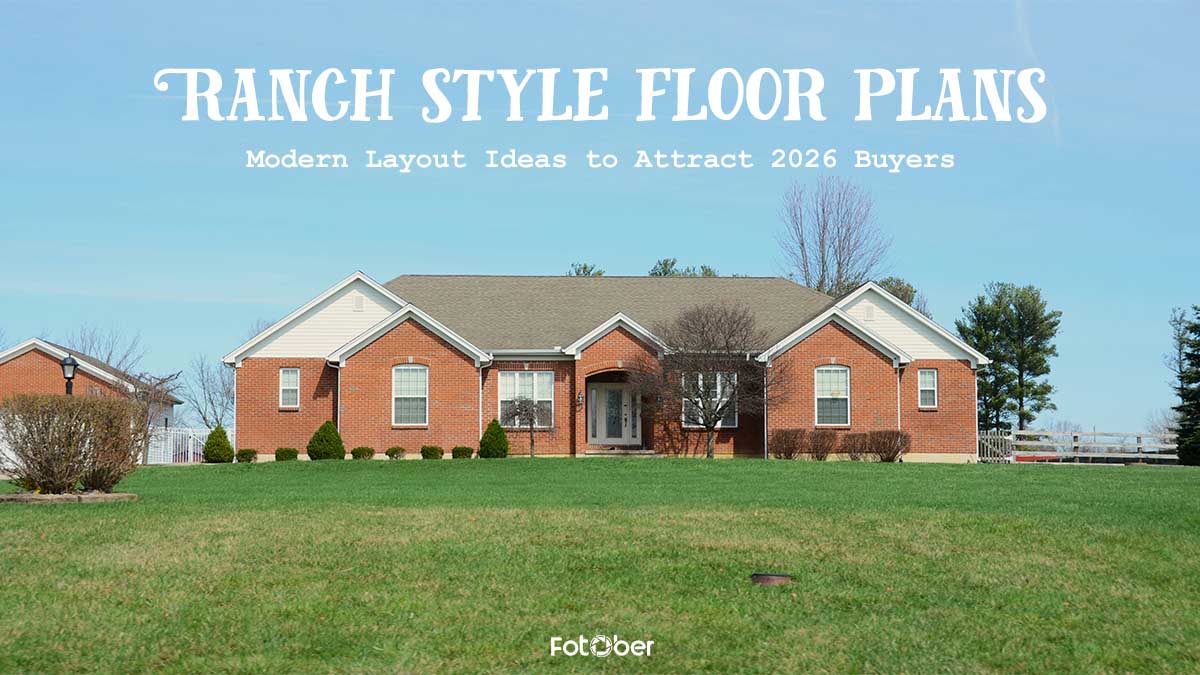
Ranch Style Floor Plans: Modern Layout Ideas to Attract 2026 Buyers

Share:
Table of Contents
- 1. Why ranch style floor plans have remained popular for decades
- 2. Core characteristics of ranch style floor plans
- 3. Key essential components of a ranch house layout
- 4. Ranch style vs. farmhouse floor plans: What’s the difference?
- 5. Exploring the main types of ranch-style floor plans
- 6. Top ranch house layout ideas for today’s homeowners
- 7. How to choose the right ranch style floor plan for your lot and lifestyle
- 8. Real estate use case: Selling the modern ranch home lifestyle
- 9. How Fotober’s floor plan services help homebuilders, buyers, and realtors
- 10. Conclusion
The classic American ranch house is experiencing a major renaissance in 2026 as a top choice for modern homeowners. Known for its sprawling, horizontal silhouettes, ranch style offers an unparalleled blend of accessibility and contemporary elegance. In this guide, we will dive into the core elements of ranch-style floor plans and demonstrate how professional floor plan rendering can elevate these properties, helping you visualize potential and maximize market value.
If you’re looking for a brief overview, most ranch-style residential properties share these five signature characteristics:
- Single-story living: A complete lack of stairs, making the entire home accessible on one level.
- Horizontal silhouette: A long, low-profile footprint that stretches across the lot rather than building upward.
- Open-concept layouts: Interior spaces where the kitchen, dining, and living areas flow together without restrictive walls.
- Low-pitched roofs: Typically featuring wide eaves to provide shade and protection for the home's exterior.
- Indoor-outdoor connection: Large picture windows and sliding glass doors that lead directly to a backyard patio or central courtyard.
1. Why ranch style floor plans have remained popular for decades
Originating in the 1930s across the American Southwest, heavily inspired by Spanish colonial architecture and informal Western living, ranch architecture exploded during the post-World War II suburban boom. Its unpretentious charm, practical layout, and functional simplicity captured the essence of mid-century suburban expansion, establishing a timeless design philosophy that continues to thrive nearly a century later.
One of the primary reasons ranch-style floor plans maintain their dominance is universal accessibility. Because single-story ranch floor plans completely eliminate interior stairs, they offer a safer, barrier-free living environment tailored to every stage of life. Young families with toddlers avoid stair safety hazards, while older adults seeking a home for long-term residency can comfortably age in place without navigating steep staircases or sacrificing floor space.
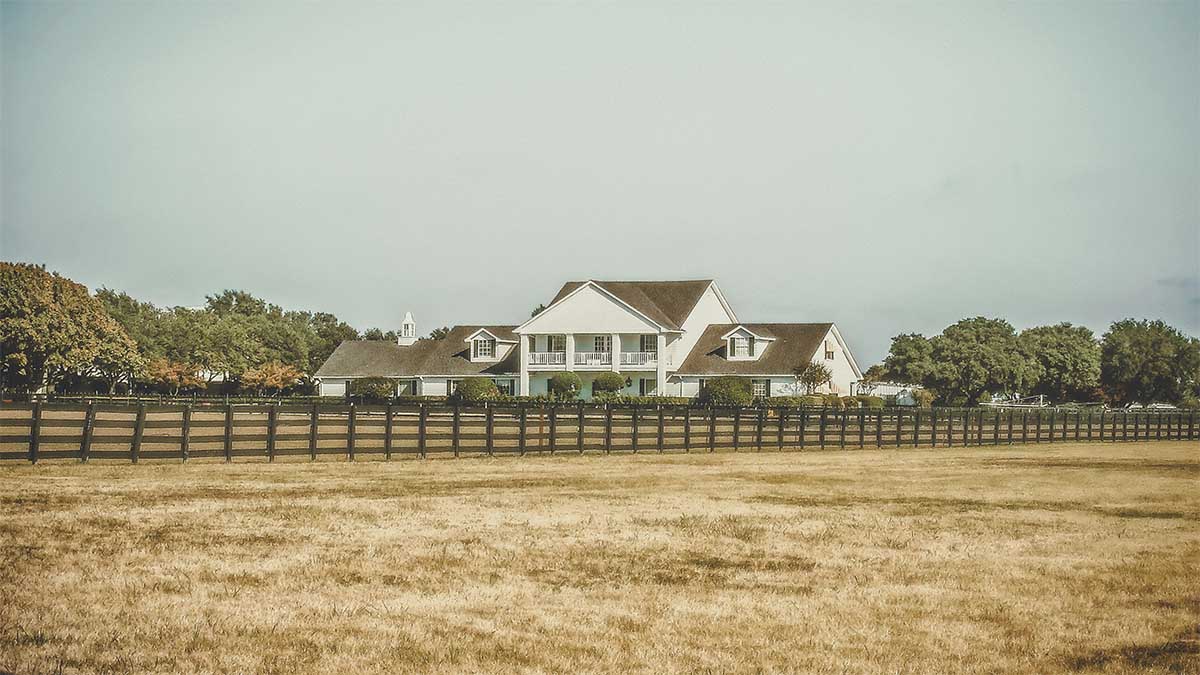
Additionally, ranch homes master the art of indoor-outdoor integration. Designed with low-slung rooflines, expansive windows, and wide sliding glass doors, these layouts naturally invite abundant sunlight and encourage a seamless transition between indoor living areas and outdoor spaces like backyards, covered decks, or central courtyards. This organic connection to nature remains a highly sought-after feature for modern lifestyles.
Finally, ranch architecture offers unmatched structural adaptability. Thanks to their simple horizontal footprints and straightforward framing, ranch homes are remarkably easy to renovate or expand over time. Homeowners can effortlessly remove non-load-bearing walls to create open-concept spaces, convert attached garages into guest suites or home offices, or add room extensions onto expansive lots. This inherent versatility ensures that a ranch floor plan can gracefully evolve alongside changing family needs, lifestyle trends, and real estate market demands.
2. Core characteristics of ranch style floor plans
While ranch style floor plans come in various architectural regional variations, they all share a distinct set of structural and aesthetic defining traits. At first glance, the most recognizable hallmark of ranch architecture is its single-story profile and sprawling horizontal orientation. Unlike multi-story homes that emphasize vertical height, ranch layouts stretch outward, parallel across wide building lots to maximize ground-level footprint and accessibility.
Complementing this grounded footprint are low-pitched gable or hip rooflines featuring wide, deep eaves. These extended overhangs serve both aesthetic and functional purposes, casting soft architectural shadows while shielding windows and exterior walls from harsh direct sunlight, heavy driving rain, and natural thermal exposure.
Inside, the heart of a modern ranch home is defined by an open ranch floor plan design. By minimizing non-load-bearing interior walls between major gathering areas, the kitchen, dining room, and great room blend effortlessly into one continuous, bright, and expansive central hub. This open-concept design enhances internal foot traffic flow, maximizes natural light distribution, and creates an ideal atmosphere for entertaining guests or staying connected with family members throughout the day.
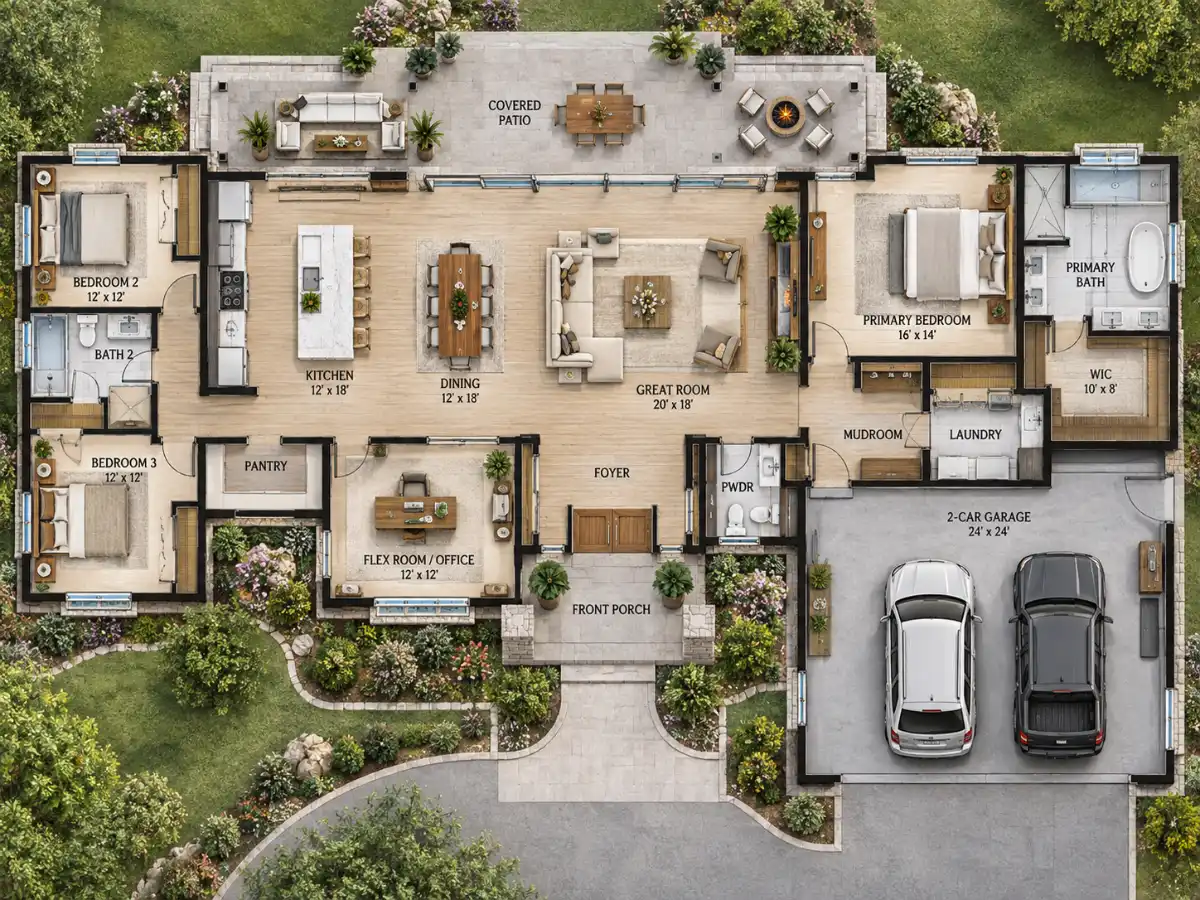
Another essential characteristic is the direct physical connection to outdoor living spaces. Large sliding glass doors, picture windows, and French doors frequently line the rear facade, granting immediate access to back patios, central courtyards, decks, or surrounding gardens.
Finally, ranch homes almost universally incorporate an attached one-to-three-car garage. Integrated smoothly into the front or side elevation, the garage provides convenient, weather-protected entry directly into the home's mudroom, pantry, or primary living zone.
3. Key essential components of a ranch house layout
A well-designed ranch floor plan relies on thoughtful spatial organization to maximize comfort, convenience, and daily living efficiency on a single level. While individual architectural styles may vary, all functional ranch-style floor plans incorporate four key structural components that define their exceptional usability.
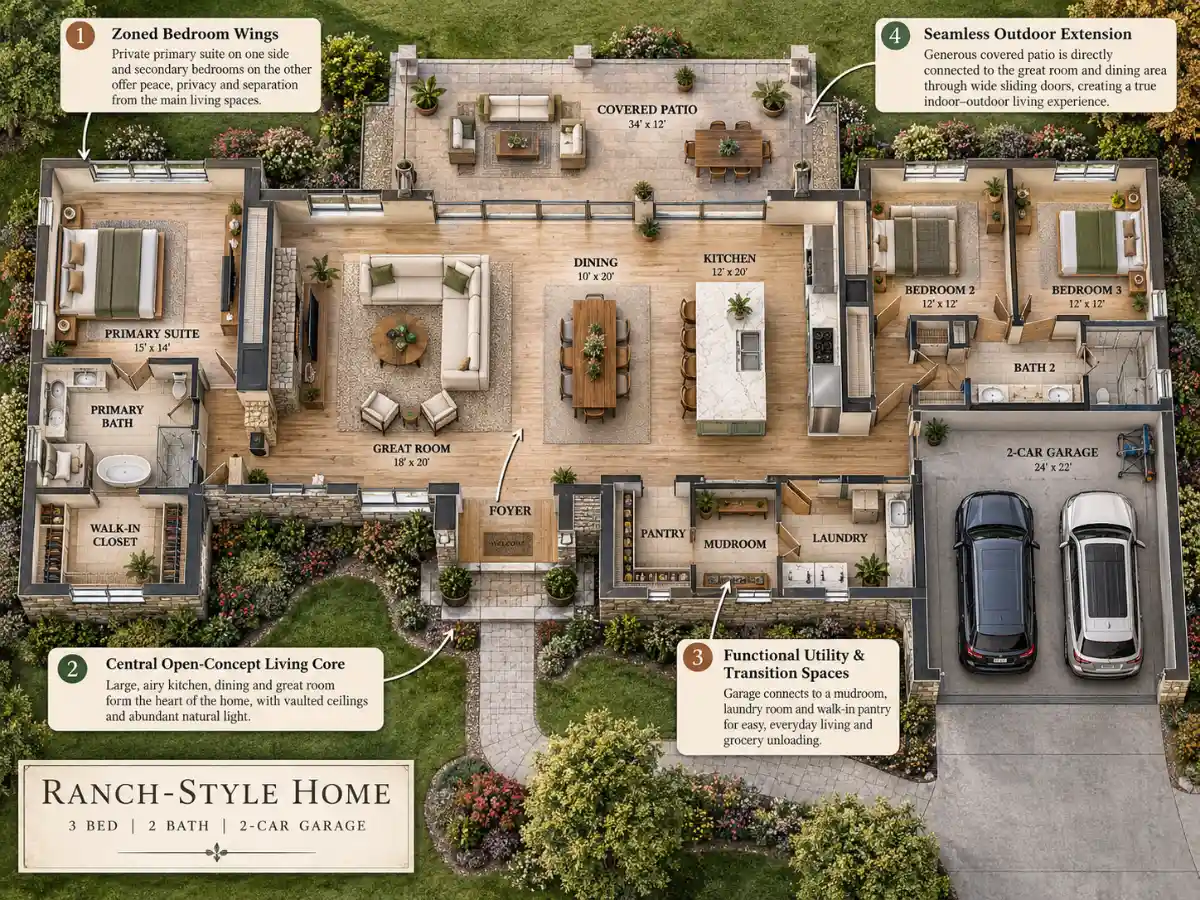
3.1. Zoned bedroom wings (Private vs. public separation)
One of the greatest strengths of a ranch layout is deliberate spatial zoning. Architecturally, the plan is usually divided into distinct functional wings: a public active zone for social gatherings and a quiet private wing for rest. By grouping bedrooms along a dedicated wing away from the main entryway and kitchen, family members enjoy enhanced privacy, sound dampening, and undisturbed sleep.
3.2. Central open-concept living core
At the heart of every ranch house sits an expansive central hub uniting the kitchen, dining space, and great room into one cohesive continuous space. Often featuring vaulted or cathedral ceilings, this open-concept core facilitates seamless social interaction, keeps family members connected during daily routines, and eliminates tight corridors to create a bright, airy atmosphere filled with natural light.
3.3. Functional utility & transition spaces
Because ranch homes prioritize practical ground-floor living, functional utility zones are seamlessly integrated into the blueprint. A typical layout features a dedicated mudroom and laundry room positioned directly at the transition point between the attached garage and the main interior. This drop-zone keeps everyday clutter, wet shoes, and outerwear contained, while an adjoining walk-in pantry provides effortless grocery unloading and storage.
3.4. Seamless outdoor extension spaces
A ranch layout is incomplete without dedicated outdoor living zones that act as direct extensions of the interior footprint. Covered patios, screened lanais, wraparound decks, or central courtyards, accessible via wide sliding or French doors, extend the living space outward, offering sheltered environments for alfresco dining, morning coffee, and outdoor entertaining year-round.
4. Ranch style vs. farmhouse floor plans: What’s the difference?
Ranch and farmhouse designs stand among the most sought-after architectural choices in modern residential construction, both prized for their relaxed aesthetics and family-centric layouts. While these two styles are often grouped due to their shared warmth and functional appeal, distinct structural features, visual lines, and spatial philosophies differentiate them.
|
Architectural feature |
Ranch-style floor plans |
Farmhouse floor plans |
|
Roof profile & pitch |
Low-pitched gable or hip roofs with wide, deep overhangs |
Steeply pitched gables with high rooflines and prominent dormers |
|
Vertical height & levels |
Exclusively single-story, sprawling horizontal footprint |
Typically 1.5 to 2 stories, utilizing a more compact footprint |
|
Outdoor living focus |
Rear-facing patios, central courtyards, or sliding glass door access |
Iconic, expansive wrap-around or covered front porches |
|
Exterior cladding |
Horizontal lap siding, brick, stone veneer, and low accents |
Vertical board and batten, white siding with dark trim accents |
|
Spatial organization |
Open-concept central hub with distinct horizontal bedroom wings |
Formal entry foyers, cozy defined spaces, or semi-open zones |
The fundamental distinction between the two styles lies in vertical orientation and outdoor design orientation. Ranch-style floor plans prioritize low-profile, single-level living that stretches outward across the width of a lot. This horizontal layout creates an effortless, private connection between interior living areas and backyard patios or courtyards. In contrast, modern and traditional farmhouse plans draw inspiration from historic multi-story agricultural homesteads, emphasizing vertical height, higher roof slopes, and strong curb appeal centered around welcoming front porches.
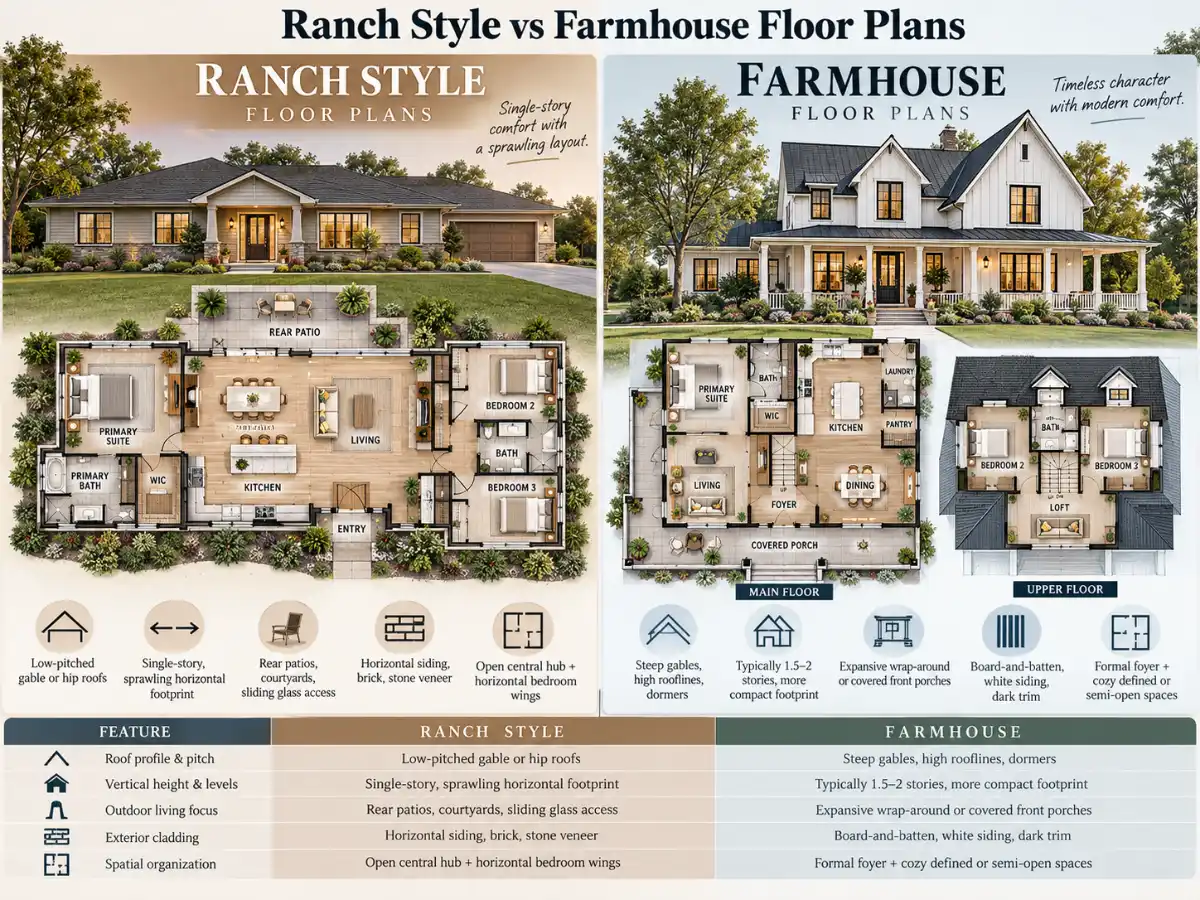
Choosing between these iconic styles comes down to lot dimensions, mobility preferences, and lifestyle needs. If your goal is stair-free accessibility, seamless single-story traffic flow, and a modern indoor-outdoor living experience focused on backyard privacy, a ranch floor plan is the superior choice. If you prefer distinct vertical zoning between public living areas and upstairs bedrooms alongside classic country charm, a farmhouse plan may be the better fit.
5. Exploring the main types of ranch-style floor plans
Over the decades, ranch architecture has evolved into several distinct variations to adapt to diverse topographies, regional aesthetic preferences, and modern lifestyle demands. Understanding these primary types helps homeowners, builders, and buyers select or design the ideal ranch style floor plans for their unique lot characteristics and spatial needs.
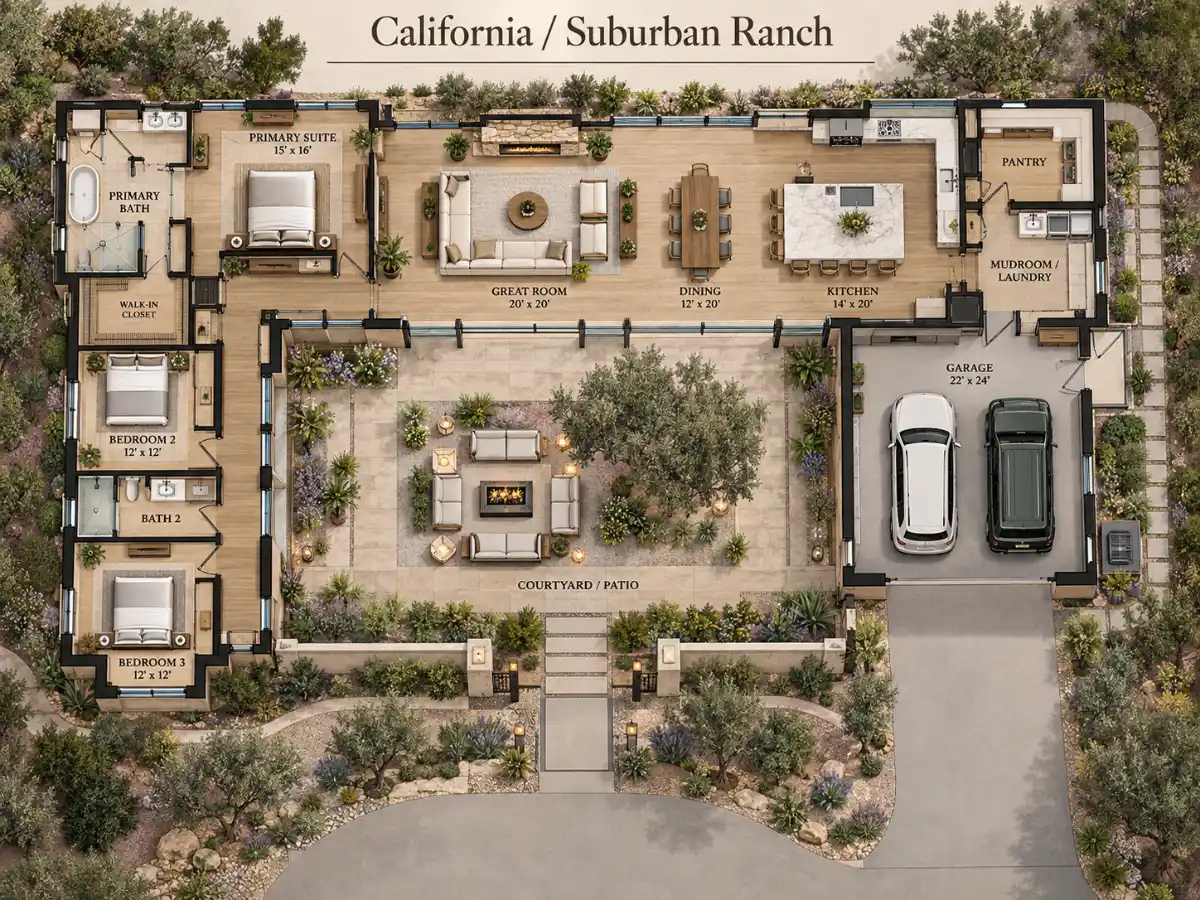
5.1. California / suburban ranch
Pioneered in the 1930s by visionary architects like Cliff May, the California ranch is the definitive archetype of classic single-story living. Designed around an L-shaped or U-shaped footprint, this layout wraps organically around a central backyard patio, courtyard, or swimming pool. Large glass sliding doors and full-height windows line the interior perimeter, effortlessly blending indoor living areas with outdoor entertainment zones to define the modern indoor-outdoor lifestyle.
5.2. Split-level ranch
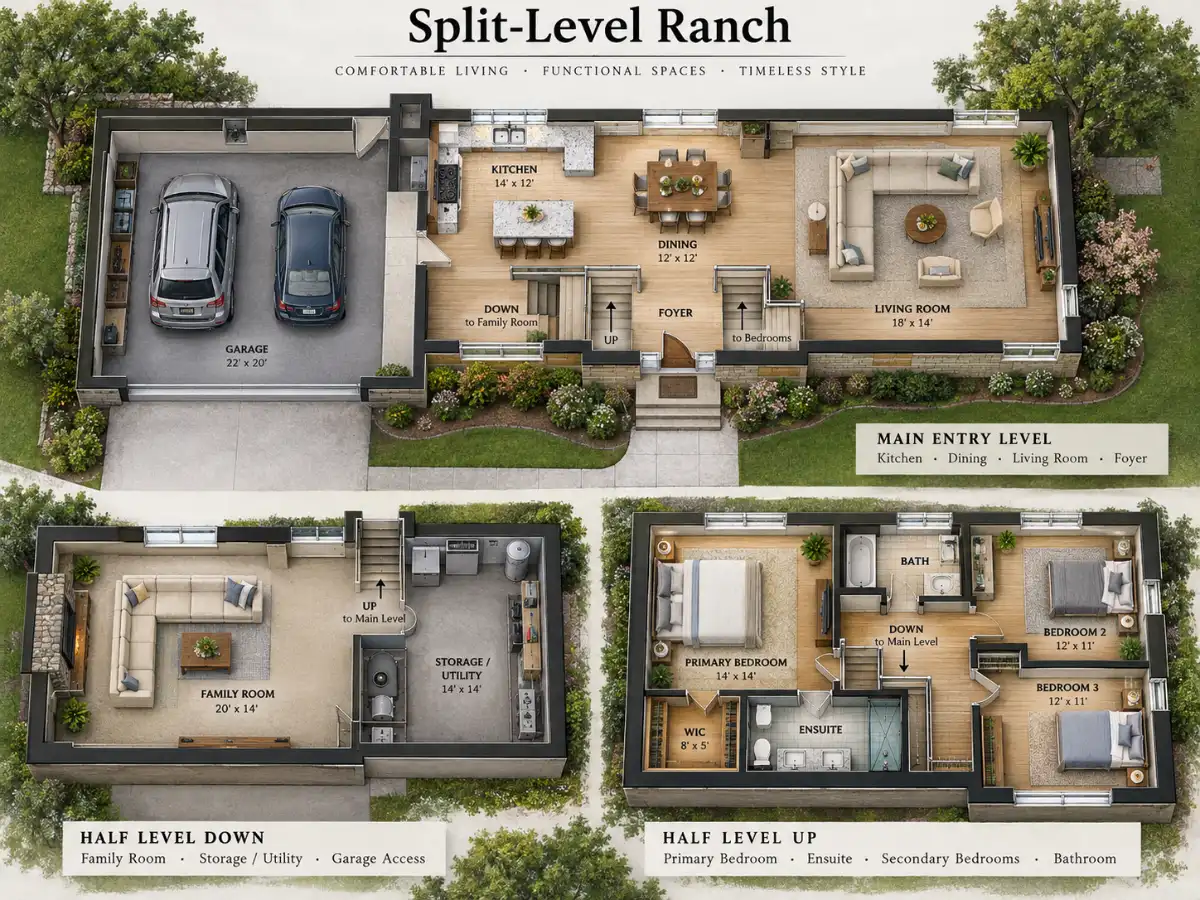
Popularized during the mid-20th century to accommodate sloped or uneven building lots, the split-level ranch breaks the traditional single-level plane into staggered living zones. Connected by short flights of half-stairs, the main entry level typically houses the kitchen, living room, and dining area, while bedrooms are elevated half a story above for added privacy, and lower-level family rooms or garages sit half a story below.
5.3. Raised ranch (High-ranch)
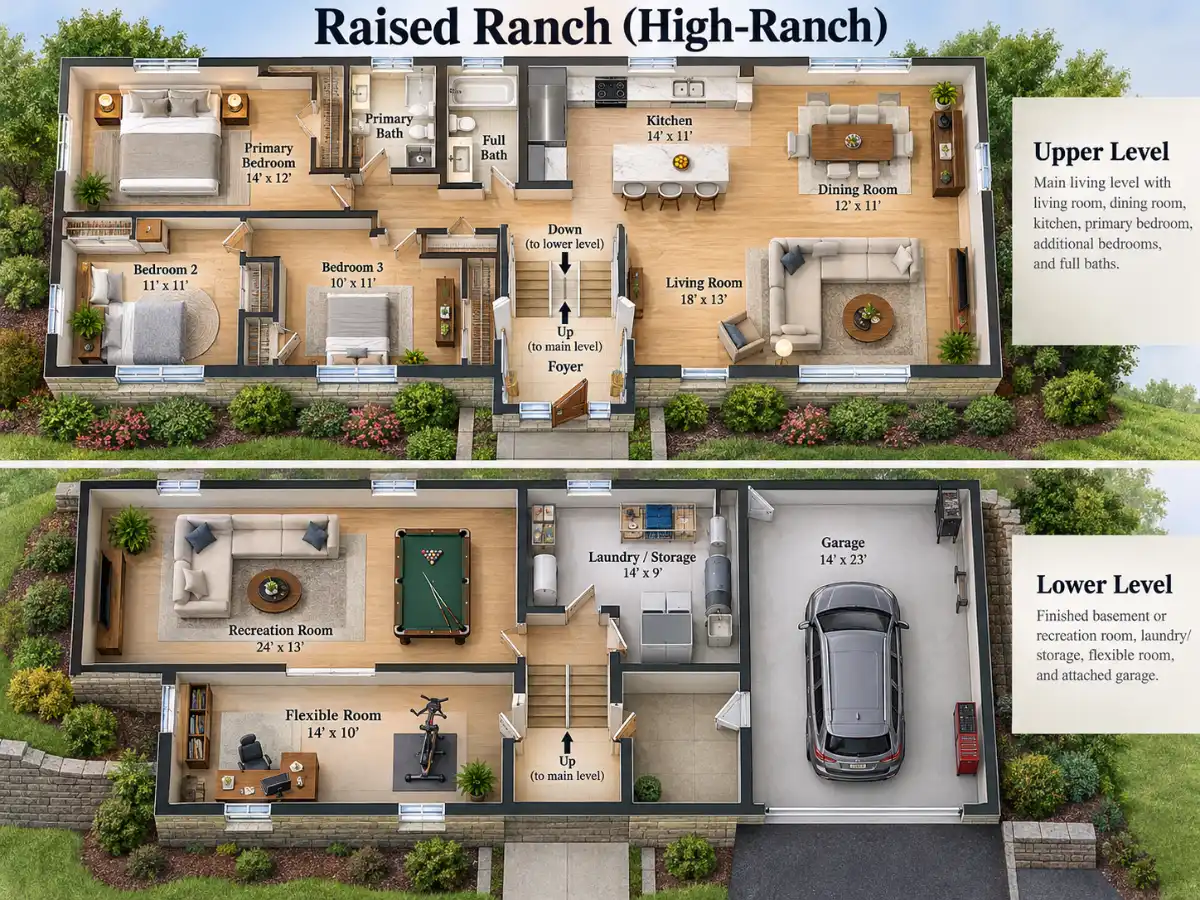
Featuring two full levels of living space anchored by a dedicated split-foyer entrance, raised ranch floor plans offer maximum efficiency for narrower lots. Upon entering the front foyer, visitors immediately navigate either an upper staircase leading to the primary living quarters, kitchen, and bedrooms, or a lower staircase descending to a finished basement, garage, or flexible recreation room.
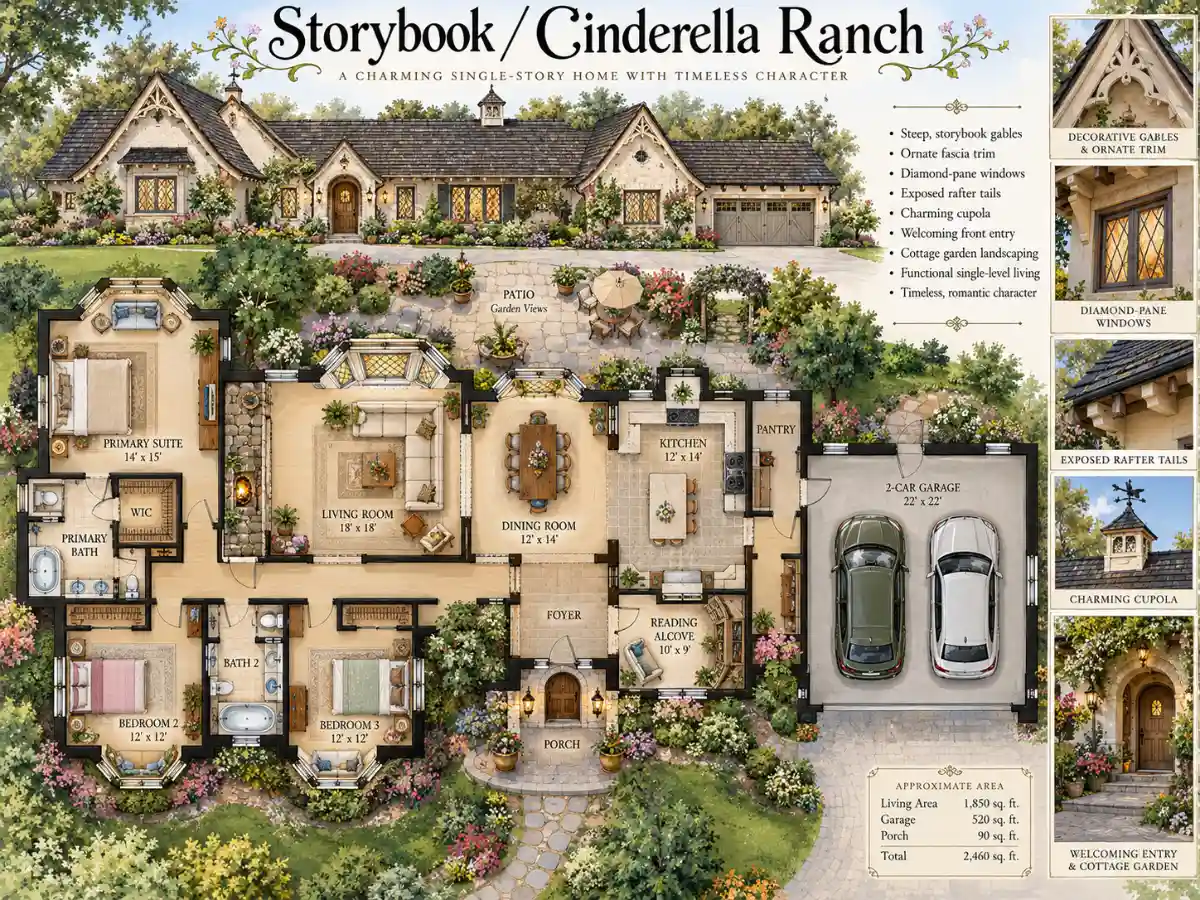
5.4. Storybook / Cinderella ranch
A charming, whimsical variation that gained widespread popularity during the 1950s suburban boom, Storybook ranches infuse traditional single-story layouts with romantic architectural details. Hallmarks include steep decorative gables, ornate fascia trim, diamond-pane windows, decorative cupolas, and exposed rafters, delivering fairytale curb appeal while retaining the functional, low-maintenance living of a standard ranch layout.
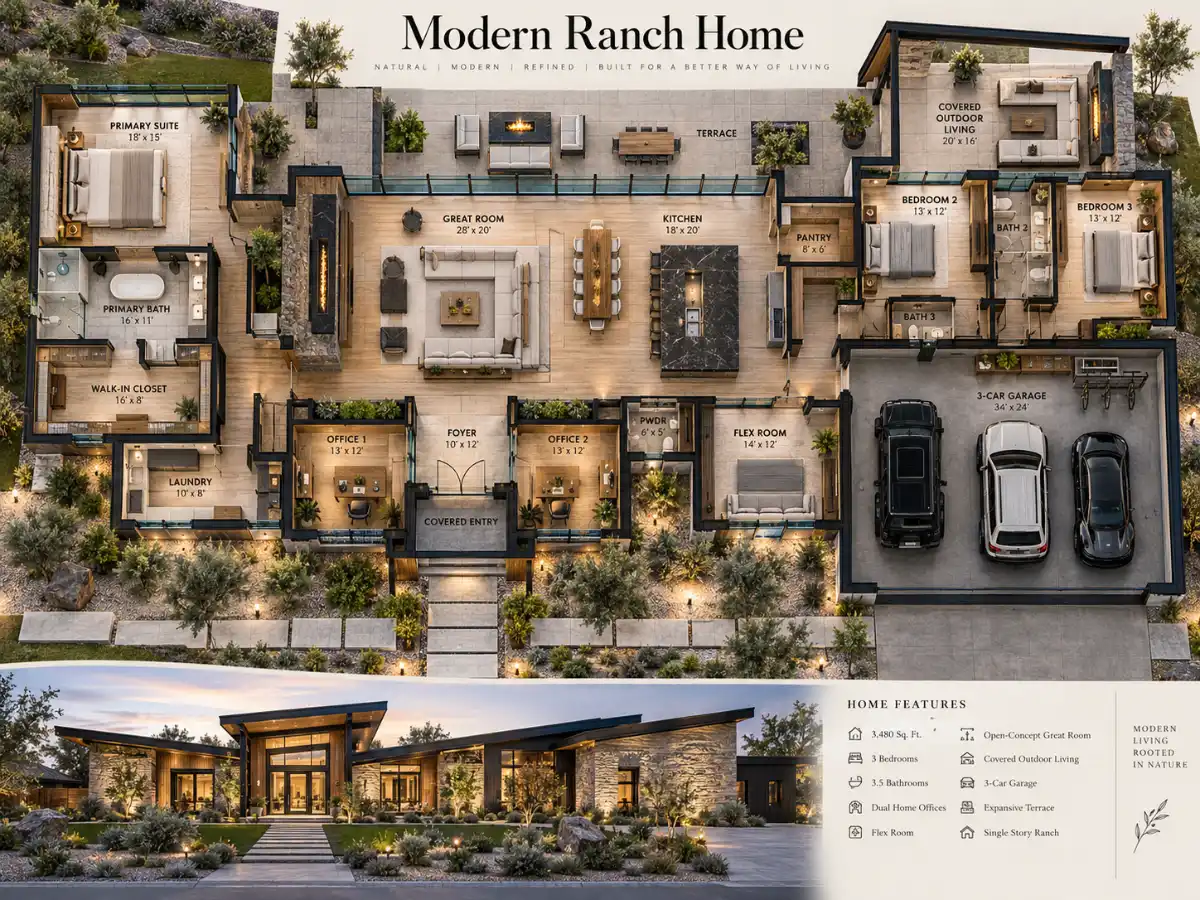
5.5. Modern ranch homes
Contemporary interpretations take the classic single-story concept and elevate it through clean architectural lines, soaring cathedral ceilings, and sophisticated material palettes. Modern ranch homes feature striking floor-to-ceiling glass walls, dramatic shed rooflines, exposed structural steel beams, and a refined combination of dark metal, warm cedar, and raw stone cladding. Inside, these layouts prioritize flexible flex spaces, dual home offices, smart home automation, and sustainable energy efficiency, offering a luxurious and sleek aesthetic tailored to contemporary families.
6. Top ranch house layout ideas for today’s homeowners
Modern lifestyle preferences have reshaped home design, driving continuous demand for single-story spaces that combine everyday convenience with smart spatial efficiency. Whether you are building on an expansive rural plot or a standard suburban lot, exploring contemporary ranch house layout ideas can inspire a functional design tailored precisely to your household's daily rhythms.
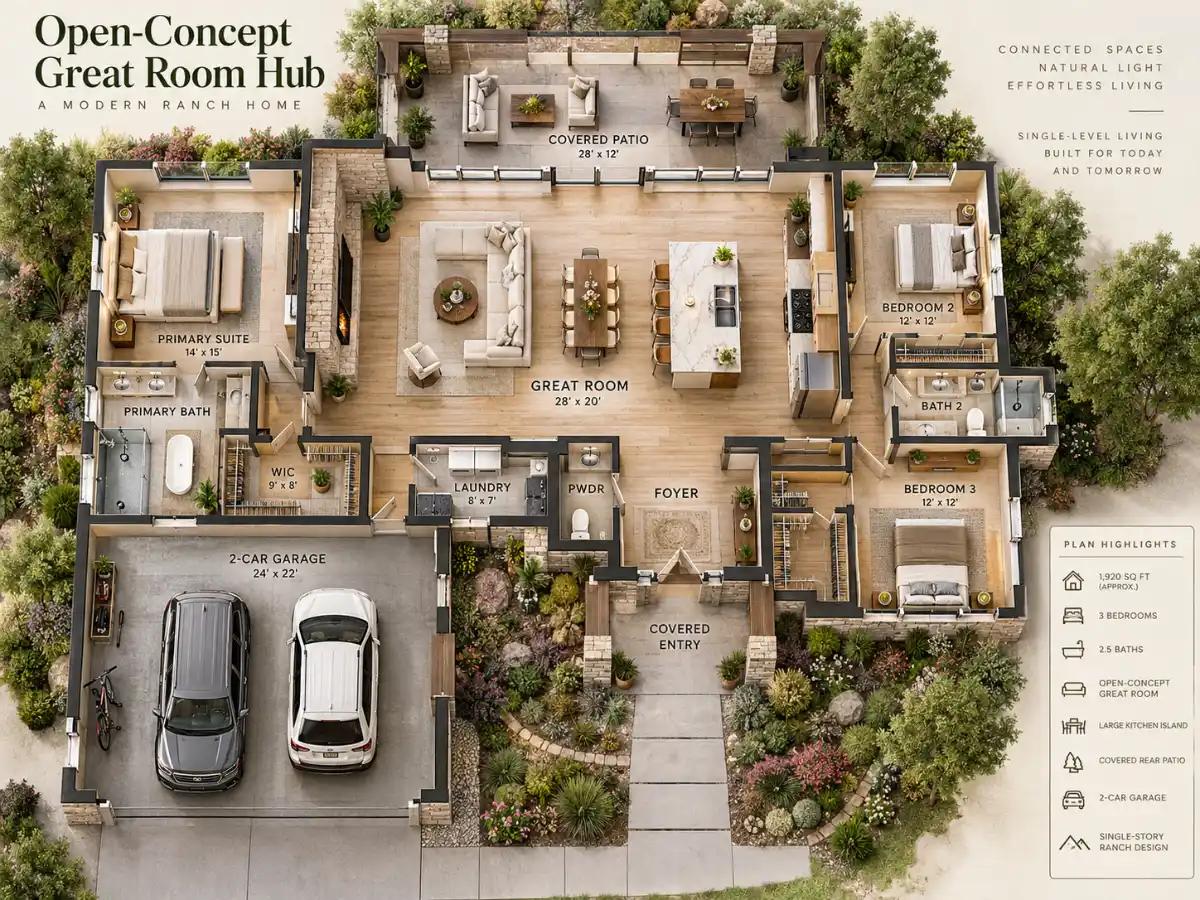
6.1. The open-concept great room hub
At the core of modern ranch design is an open ranch floor plan that integrates the kitchen, dining area, and main living room into a single, light-filled great room. Anchored by a large multi-functional kitchen island, this layout eliminates claustrophobic hallway barriers to create effortless sightlines across the central living zone. Incorporating vaulted or cathedral ceilings along with clerestory windows amplifies the sense of vertical volume, turning a mid-sized footprint into a dramatic, open sanctuary ideal for hosting family gatherings.
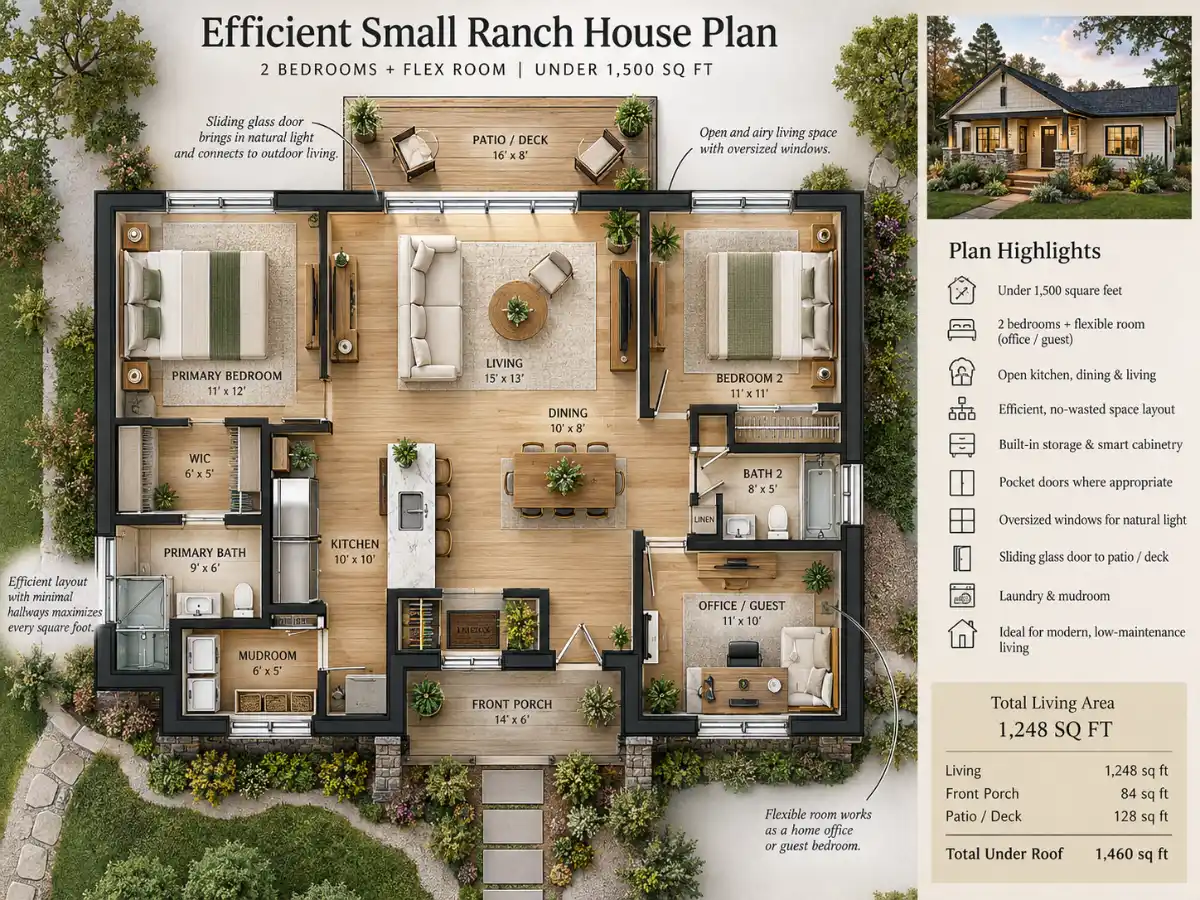
6.2. Maximizing efficiency in small ranch house plans
For homeowners seeking budget-friendly construction or low-maintenance living, small ranch house plans under 1,500 square feet offer incredible functionality when designed intentionally. To maximize every square foot, these compact layouts utilize pocket doors to save swing space, built-in storage cabinetry, and multi-functional flex rooms that easily transition from home offices to guest bedrooms. Strategically placing oversized windows and sliding doors prevents smaller single-story spaces from feeling enclosed, bouncing natural light throughout the entire interior.
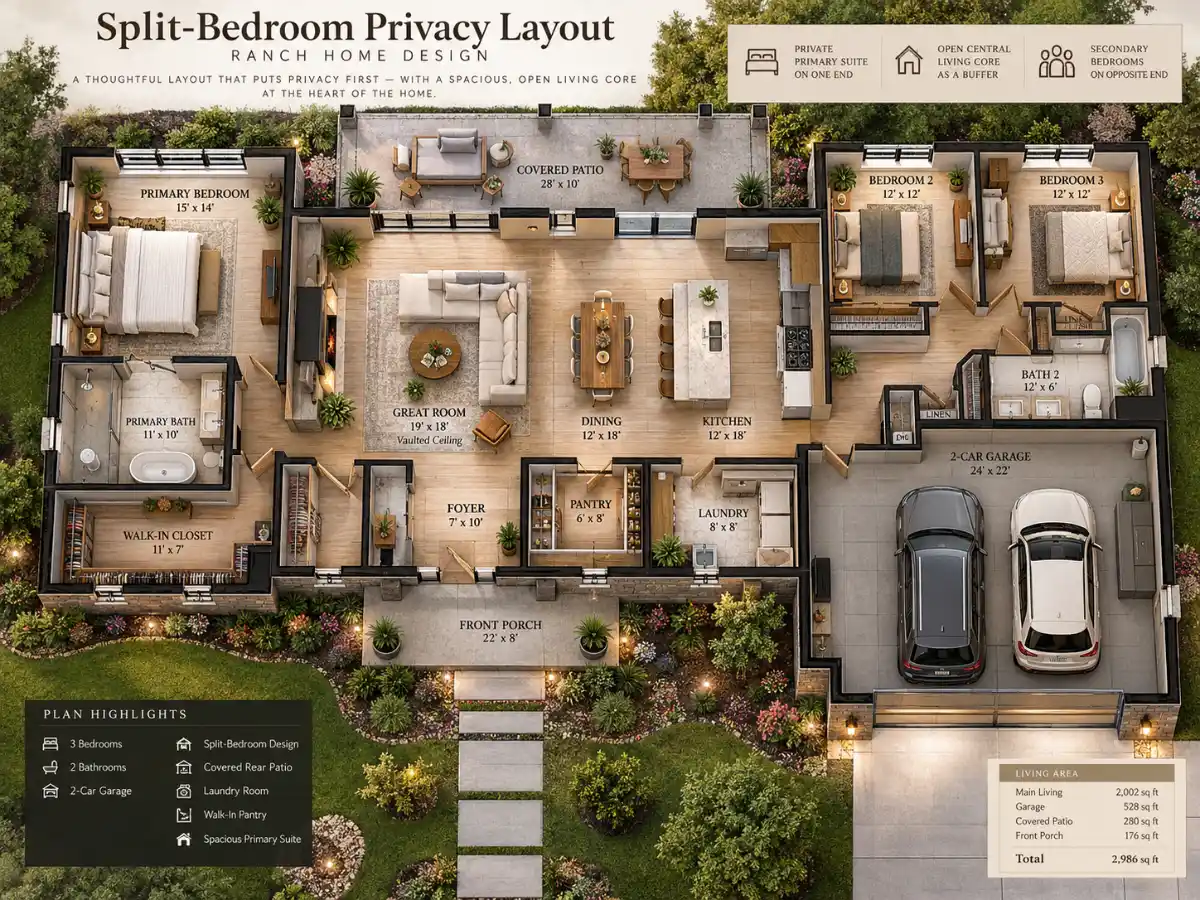
6.3. The split-bedroom privacy layout
A favorite among families and multi-generational households, the split-bedroom configuration places the primary suite on one end of the home while positioning secondary bedrooms on the opposite side. Divided by the central great room and kitchen, this arrangement establishes an acoustic buffer, ensuring maximum peace and solitude for parents or guests while keeping high-traffic noise centered.
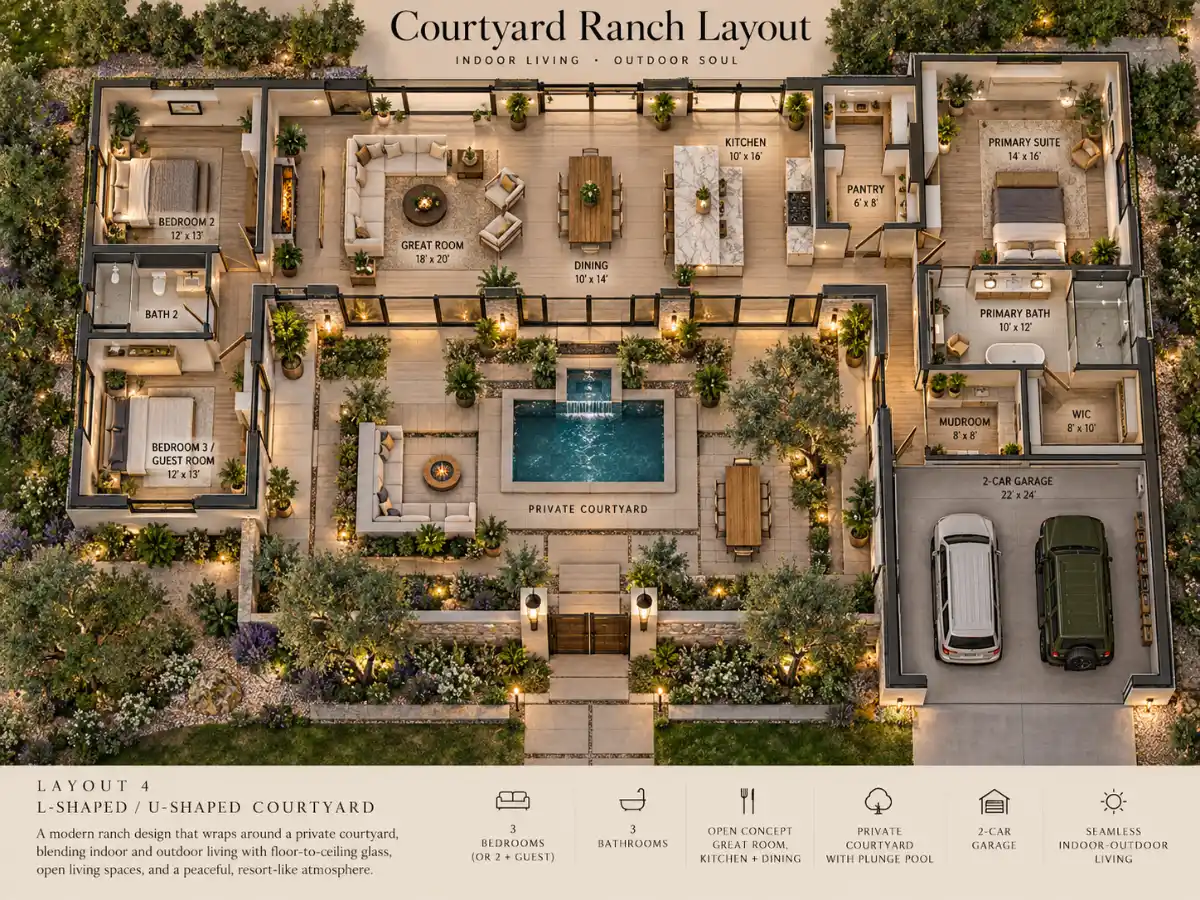
6.4. L-shaped and U-shaped courtyard layouts
To create a secluded outdoor oasis, L-shaped and U-shaped ranch layouts bend the home's footprint around a private central patio, outdoor kitchen, or swimming pool. With floor-to-ceiling glass doors lining the surrounding interior wings, every major room maintains a direct view and physical pathway to the central courtyard. This configuration shields your outdoor recreation area from wind and neighboring sightlines while reinforcing the signature indoor-outdoor connection of ranch architecture.
7. How to choose the right ranch style floor plan for your lot and lifestyle
Selecting the right ranch floor plan requires balancing your property's physical boundaries with your household's long-term lifestyle needs. Because single-story homes stretch horizontally rather than vertically, evaluating key lot characteristics and living preferences before finalizing architectural blueprints is essential.
- Lot width, setbacks, and topography: Standard ranch-style floor plans demand wider building footprints than multi-story homes. Ensure your lot offers sufficient width to accommodate local building setbacks, property lines, and attached garages. For sloping or uneven terrain, opt for a split-level or raised ranch layout rather than costly foundation excavation.
- Family dynamics and long-term accessibility: Consider your household's current and future mobility needs. If aging in place or multi-generational living is a priority, select a plan featuring wide interior hallways, zero-step entryways, and curbless showers. For families with young toddlers, a layout with bedrooms in closer proximity may be preferable to a widely split-bedroom design.
- Solar orientation and energy efficiency: Pay close attention to how your lot catches natural sunlight throughout the day. Position rear glass walls, open living areas, and outdoor patios toward the south or southwest to maximize interior daylighting while optimizing thermal efficiency.
- Construction budget vs. footprint efficiency: Keep in mind that single-story homes require larger foundations and roof surface areas per square foot than two-story builds. Choosing a streamlined rectangular or L-shaped footprint keeps framing, roofing, and foundation costs manageable without compromising on spacious open-concept living.
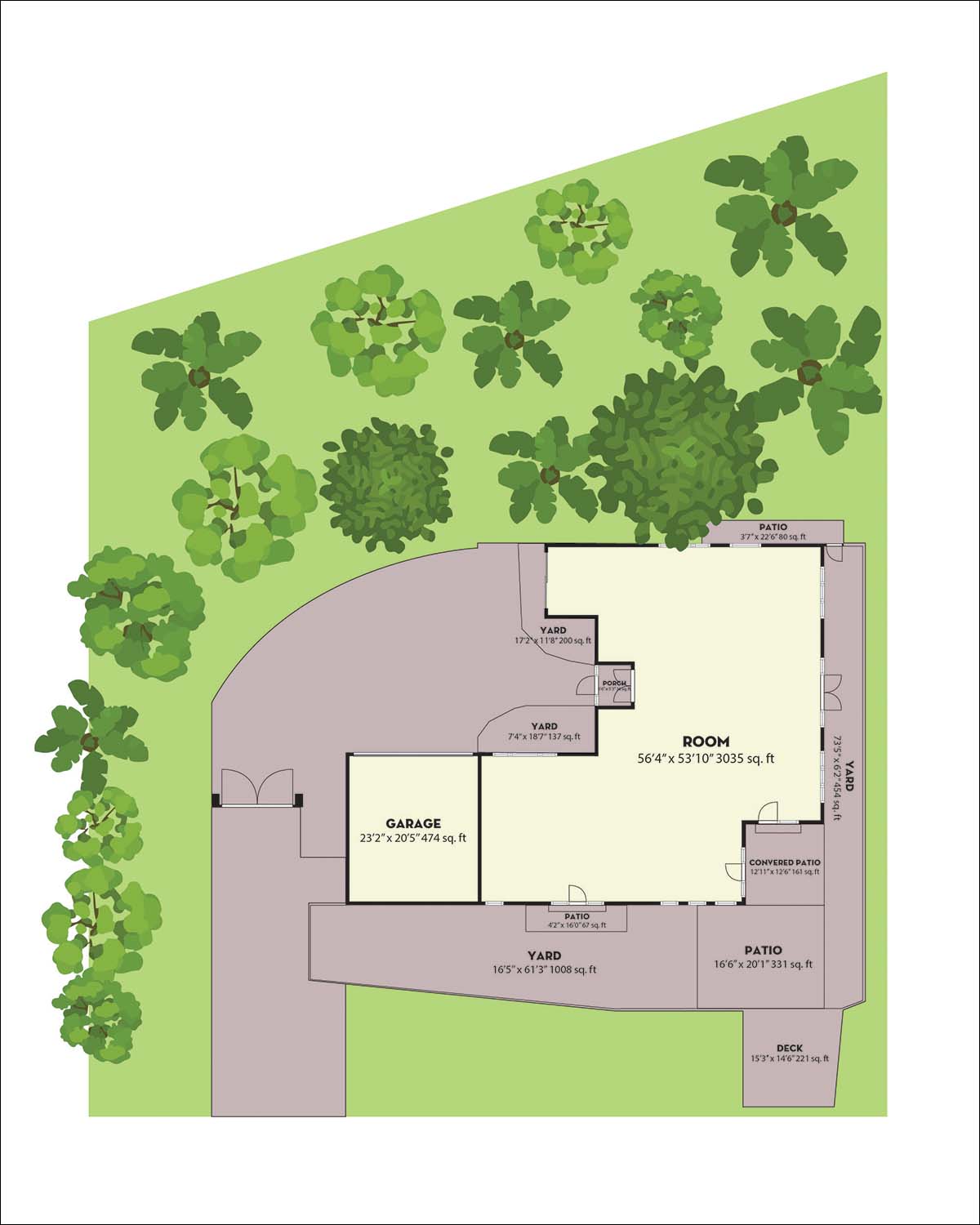
8. Real estate use case: Selling the modern ranch home lifestyle
Marketing a ranch home often comes with a unique set of challenges. To the untrained eye and the bland neutral camera lens, an older ranch can sometimes feel "boxed-in" or dim, characterized by the heavy wood paneling and low ceilings of decades past. Without high-quality visuals, potential buyers may overlook the "good bones" and focus solely on the dated aesthetics.
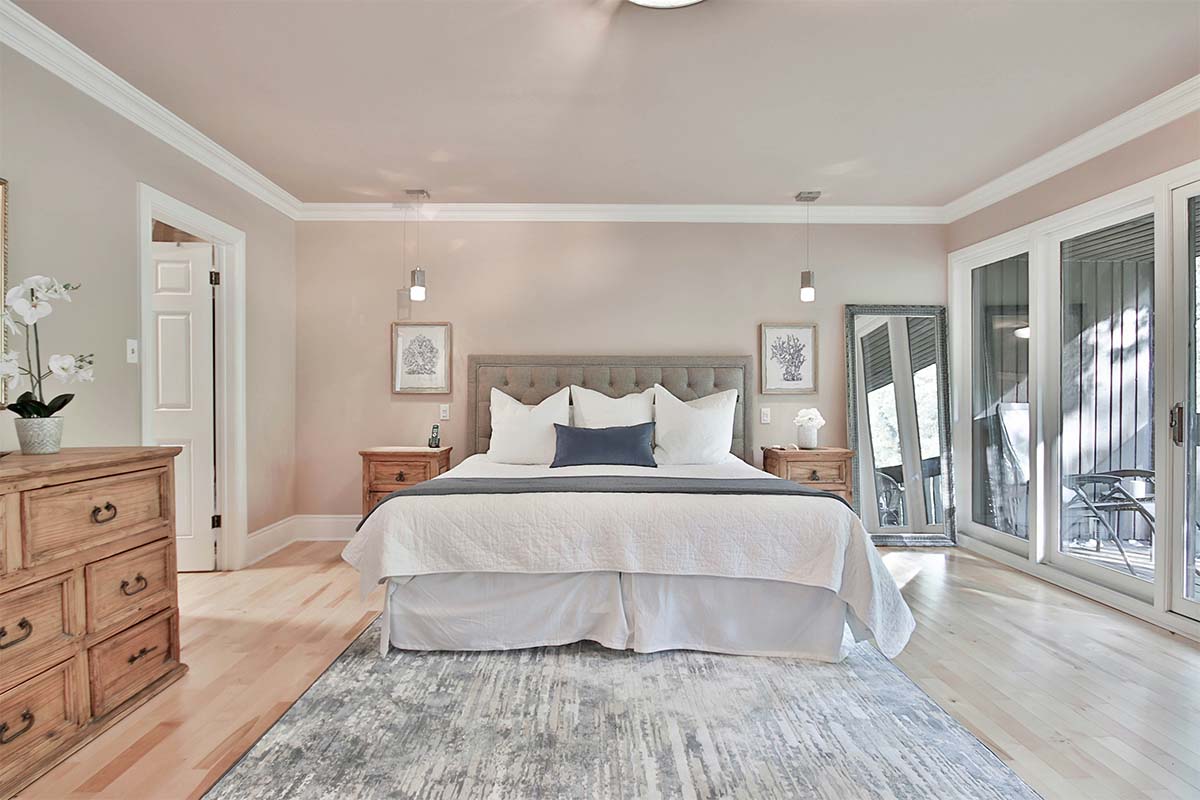 Professional post-production can revive a classic ranch house to be more appealing to modern buyers.
Consider a recent success story: a classic 1970s property that had languished on the market for over 60 days. The original listing photos were flat, making the spacious rooms appear cramped and uninviting. The turning point came when the agent partnered with Fotober for a total visual overhaul. We applied virtual staging to replace heavy, dated furniture with sleek, minimalist pieces that accentuated the open ranch-style floor plan. Furthermore, we utilized day-to-dusk editing to showcase the home’s expansive horizontal silhouette against a glowing twilight sky, creating instant curb appeal.
The result was transformative. Within 48 hours of updating the listing, showing requests tripled, and the property sold for 12% above the asking price. This use case proves that when you stop selling "old square footage" and start selling a "modern lifestyle" through expert imagery, the market responds with enthusiasm.
9. How Fotober’s floor plan services help homebuilders, buyers, and realtors
Whether you are designing a new custom home or marketing an existing single-story property, converting architectural concepts into clear visual assets is crucial. Fotober’s professional floor plan redrawing and rendering services bridge the gap between technical blueprints and high-impact visual presentation, empowering homebuilders, buyers, and real estate professionals alike.
For custom homebuilders and designers, Fotober converts rough hand-sketches, PDF files, or legacy blueprints into high-precision, fully dimensioned 2D floor plans. These clean, standardized visuals make it easy to communicate room dimensions and structural traffic flow during client presentations and project planning.

For buyers evaluating ranch-style floor plans, Fotober crafts immersive 3D floor plan renderings. These lifelike spatial visualizations allow homeowners to visualize furniture arrangements, wall placements, and room proportions, bringing creative ranch house layout ideas to life long before groundbreaking.
For real estate agents listing single-level homes, vacant or dated interiors can often feel hard to evaluate online. Fotober’s virtual staging and real estate media enhancement services populate empty layouts with modern furniture and realistic decor. This helps prospective buyers instantly grasp spatial scale and room functionality on MLS listings, driving higher engagement and faster sales conversions.
Ready to elevate your architectural designs or real estate listings? Partner with Fotober today to transform your sketches and blueprints into high-precision 2D and 3D floor plan visuals.
10. Conclusion
Ranch-style floor plans have proven their enduring value over nearly a century, seamlessly combining timeless aesthetic appeal with unmatched single-story practical living. From accessible, stair-free spatial flow and light-filled open concepts to effortless indoor-outdoor connectivity, ranch architecture continues to evolve alongside contemporary lifestyle demands. Whether you are planning a custom build, renovating a mid-century classic, or utilizing professional 2D and 3D floor plan renderings to visualize your project, choosing a ranch house layout is a timeless investment in long-term comfort, everyday accessibility, and functional design versatility.
Follow us on social media to stay updated with the latest trends in the real estate market and popular architectural styles.
- Facebook: fotobermedia.co
- YouTube: Fotober
- TikTok: @fotober
- Instagram: fotober_media.
Related posts

Modern Luxe Interior Design: Elements, Style Guide and How to Stage It
October 10, 2026

Minimalist Interior Design: Characteristics, Style Guide, and Staging
October 8, 2026

Coastal Interior Design: Style Definition & Staging Guide
September 30, 2026

Contemporary Interior Design: Key Elements and How to Stage This Style
September 30, 2026
