




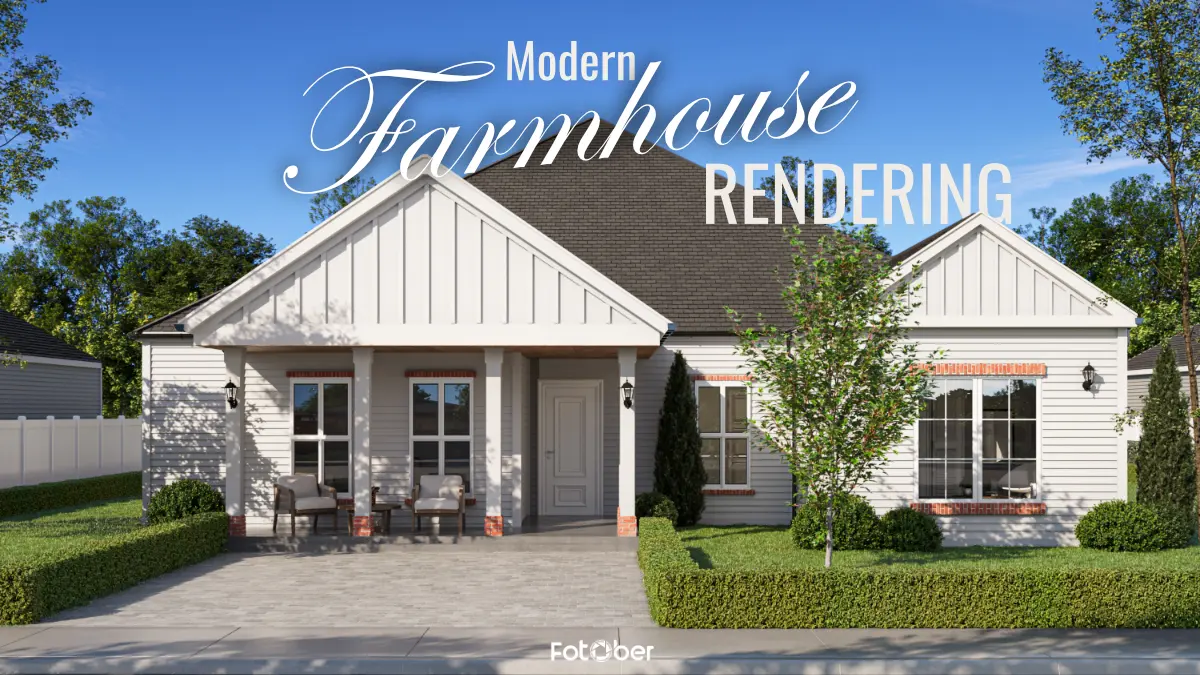
How Modern Farmhouse Rendering Transforms Real Estate Visual Marketing

Share:
Table of Contents
- 1. The aesthetic DNA of the modern farmhouse
- 2. Elevating modern farmhouse exterior 3D visualization
- 3. Crafting immersive modern farmhouse interior rendering
- 4. The business value of modern farmhouse rendering for real estate
- 5. Why outsourcing modern farmhouse rendering is essential in today’s market
- 6. Partnering with Fotober: Your strategic visual powerhouse for modern farmhouse rendering
- 7. Step-by-step breakdown: Executing a high-impact farmhouse rendering project
- 8. Conclusion
A building is never just a collection of wood, steel, and glass; it is a narrative waiting to be told. In contemporary residential design, few narratives have captured the global imagination as much as the Modern Farmhouse. Combining the rustic charm of rural vernacular architecture with clean, minimalist lines and state-of-the-art spatial fluidity, the Modern Farmhouse represents a lifestyle aspiration. However, translating this architectural masterpiece from blueprinted vision to emotional reality before a single nail is driven presents a significant marketing challenge.
This is where advanced 3D architectural rendering for real estate bridges the gap between imagination and buyer commitment. In this guide, we examine the artistic precision, technical mastery, and strategic necessity of modern farmhouse rendering, and why outsourcing visual production is the ultimate growth hack for realtors, photographers, and videographers today.
1. The aesthetic DNA of the modern farmhouse
To render a property effectively, one must understand its architectural soul. The Modern Farmhouse is not merely "rustic meets modern"; it is a delicate balance of contrast, proportion, and texture.
|
MODERN FARMHOUSE DESIGN TRINITY | |
|
1. ARCHITECTURAL CONTRAST |
Crisp white board-and-batten vs. Dark metal & iron frames |
|
2. TACTILE MATERIALITY |
Rough-hewn reclaimed wood vs. Smooth quartz & matte metal |
|
3. SPATIAL DYNAMICS |
Soaring vaulted ceilings vs. Intimate, cozy gathering nooks |
1.1. Key architectural elements
From a lensman’s perspective, the Modern Farmhouse offers a canvas rich in geometric structure and dramatic vanishing points. Key features include:
- A-frame gabled rooflines: Steeply pitched roofs that create bold silhouette lines against the sky.
- Board and batten siding: Vertical cladding that adds rhythm and texture to the exterior elevation.
- Industrial metal accents: Dark standing-seam metal roofs, black-framed steel windows, and exposed iron hardware that anchor the airy palette.
- Exposed structural timber: Reclaimed wooden beams, lintels, and porch columns that inject warmth and historical nostalgia.
1.2. Lighting, textures, and mood
As photographers, we know that light defines structure. The Modern Farmhouse relies heavily on dynamic range. The bright, reflective white surfaces demand precise exposure control to prevent highlight clipping, while the dark, matte accents require subtle fill light to reveal fine shadow details.
In a high-end 3D visual space, achieving a provoking modern farmhouse rendering requires complex ray-tracing algorithms, dynamic global illumination, and meticulous Physically Based Rendering (PBR) texturing. Without these, the render looks sterile, synthetic, and uninviting.
2. Elevating modern farmhouse exterior 3D visualization
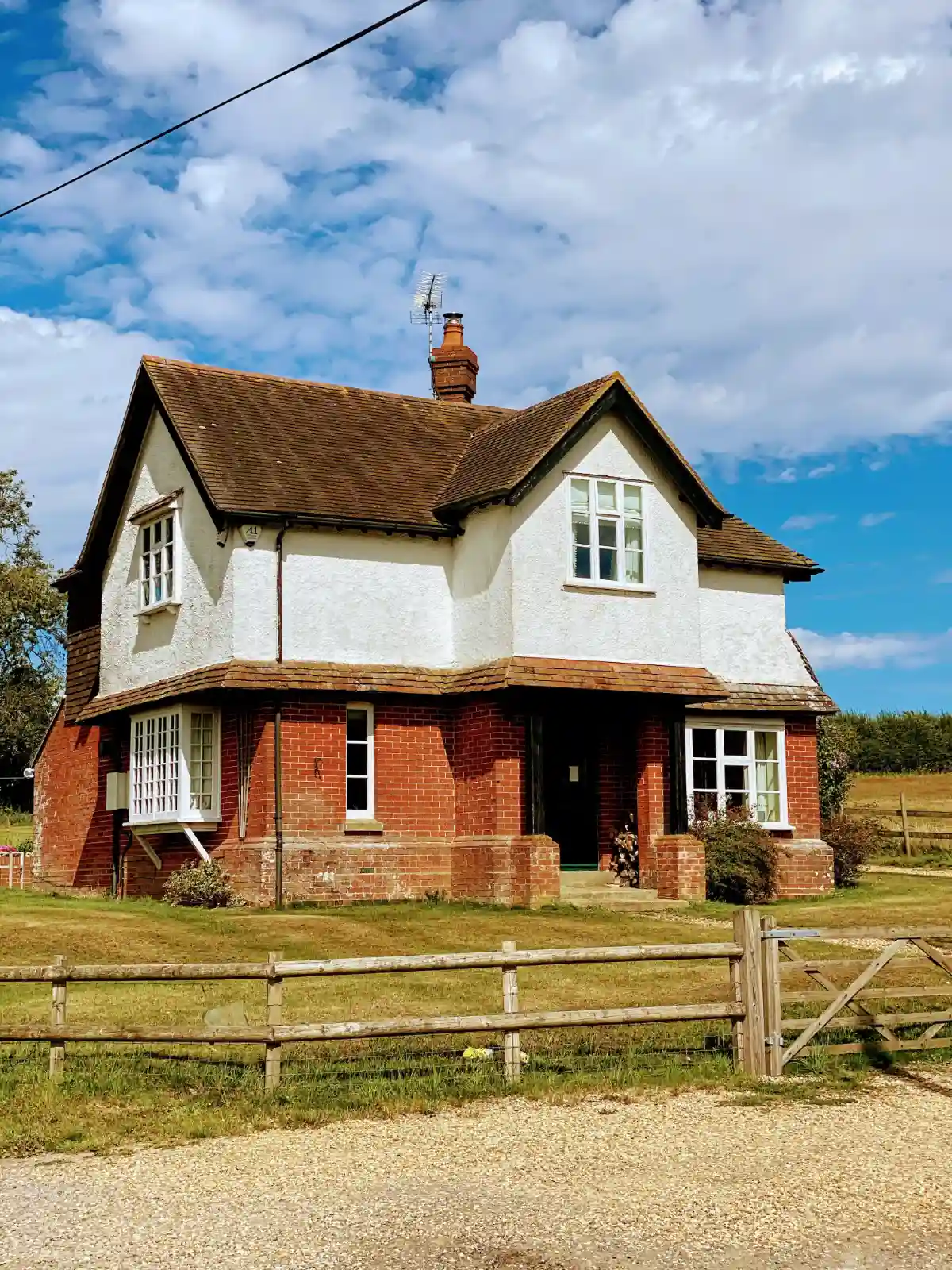
Creating a compelling modern farmhouse exterior 3D visualization requires more than pasting 3D models onto a background photo. It demands cinematic staging, environmental storytelling, and spatial accuracy.
2.1. Capturing scale, landscape, and natural light
The exterior of a Modern Farmhouse must feel rooted in its natural surroundings. Whether set against a sprawling countryside, an oak-dotted meadow, or a modern suburban lot, the exterior rendering must capture:
- Golden hour volumetrics: Sunlight striking the vertical board-and-batten siding at an oblique angle casts subtle micro-shadows, accentuating the building’s tactile depth.
- Environmental context: Realistic foliage, atmospheric haze, and organic ground cover that blend seamlessly around the foundation lines.
- Atmospheric lighting transitions: Showing the home at dusk, with warm interior light spilling through massive black-framed windows onto a twilight patio, creates a powerful emotional pull for prospective buyers.
2.2. Material accuracy in exterior CGI
A common flaw in amateur rendering is "flat material disease." A white vinyl wall looks entirely different from white-painted cedar board under direct sunlight. Professional modern farmhouse rendering accounts for:
- Specular reflection & roughness maps: Differentiating between the glossy finish of metal roof trim, the satin finish of painted wood, and the matte, porous surface of fieldstone.
- Imperfection mapping: Subtle variations in texture, seam alignments, and light diffusion that give digital structures a real-world, tangible feel.
3. Crafting immersive modern farmhouse interior rendering
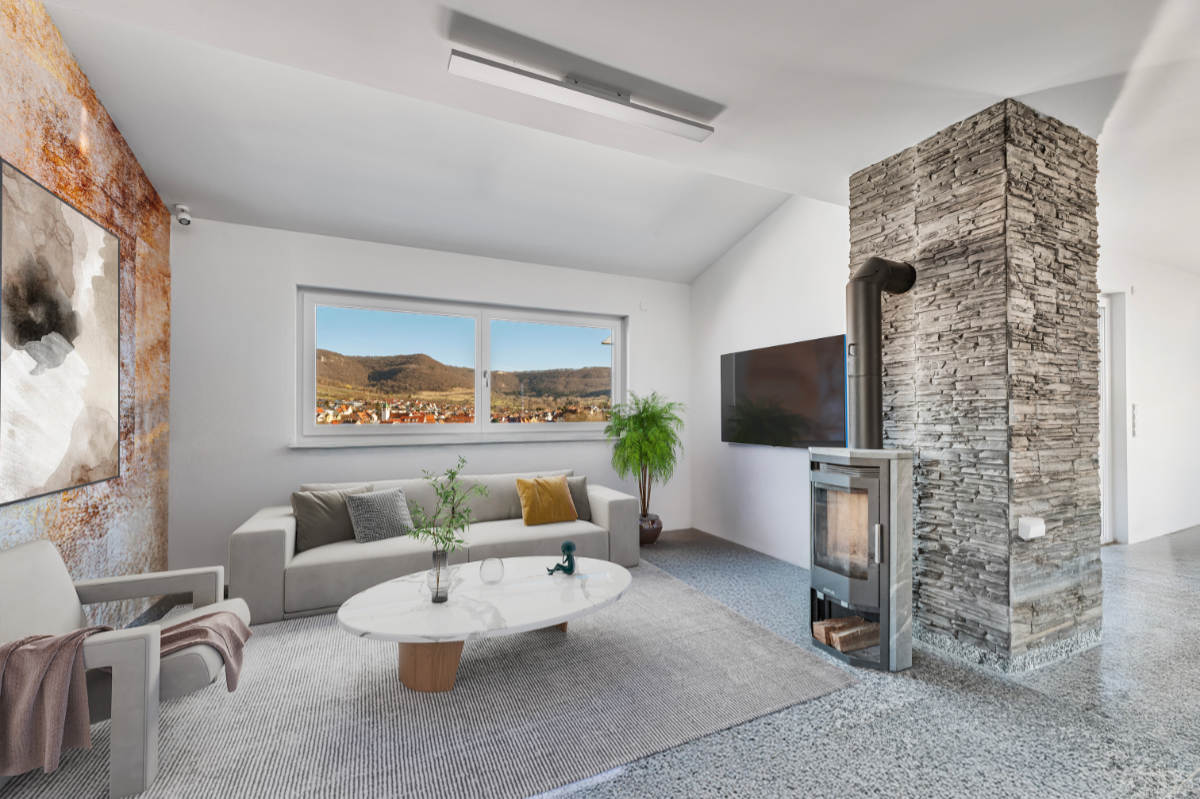
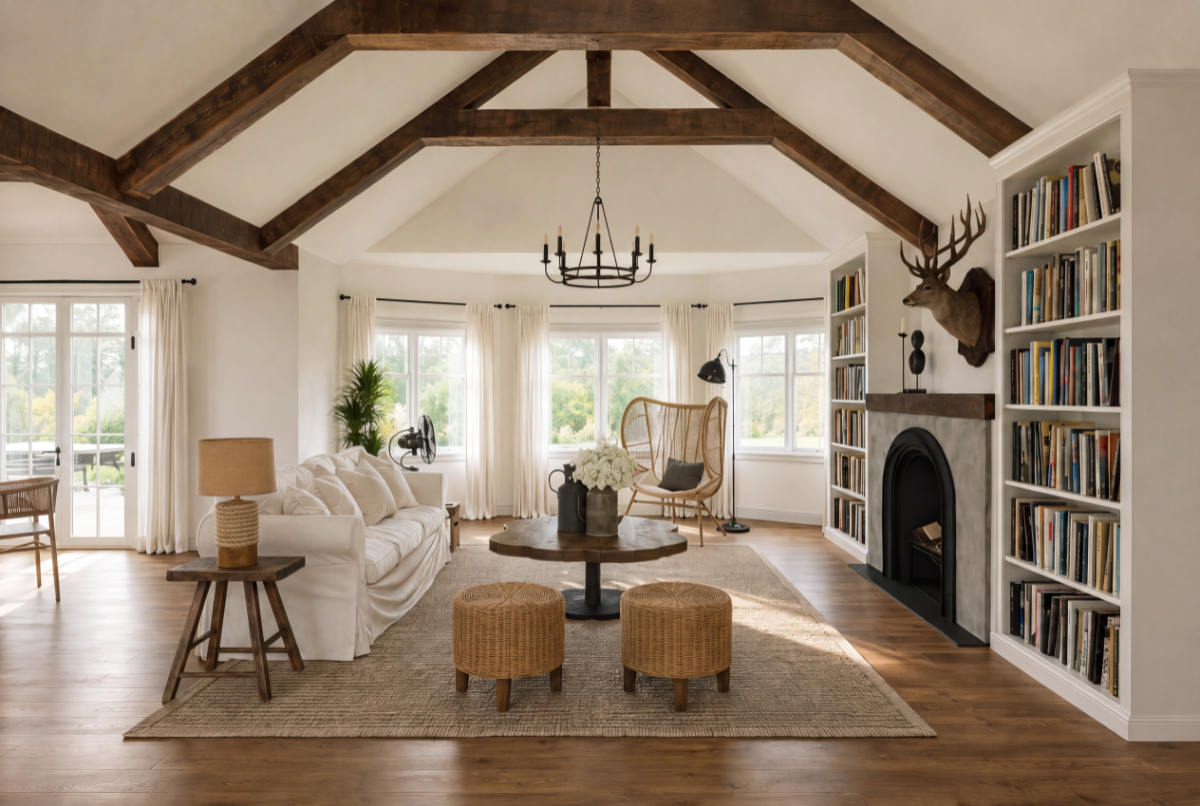
Moving inside, a modern farmhouse interior rendering must translate feelings of openness, warmth, and refined comfort. The challenge lies in balancing open-concept grandeur with human-scale intimacy.
|
INTERIOR CGI FOCUS AREAS FOR MAXIMUM EMOTIONAL IMPACT | |
|
Vaulted great rooms |
Showcasing scale, natural light, and architectural timber beams |
|
Culinary kitchens |
Highlighting stone counters, brass fixtures, and open shelving |
|
Spa-like primary suites |
Emphasizing serene lighting, wood accents, and freestanding tubs |
3.1. Open-concept spatial flow and composition
Just as a cinematographer selects specific focal lengths (e.g., a 24mm tilt-shift lens to maintain vertical lines without distortion), a CGI artist must carefully frame interior scenes.
- Leading lines: Utilizing linear wood-plank flooring, long kitchen islands, and structural ceiling ridge beams to guide the viewer’s eye through the space.
- Depth of field (DoF): Applying subtle, lens-like foreground blurring (bokeh) on decorative staging elements, like a vase of eucalyptus or a textured throw blanket, to draw focus to primary architectural features.
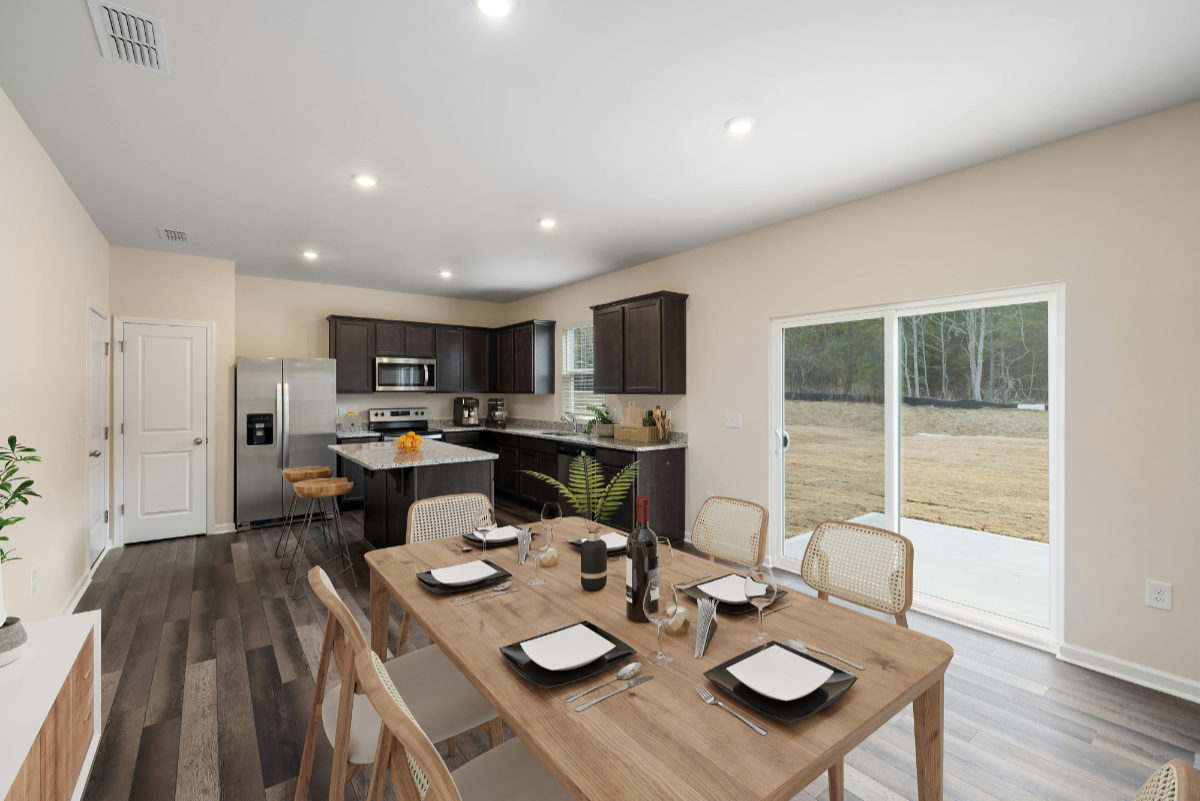
3.2. Cozy minimalist staging & lighting dynamics
Interior spaces in Modern Farmhouses are defined by modern minimalism warmed by organic elements. Renders must carefully balance:
- Ambient vs. accent light: Natural light pouring through floor-to-ceiling sliding glass doors integrated with warm 2700K pendant lights over a white oak kitchen island.
- Textile softness: Subsurface scattering (SSS) techniques applied to linen sofas, woven rugs, and leather armchairs to make materials look soft and inviting.
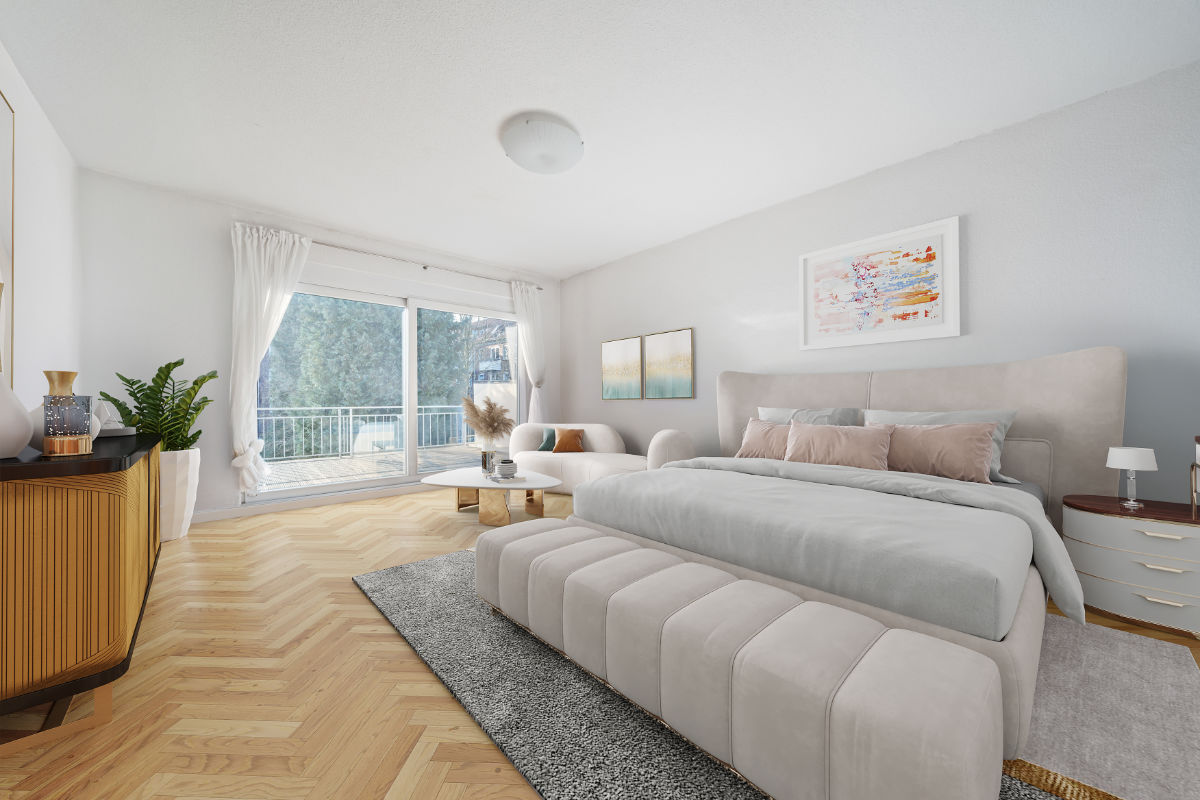
3.3. Essential best practices for modern farmhouse visuals
To maximize buyer engagement, ensure your visual strategy incorporates these industry best practices:
- Maintain light balance: Modern farmhouses rely heavily on natural daylight. Ensure window views are balanced cleanly with interior ambient warmth.
- Respect architectural proportions: Avoid over-stretching modern farmhouse renderings with ultra-wide virtual lenses (e.g., sub-14mm equivalents). This creates noticeable distortion that misleads buyers and damages trust upon physical inspection.
- Prioritize material realism: Spend extra attention on wood-to-metal transition points. The juxtaposition between organic wood grain and industrial black iron is the hallmark of the Modern Farmhouse aesthetic.
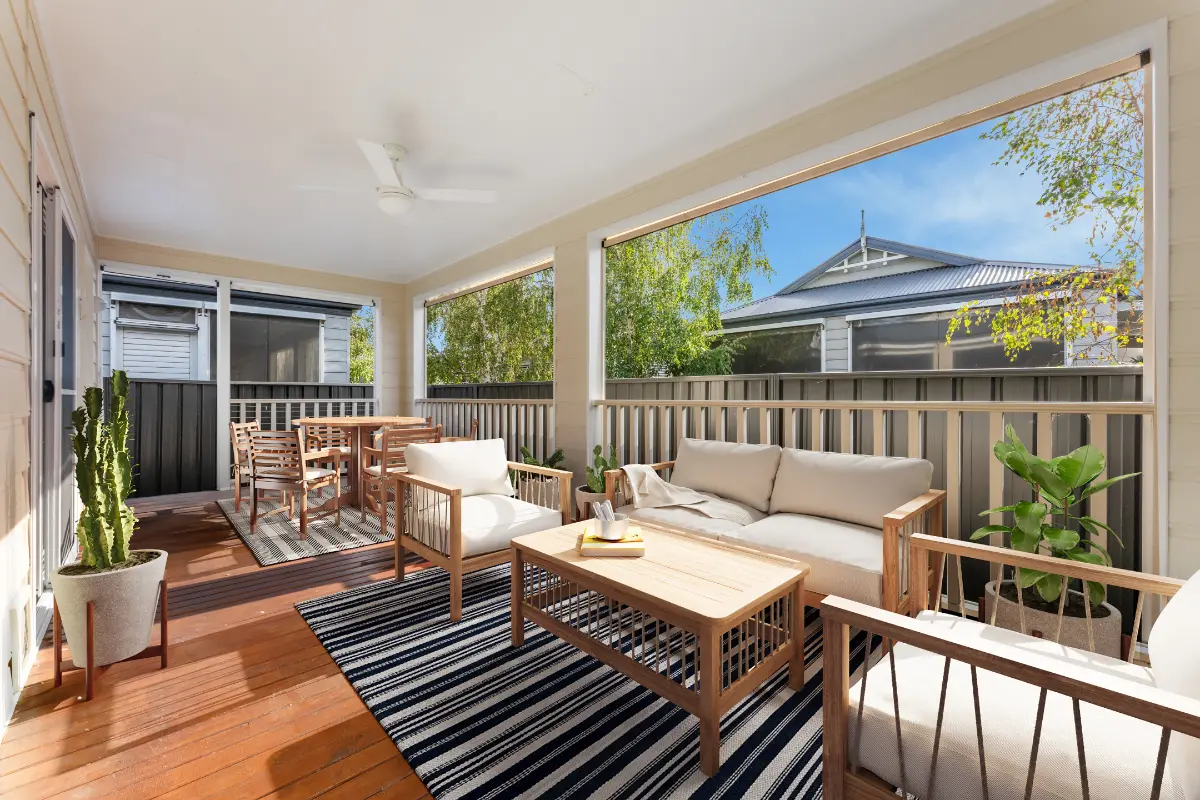
- Embrace multi-angle storytelling: Never rely on a single wide shot. Combine wide environmental exterior visual angles with tight, detailed hero shots of key architectural flourishes (e.g., custom staircase detailing, kitchen range hearths, or covered patio fireplace nooks).
|
VISUAL MARKETING BEST PRACTICES | |
|
DO: |
DON'T: |
4. The business value of modern farmhouse rendering for real estate
Beyond aesthetics, 3D architectural rendering for real estate is an essential business accelerator. Modern real estate buyers make decisions emotionally and visually, often long before setting foot on a property.
4.1. Pre-selling off-plan properties
For real estate developers and agents, waiting until construction ends to begin marketing is a costly mistake. High-fidelity modern farmhouse rendering allows you to:
- Launch listings months early: Generate interest, accumulate waitlists, and secure pre-construction sales while the ground is still being broken.
- Reduce holding costs: Minimize interest expenses on construction loans by shortening the overall time on market.
- Test market preferences: Present different finish options (e.g., dark vs. light kitchen cabinetry) in renderings to determine prospective buyer preferences.
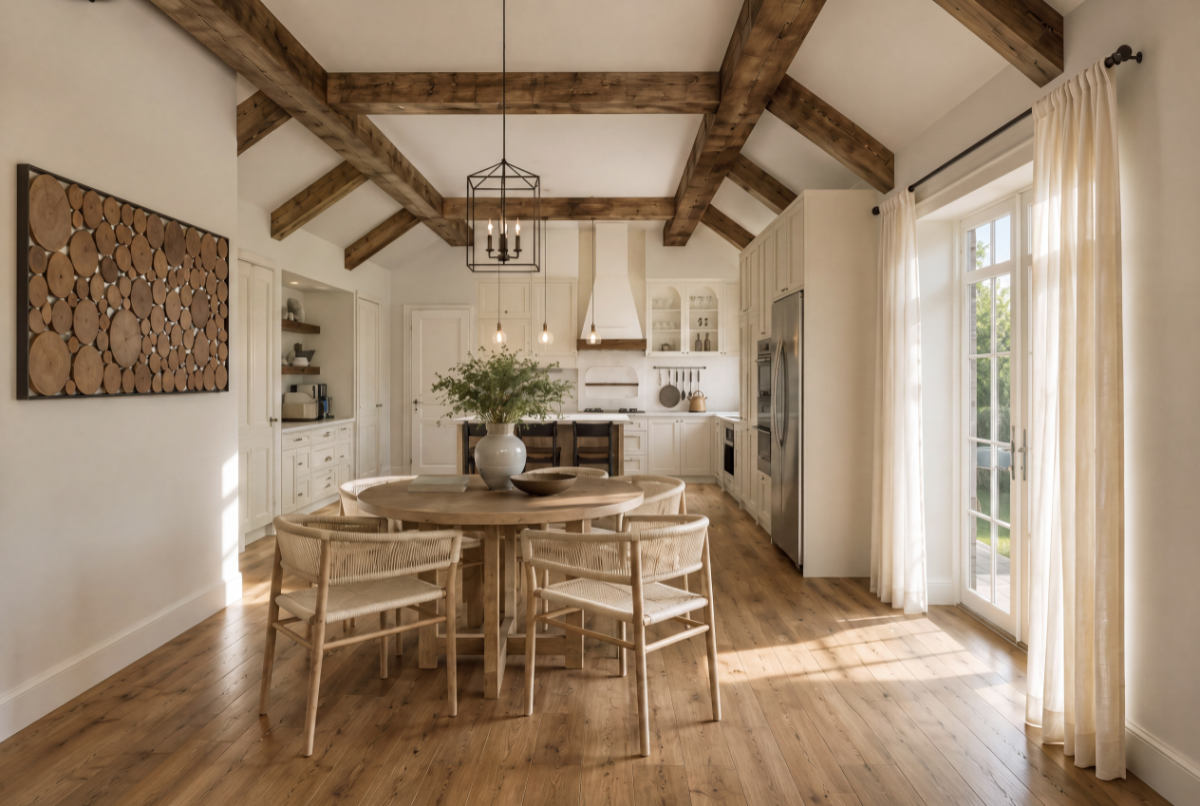
4.2. Emotional storytelling through lens-inspired CGI
Photos evoke emotion because they capture a real moment in time. High-end CGI works because it simulates that moment with cinematic rigor. When a buyer looks at a high-end interior render featuring morning sun hitting a coffee cup on a quartz waterfall island, they are visualizing their future life.
5. Why outsourcing modern farmhouse rendering is essential in today’s market
The demand for high-grade visual content has exploded. Today’s buyers expect cinematic video tours, flawless HDR photography, twilight shots, floor plans, and photorealistic 3D visual walkthroughs. For real estate photographers, videographers, and listing agents, managing this immense workload internally quickly creates an operational bottleneck.
|
IN-HOUSE VS. OUTSOURCED VISUAL PRODUCTION | |
|
In-house bottlenecks |
Outsourced efficiency (Fotober) |
|
High hardware/software overhead |
Zero capital investment in tech stack |
|
Hours spent in render queues |
Overnight processing & fast turnarounds |
|
Creative burnout from editing |
Unlimited scalability for big jobs |
|
Lost time for client development |
Core focus remains on relationships |
5.1. The in-house bottleneck
- Hardware & software overhead: Photorealistic modern farmhouse rendering demands dedicated GPU render nodes, expensive software licenses (V-Ray, Corona, Unreal Engine, Photoshop), and ongoing maintenance.
- Time sink vs. core revenue: Every hour spent tweaking light values, masking foliage, or waiting on frame renders is an hour not spent building client relationships, pitching new listings, or shooting on location.
- Skill-set overlap limits: A brilliant architectural photographer is not necessarily a 3D Modeler, nor is a busy real estate agent a master of digital post-production. Compacting these distinct skill sets into one person degrades overall output quality.
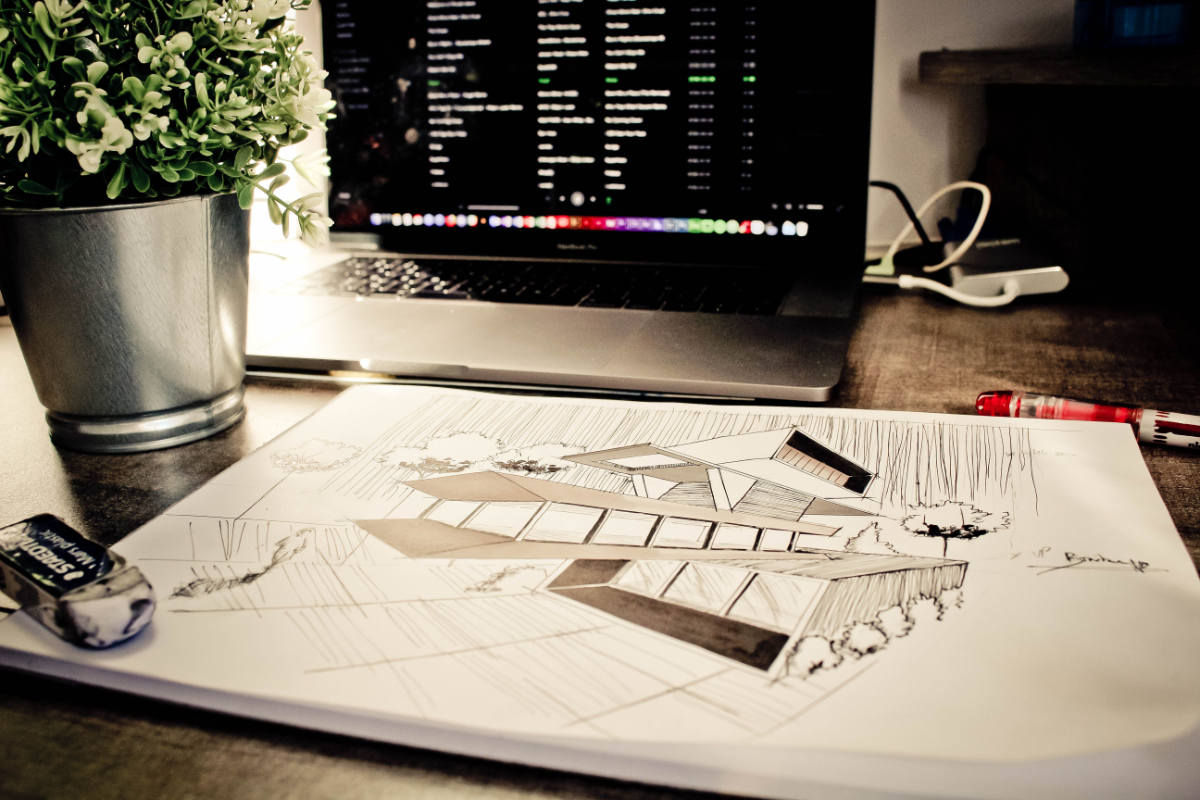
5.2. Elevating quality while scaling capacity
Outsourcing specialized post-production and CGI tasks allows creative and real estate businesses to run lean, stay agile, and scale effortlessly. By delegating post-processing and 3D creation to dedicated professionals, you transform fixed overhead into a flexible variable cost, enabling you to accept larger portfolios without sacrificing turnaround speed.
6. Partnering with Fotober: Your strategic visual powerhouse for modern farmhouse rendering
At Fotober, we bridge the gap between creative vision and technical execution. We don't just edit images or render models; we think like photographers, frame like directors, and design like architects.
6.1. How Fotober empowers real estate professionals
For real estate agents and brokers, first impressions are critical. Fotober delivers complete visual packages that elevate listings above the competition.
- Turnkey visual solutions: From raw image enhancement and virtual staging to full-scale modern farmhouse rendering, we equip agents with the assets needed to impress sellers and win competitive listings.
- Faster sales cycles: Photorealistic renderings reduce hesitation for buyers considering off-plan, pre-construction, or under-renovation homes.
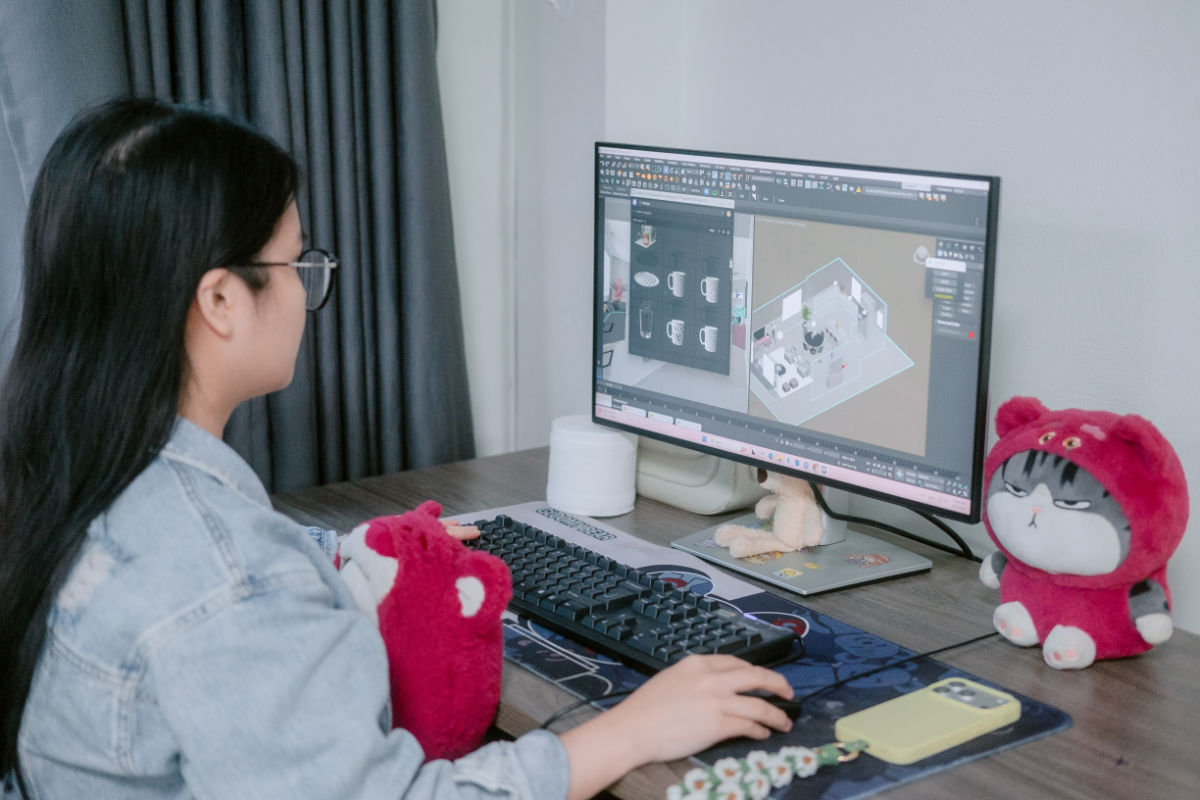
6.2. How Fotober amplifies photographers & videographers
For professional visual creators, Fotober operates as your silent back-office production team.
- Seamless photo & video editing: We handle advanced exposure blending (HDR), sky replacements, grass enhancement, perspective correction, day-to-dusk conversions, and video color grading.
- Expanding your service portfolio without capital risk: Offer your clients high-end 3D visual rendering services without hiring internal 3D artists or purchasing rendering farms. You win the client contract; Fotober builds the CGI assets.
- Unmatched consistency & speed: Maintain rock-solid brand consistency across thousands of images and renders with fast, reliable turnaround times that keep your production pipeline moving.
6.3. Precision, artistry, and scalability at scale
What sets Fotober apart is our hyper-focused attention to detail. Whether adjusting the subtle color warmth of an exposed timber beam in a modern farmhouse interior rendering or tuning the ambient occlusion around an exterior stone porch, our team understands the subtle nuances that make digital imagery feel authentically real.
7. Step-by-step breakdown: Executing a high-impact farmhouse rendering project
To help you understand how a complex architectural rendering comes together, here is the roadmap we follow at Fotober to turn raw files into high-converting visual assets:
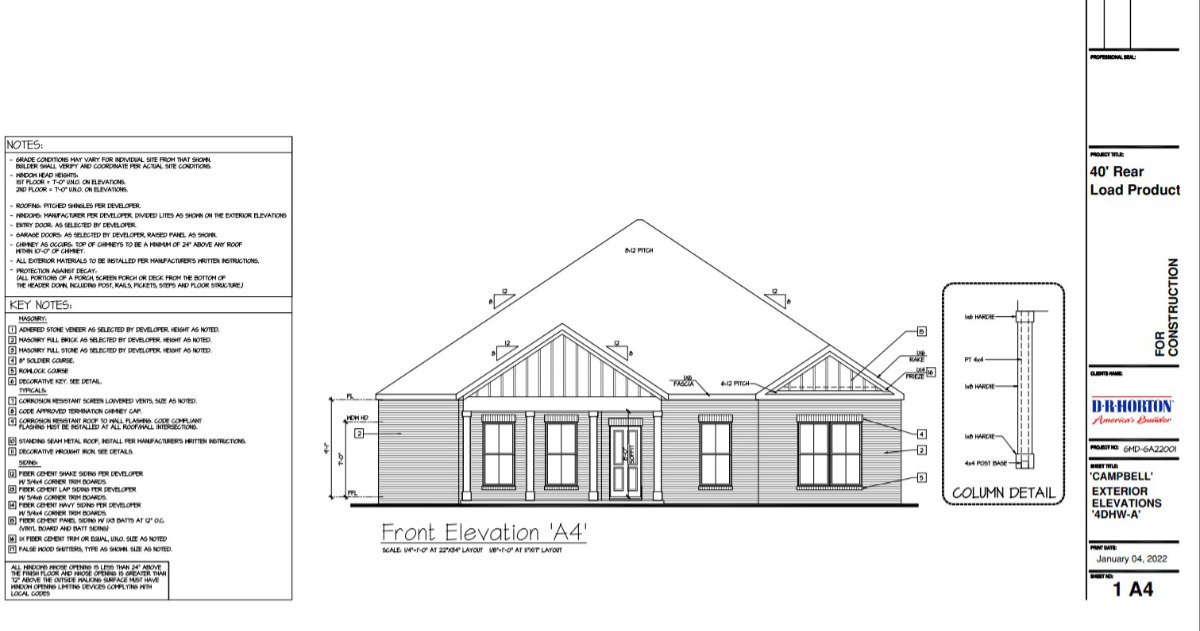
7.1. Phase 1: Architectural input & 3D wireframing
We take your CAD files, 2D floor plans, elevation drawings, or hand sketches and build an accurate 3D digital framework. Scale, ceiling heights, roof pitches, and window openings are defined with millimetric precision.
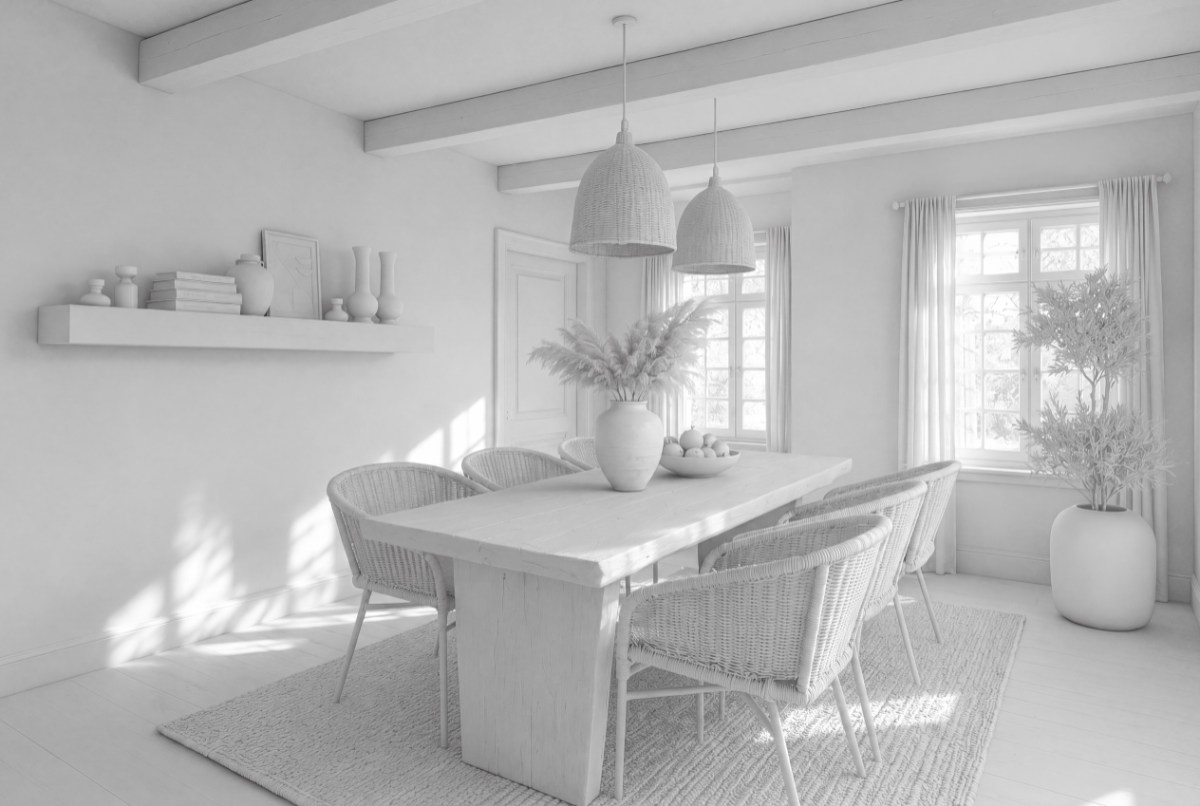
7.2. Phase 2: Material mapping & lighting setup
We apply PBR (Physically Based Rendering) shaders to reflect real-world physics. Wood grains are given elevation maps; glass is assigned precise refraction indices; white painted surfaces are given authentic diffuse parameters. Sunlight direction, ambient skydome lighting, and artificial interior fixtures are dialed in to match the desired time of day.
7.3. Phase 3: Composition, framing & staging
Applying fundamental cinematic composition rules, we select focal lengths that showcase space naturally. Interior spaces are virtually staged with curated furniture, textiles, and decor that align with the Modern Farmhouse design aesthetic.
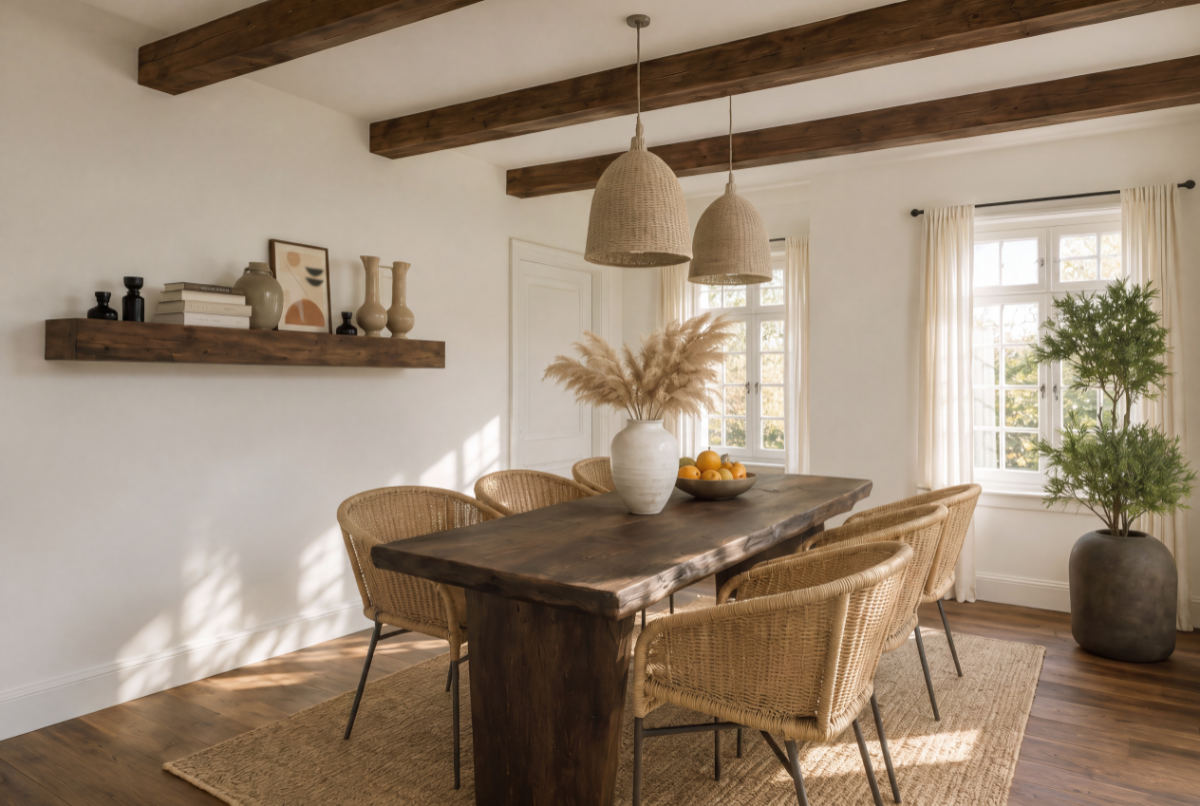
7.4. Phase 4: High-resolution rendering & post-processing
The scene is rendered at production-grade resolutions using high-powered ray-tracing hardware. Finally, our post-processing artists perform precision color grading, lens distortion correction, atmospheric enhancements, and fine-contrast adjustments to give the final output a crisp, photographic finish.
8. Conclusion
The Modern Farmhouse trend is more than a fleeting architectural trend; it is an enduring design language built around light, balance, warmth, and modern functionality. Capturing its true charm requires an artistic eye, deep technical understanding, and visual rendering capabilities that convert casual viewers into dedicated buyers.
Whether you are seeking to elevate a project with stunning modern farmhouse rendering, deliver incredible modern farmhouse exterior 3D visualization, or need an elite, reliable editing partner to scale your creative studio, Fotober is ready to power your growth. Focus on winning new deals, capturing moments, and creating architecture.
Ready to elevate your visual output? Partner with Fotober today and experience world-class 3D architectural rendering, photo editing, and video post-production tailored for property professionals. Visit Fotober.com to discover our services and start your next project today!
Follow us on social media to acquire more useful tips and in-depth analysis on real estate marketing, home rendering, and up-to-date details of our services!
- Facebook: fotobermedia.co
- YouTube: Fotober
- TikTok: @fotober
- Instagram: fotober_media.
Related posts

Minimalist Interior Design: Characteristics, Style Guide, and Staging
October 8, 2026

Coastal Interior Design: Style Definition & Staging Guide
September 30, 2026

Contemporary Interior Design: Key Elements and How to Stage This Style
September 30, 2026

Scandinavian Interior Design: Key Elements, Style Guide, and Staging
September 30, 2026
