




AI floor plan generator free vs professional rendering: what actually sells homes

Share:
Table of Contents
- 1. Why AI floor plan generators are everywhere right now
- 2. Best AI floor plan generator free tools and what they actually deliver
- 3. AI vs professional rendering: what ai floor plan generator free cannot replace
- 4. Why AI floor plan generator free outputs don’t convert in real listings
- 5. Hybrid approach: using AI floor plan generator free effectively
- Conclusion
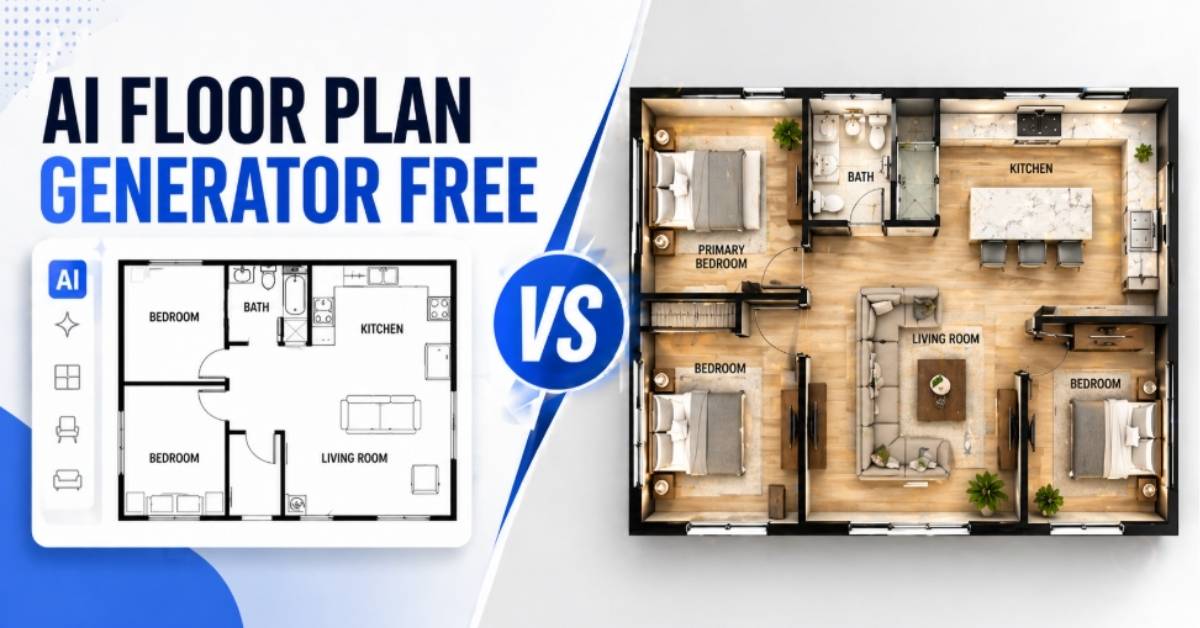
In today’s real estate market, speed is no longer a competitive advantage, it is the baseline. What actually differentiates listings is how clearly and convincingly a property is presented. The rise of the AI floor plan generator free trend reflects a shift toward automation, but it also exposes a growing gap between “creating content” and “creating conversion-driven visuals.” This article breaks down that gap in a practical, industry-level way.
1. Why AI floor plan generators are everywhere right now
The explosion of the AI floor plan generator free ecosystem is driven by one core factor: operational pressure. Real estate teams are handling more listings, tighter timelines, and higher expectations for visual content. Traditional floor plan workflows, manual drafting, revisions, rendering, simply cannot keep up with this pace anymore. AI tools step in as a natural solution to remove bottlenecks at the early stage.

Free AI tools for generating floor plan
From a workflow perspective, a free floor plan generator AI reduces friction significantly. Instead of relying on back-and-forth communication with designers, agents can instantly generate layouts, test ideas, and move forward with listings faster. This is especially valuable for teams managing dozens of properties at the same time. Speed here is not just convenience, it directly impacts time-to-market and revenue cycles. Another reason these tools are gaining traction is accessibility. A modern AI home design tool removes the technical barrier that used to exist in architecture and design. You no longer need to understand CAD systems or spatial drafting principles to produce a layout. Combined with the simplicity of an automatic floor plan maker, this opens the door for non-design professionals to participate in the content creation process.
However, this widespread adoption also creates a hidden problem. Because tools are easy to use, outputs become standardized and repetitive. Many listings start to look the same, and differentiation is lost. This is where the limitations of an online floor plan creator begin to surface in real-world performance.
2. Best AI floor plan generator free tools and what they actually deliver
When evaluating any AI floor plan generator free, the biggest mistake is judging it based on how “clean” the output looks. In reality, these tools should be evaluated based on what stage of the workflow they truly support. Most AI tools are built for speed and ideation, not for final marketing use and understanding this distinction will help you avoid misusing them in real projects.
2.1. Common categories of free floor plan generator AI tools
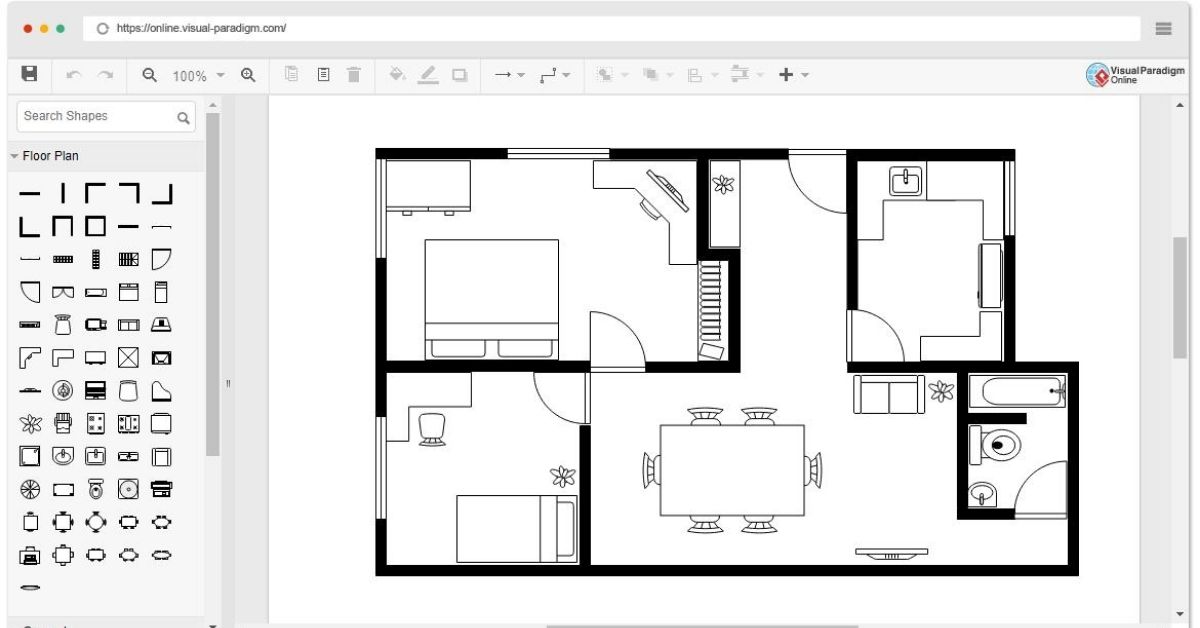
The current landscape of free AI floor plan tools is not defined by how “advanced” the technology is, but by what problem each tool is trying to solve. In practice, most platforms fall into a few clear categories, from fast layout generators to more complete design assistants. Understanding these categories helps you choose the right tool and avoid expecting too much from the wrong one.
The common categories
The most widely used category is the free floor plan generator AI, which focuses on speed and simplicity. Tools like Planner 5D, RoomSketcher, and Floorplanner allow users to quickly generate basic 2D layouts from simple inputs such as room sizes or drag-and-drop elements. These platforms are ideal for early-stage ideation, especially when you need multiple layout variations quickly. However, the output is often generic and lacks the spatial logic needed for real-world usability or marketing.
The next layer is the AI home design tool, where platforms begin to integrate furniture placement, zoning suggestions, and basic styling. Tools like Homestyler and Coohom fall into this category. They produce more visually complete layouts, which can be helpful for presentations or quick visualization. That said, these decisions are still pattern-based rather than context-aware, meaning the layouts may look polished but don’t always reflect how people actually live in the space.
Another important category is the automatic floor plan maker, which is designed to convert existing inputs into digital plans. Tools such as Magicplan and RoomScan Pro allow users to generate floor plans from photos, scans, or rough sketches. These tools are extremely efficient for saving time, especially for real estate professionals who need quick documentation. However, they do not improve the design itself, they simply digitize what already exists.
Finally, there are online floor plan creators that focus on collaboration and accessibility. Platforms like SketchUp Free and Foyr Neo allow teams to create, edit, and share plans directly in the browser. These tools are useful for workflows and team coordination, but they often prioritize ease of use over design intelligence, which limits their effectiveness for high-end or conversion-focused projects.
Some platforms position themselves among the best AI architecture tools by combining multiple features into one ecosystem. While this sounds promising, the core limitation remains consistent across all categories: these tools are designed to assist and accelerate the process, not replace professional decision-making.
2.2. Strengths of AI home design tool platforms in real workflows
The real value of any AI floor plan generator free lies in its ability to accelerate the early stages of a project. When used correctly, these tools can significantly reduce time spent on repetitive tasks and allow teams to focus on higher-level decisions.
The most obvious strength is speed. Generating a layout manually can take hours, especially when multiple revisions are involved. With a free floor plan generator AI, this process is reduced to minutes. This allows teams to test multiple ideas quickly and move forward without getting stuck in early-stage iterations.
Another important advantage is scalability. AI tools can produce multiple variations from a single input, which is extremely useful when exploring different design directions. Instead of committing to one layout too early, teams can evaluate several options side by side. This is where many best AI architecture tools provide real operational value. Accessibility is also a key factor. A modern AI home design tool removes the need for specialized knowledge, enabling non-designers to participate in the process. This is particularly useful in real estate teams where agents, marketers, and managers need to collaborate on visual content without relying entirely on designers.
In addition, tools like an automatic floor plan maker are highly effective for converting existing materials into usable formats. This is especially valuable when dealing with older properties or incomplete documentation. Instead of starting from scratch, teams can build on what already exists and save significant time. Finally, the convenience of an online floor plan creator supports remote workflows and fast collaboration. Teams can edit, share, and export plans in real time, which aligns well with the pace of modern real estate operations.
2.3. Limitations of automatic floor plan maker and online floor plan creator outputs
Despite their advantages, the limitations of a AI floor plan generator free become very clear once you move beyond the ideation phase. These tools are not designed to solve complex spatial problems or optimize layouts for real-world use.
One of the most critical issues is weak spatial logic. AI-generated layouts often fail to reflect how people actually move through a space. Circulation paths can be inefficient, room connections may feel unnatural, and the overall flow lacks coherence. This is a common problem across all categories, from automatic floor plan maker tools to more advanced platforms. Another major limitation is the absence of buyer psychology. A good floor plan is not just technically correct, it must align with how buyers think and what they value. Tools categorized as an AI home design tool do not understand priorities such as open living spaces, privacy zones, or the importance of certain focal points. As a result, the layout may function on paper but fail to resonate in practice.
Furniture placement is also frequently unrealistic. Many AI-generated plans include objects that do not match real-world proportions or spacing. This creates a misleading representation of the space, which can negatively impact buyer perception. Even when using a free floor plan generator AI, this issue appears consistently.
Visual communication is another weak point. Outputs from an online floor plan creator often lack hierarchy and emphasis. Without clear visual cues, buyers struggle to understand the layout quickly. In a competitive listing environment, this lack of clarity directly reduces engagement. Finally, these tools are not marketing-ready. While they can generate layouts efficiently, they do not optimize them for presentation or conversion. Even the best AI architecture tools still require human refinement to produce visuals that truly perform in the market.
In short, AI tools are excellent for generating options, but they are not reliable for making final decisions. Understanding this limitation is essential if you want to use them effectively rather than depend on them blindly.
3. AI vs professional rendering: what ai floor plan generator free cannot replace
To understand what actually sells a home, you need to look beyond output quality and focus on how each approach impacts perception, clarity, and ultimately conversion.
3.1. AI tools: how free floor plan generator AI and AI home design tool impact speed
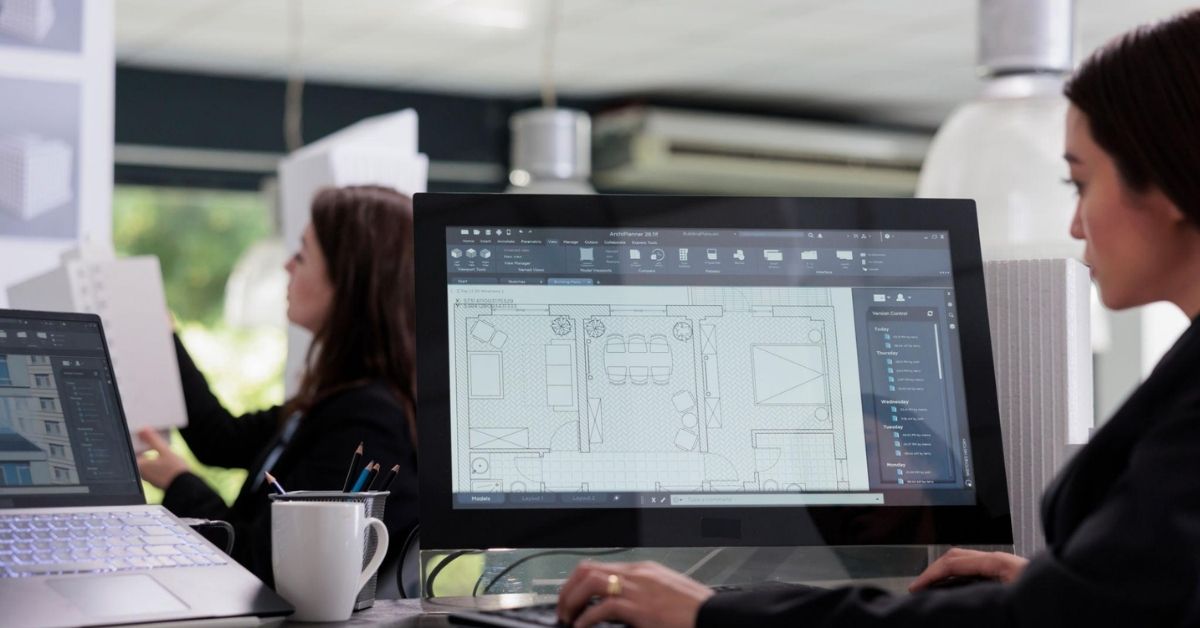
At their core, AI tools are built for efficiency. A typical AI floor plan generator free allows users to generate layouts in seconds, which dramatically reduces the time required for early-stage planning. For teams handling high volumes of listings, this speed is not just convenient, it is operationally necessary.
AI tools
The main advantage of AI tools lies in their ability to scale. With a free floor plan generator AI, users can create multiple variations from a single input, test different configurations, and iterate quickly without increasing cost. This makes AI particularly useful for brainstorming and internal discussions, where the goal is to explore possibilities rather than finalize decisions. Another strength of AI tools is accessibility. Platforms categorized as an AI home design tool remove the need for technical expertise, allowing agents, marketers, and even clients to participate in the layout creation process. This reduces dependency on specialized roles and speeds up communication across teams. However, these advantages come with clear limitations. Most outputs from an automatic floor plan maker are generated based on patterns rather than intent. The system does not understand why certain layouts work better than others, it simply predicts what a layout should look like based on existing data.
As a result, AI-generated plans often lack prioritization. Key areas such as the kitchen or living room are not emphasized, and the overall layout does not guide the viewer’s attention. Even when using an online floor plan creator, the final output tends to feel flat and generic, making it difficult for buyers to interpret quickly.
In practical terms, AI tools are excellent for creating layouts, but they are not designed to influence decisions. They help you produce content faster, but they do not necessarily help you sell better.
3.2. Professional rendering: why best AI architecture tools still fall short in conversion
Professional rendering operates on a completely different level. Instead of focusing on speed, it focuses on clarity, perception, and emotional impact. The goal is not just to show a layout, but to make that layout immediately understandable and appealing to potential buyers.
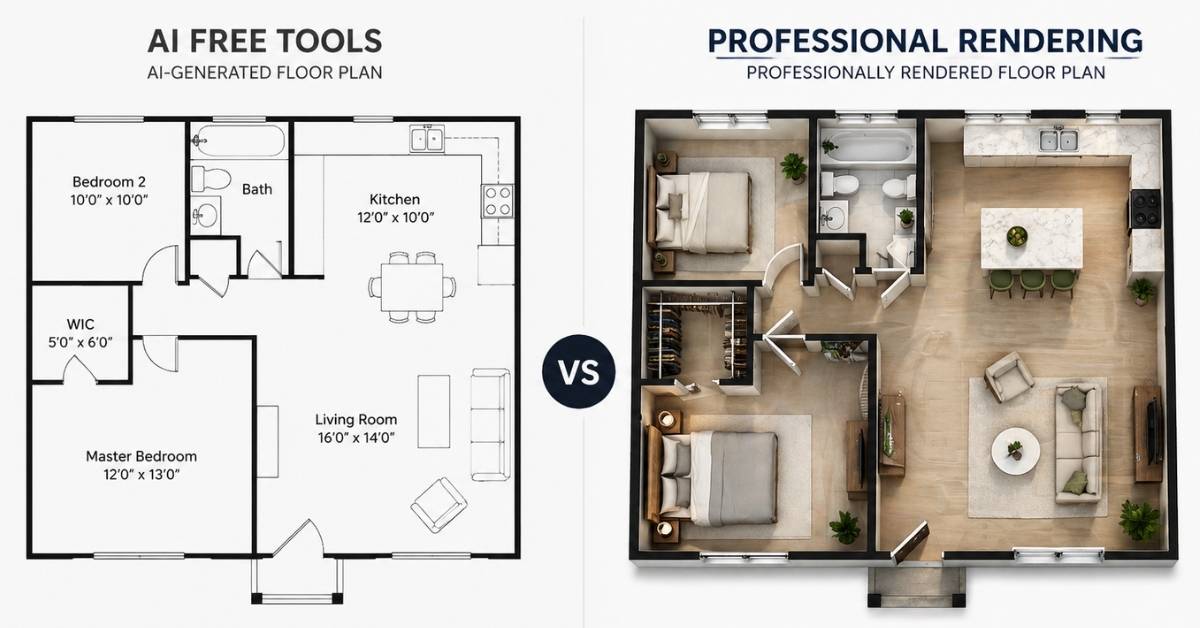
One of the most important aspects of professional rendering is visual hierarchy. A well-designed floor plan guides the viewer through the space in a logical sequence, highlighting key areas and creating a sense of flow. This is something that even the best AI architecture tools struggle to achieve consistently, because it requires intentional design decisions rather than automated output. Another critical factor is buyer psychology. Professional designers understand how people evaluate a home, even if they are not consciously aware of it. They emphasize focal points, optimize room proportions, and structure the layout in a way that aligns with real-life usage. This transforms a technical drawing into a compelling visual narrative.
Professional rendering also improves spatial clarity. Instead of presenting all elements equally, it uses contrast, scale, and composition to make the layout easy to read at a glance. This is particularly important in online listings, where buyers make decisions within seconds. A clear, well-structured plan immediately builds confidence, while a confusing one creates hesitation. Beyond clarity, professional visuals create emotional engagement. Buyers are not just looking for a functional space, they are imagining their future lifestyle. A professionally rendered floor plan supports this process by making the space feel intuitive, livable, and desirable. From a performance standpoint, the difference is measurable. Listings with professionally refined visuals tend to have higher engagement, longer viewing times, and better conversion rates. This is because they reduce cognitive effort for the buyer and make the decision process easier.
In summary, while a AI floor plan generator free helps you produce layouts quickly, professional rendering helps those layouts perform in the market. One is about efficiency, the other is about effectiveness, and in real estate, effectiveness is what ultimately drives results.
4. Why AI floor plan generator free outputs don’t convert in real listings
At a technical level, outputs from a AI floor plan generator free are not necessarily wrong. Dimensions can be accurate, room labels are clear, and the structure looks complete. The issue is not correctness, it is communication. In real estate, a floor plan is not just a technical document; it is a decision-making tool. If it fails to communicate instantly, it fails to perform.

Problems of free AI generator tools
One of the most common problems is poor spatial flow. AI-generated layouts often ignore how people naturally move through a home. Circulation paths may look acceptable on paper, but they lack intuitive transitions between spaces. This creates a subtle sense of discomfort for buyers, even if they cannot clearly explain why the layout feels “off.”
Another critical weakness is the absence of focal points. In effective listings, certain areas must stand out immediately, typically the kitchen, living room, and primary bedroom. These are the spaces that influence buying decisions. However, outputs from an AI home design tool tend to distribute attention evenly across all rooms, which dilutes the impact of these key areas. Furniture placement is also a recurring issue. Many layouts generated by an automatic floor plan maker include unrealistic proportions or awkward spacing. Sofas may be oversized, pathways too narrow, or arrangements impractical for daily use. This does not just affect aesthetics, it directly impacts how buyers perceive the livability of the home. Visual clarity is another major limitation. Plans created through an online floor plan creator often lack hierarchy, contrast, and depth. Everything appears equally important, which makes it harder for viewers to process the layout quickly. In a fast-scrolling environment like online listings, this lack of clarity leads to immediate disengagement.
The underlying issue comes down to buyer behavior. Most buyers do not study floor plans carefully, they scan, interpret, and decide within seconds. If the layout is not instantly understandable, it creates friction in the decision process. This is why relying solely on a AI floor plan generator free often results in lower engagement and weaker listing performance.
5. Hybrid approach: using AI floor plan generator free effectively
In professional workflows today, AI is not treated as a replacement, it’s treated as a starting point. The most effective teams combine the speed of an AI floor plan generator with human refinement to produce results that are both efficient and market-ready. This hybrid approach is increasingly common across real estate media agencies and architecture studios, especially those handling high volumes of listings.

The hybrid approach
The first stage is rapid layout generation. AI tools are used to create multiple layout options within minutes, allowing teams to explore different configurations without committing time to manual drafting. According to McKinsey & Company, generative AI can improve early-stage design productivity by up to 40%, particularly in tasks involving iteration and concept generation. In practice, this means teams can test more ideas faster, which leads to better initial direction before refinement begins.
The second stage is human refinement, which remains critical. While AI can generate structurally correct layouts, it lacks contextual understanding, how people move through a space, what buyers prioritize, and how layouts affect perceived value. Research from the National Association of Realtors shows that floor plans are among the most desired features in online listings, yet poorly presented layouts can reduce clarity and buyer engagement. This is where professionals step in to adjust spatial flow, correct proportions, and align the layout with real-world usability.
The final stage is converting the layout into a marketing-ready visual. This is not just about accuracy, it’s about communication. Clear hierarchy, readable structure, and strong focal points help buyers understand a property quickly. According to a consumer behavior report by Zillow, listings that provide better visual information, including floor plans and enhanced media, tend to receive more views and longer time-on-page, both of which are key indicators of engagement. In competitive markets, this directly impacts how quickly a property attracts serious interest. Different tools play different roles in this workflow. AI generators accelerate ideation. Conversion tools digitize existing plans. Collaboration platforms streamline revisions and delivery. However, none of these tools replace the need for final decision-making. What makes the hybrid approach effective is balance, AI handles speed and iteration, while professionals ensure the output is usable, realistic, and aligned with buyer expectations.
In today’s market, this is no longer optional, it’s the baseline. Teams that rely entirely on AI often produce layouts that look acceptable but lack clarity and impact. Those that integrate AI into a structured workflow consistently achieve stronger results, not just in visual quality, but in how their content performs in real listings.
Conclusion
The rise of the ai floor plan generator free is not a temporary trend, it reflects a fundamental shift in how content is produced. However, it is important to understand its role clearly. AI is a tool for acceleration, not a complete solution for conversion. For real estate professionals, the goal should not be to replace human input but to optimize it. Use AI to reduce repetitive work and generate ideas quickly. Then apply professional thinking to refine and present those ideas in a way that resonates with buyers.
In a competitive market, clarity and perception matter more than speed alone. A layout that communicates effectively will always outperform one that is simply generated faster. That is the difference between creating content and creating results.
- Facebook: fotobermedia.co
- YouTube Channel: Fotober
- TikTok Channel: @fotober
- Instagram: fotober_media
- Email support: [email protected]
- Hotline: +84 942 110 297
Related posts

Modern Luxe Interior Design: Elements, Style Guide and How to Stage It
October 10, 2026

Minimalist Interior Design: Characteristics, Style Guide, and Staging
October 8, 2026

Coastal Interior Design: Style Definition & Staging Guide
September 30, 2026

Contemporary Interior Design: Key Elements and How to Stage This Style
September 30, 2026
