




How 3D Rendering for Property Developers Helps Sell Unbuilt Homes

Share:
Table of Contents
- 1. The evolution of pre-construction marketing: From blueprints to cinematic experiences
- 2. Unpacking the strategic value of 3D rendering for property developers
- 3. The intersection of photography, cinematography, and CGI in 3D rendering for property developers
- 4. Why post-production outsourcing is essential for modern visual creators & developers
- 5. Why Fotober is the strategic outsourcing partner for realtors, photographers, and videographers
- 6. Step-by-step guide: Integrating 3D rendering into your real estate marketing campaign
- 7. Comparative analysis: Physical model vs. 2D rendering vs. photorealistic 3D visualizations
- 8. Real-world case example: Preselling a luxury high-rise development with 3D rendering
- 9. Future trends in pre-construction visualization
- 10. Conclusion: Elevating your real estate vision with Fotober
In modern real estate, a profound challenge often arises: How do you capture the soul of a space that does not yet exist? For decades, property developers relied on two-dimensional blueprints, floor plans, and abstract artistic sketches to secure financing, obtain planning permissions, and presell units. Today, the global real estate market operates at a vastly different velocity. Buyers and investors demand immersion long before the first foundation is poured.
This is where advanced computer-generated imagery (CGI), photorealistic digital cinematography, and high-end visual post-production converge. Utilizing 3D rendering has shifted from a luxury add-on to an absolute strategic necessity. In this comprehensive guide, we will explore how cutting-edge 3D rendering for property developers is redefining spatial storytelling, why photorealism is the ultimate marketing catalyst, and how partnering with specialized post-production ecosystems like Fotober empowers realtors, photographers, and visual creators to scale their operations effortlessly.
1. The evolution of pre-construction marketing: From blueprints to cinematic experiences
[Traditional marketing] ➔ 2D blueprints ➔ Abstract sketches ➔ Low pre-sales
[Modern CGI ecosystem] ➔ Photorealistic 3D ➔ Virtual walkthroughs ➔ Rapid capital conversion
1.1. Why 2D plans no longer sell high-end real estate
Human beings do not think in orthographic projections. While architects and structural engineers read CAD drawings with ease, the average luxury home buyer or commercial investor struggles to translate lines, dimensions, and hatchings into a three-dimensional emotional reality.
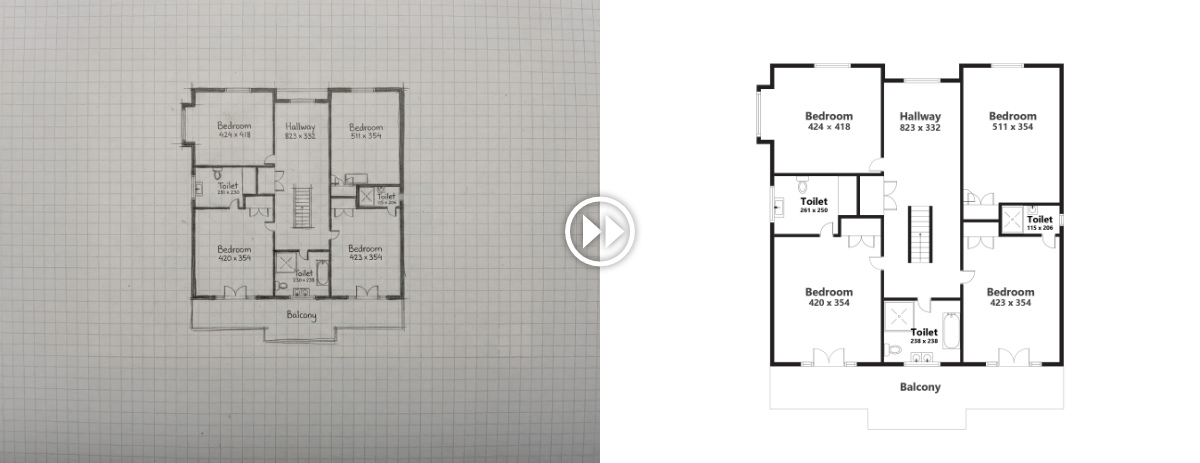
When presented with traditional 2D media, buyers experience cognitive friction. They cannot visualize the spatial proportion between the island counter and the floor-to-ceiling windows, nor can they feel the ambient luxury of a master suite bathed in golden-hour sunlight. Cognitive friction creates hesitation, and in high-stakes real estate, hesitation kills sales cycles.
1.2. The power of emotional connection in pre-construction sales
Real estate purchases, whether a $500,000 residential condominium or a $50,000,000 mixed-use commercial tower, are fundamentally driven by emotion and rationalized by logic.
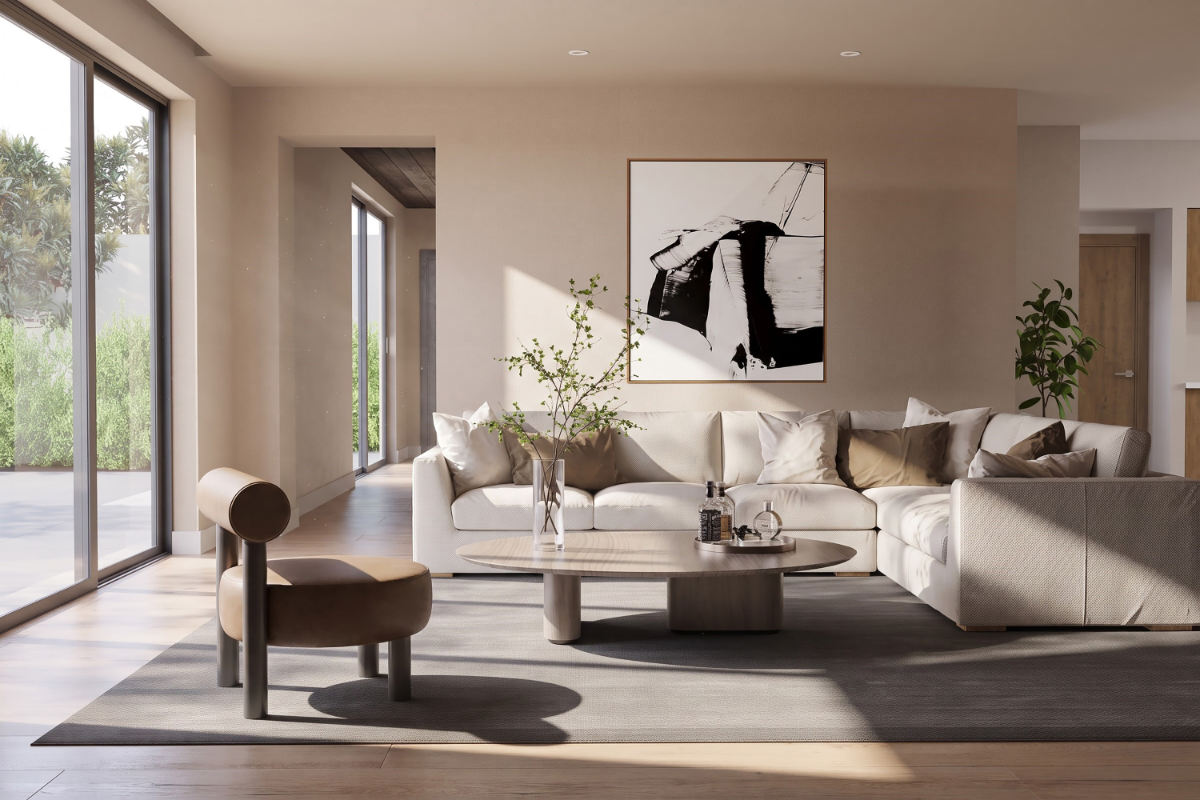
Cinematic visualization of 3D rendering for property developers bridges the gap between vision and reality. By applying principles borrowed from fine-art architectural photography such as:
- Golden-ratio composition,
- Physically accurate lens distortion,
- Natural depth of field, and
- Realistic light decay,
...we create visual assets that evoke immediate desire. A prospect is no longer looking at an upcoming construction site; they are looking at their future home, their next corporate headquarters, or their highest-yielding investment portfolio asset.
2. Unpacking the strategic value of 3D rendering for property developers
To build a high-converting visual campaign, developers and real estate marketers must leverage specialized rendering workflows tailored to distinct phases of the development lifecycle.
3D VISUALIZATION PIPELINE FOR DEVELOPERS:
[Architectural CAD/BIM] -> [3D geometry & texturing (PBR)] -> [Virtual camera & cinematic lighting setup] -> [High-end CGI rendering & post-production] -> Photorealistic exterior & interior stills + interactive 3D floor plans & walkthroughs + hybrid drone / CGI photomontage.
2.1. 3D rendering for property developers: Transforming visions into tangible assets
3D rendering for property developers serves as the foundational bridge between architectural intent and market reality. By digitizing the building information model (BIM) or CAD files, rendering specialists construct a precise virtual twin of the proposed structure.
This digital twin allows developers to test design decisions, such as facade cladding materials, window tinting, and landscape integration, before committing millions of dollars to physical materials. More importantly, it provides sales teams with high-resolution visual collateral to launch pre-sales campaigns months or even years before project completion.
2.2. 3D architectural rendering services for developers: Scalability and precision
Investing in specialized 3D architectural rendering services for developers provides the technical infrastructure needed to produce complex visual suites. Modern developments require more than a single exterior hero shot. A comprehensive sales kit demands:
- Aerial photomontage renders: Merging high-resolution drone photography of the actual site with 3D models of the future building to show true surrounding views and neighborhood context.
- Interior lifestyle renders: Detailed depictions of living rooms, kitchens, and wellness amenities, complete with realistic furniture, soft furnishings, and realistic interior lighting.
- Architectural detail close-ups: Macro-style visualizations highlighting premium materials, custom joinery, imported marble, and bespoke fixtures.
|
TYPES OF RENDERING ASSETS | |
|
ASSET TYPE |
PRIMARY MARKETING PURPOSE |
|
Hero exterior renders |
Hero web banners, billboards, press releases |
|
Interior lifestyle CGI |
Buyer emotional connection, brochures |
|
Aerial drone integration |
Showing proximity to coastlines/city centers |
|
3D cutaway floor plans |
Layout comprehension and spatial orientation |
|
Virtual 360 walkthroughs |
Remote buyer conversion, interactive displays |
Not all 3D renders are created equal. Poorly executed CGI, characterized by flat lighting, repetitive plastic textures, and cartoonish entourage figures, can actually damage a developer’s brand reputation and signal a cheap build quality.
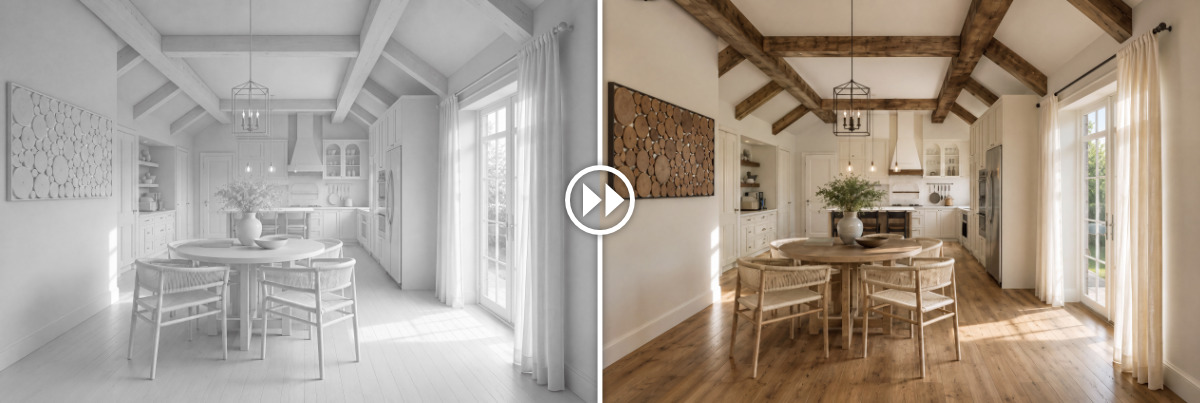
Conversely, photorealistic 3D rendering for real estate marketing relies on advanced Physically Based Rendering (PBR) workflows. This involves:
1. Subsurface scattering: Simulating how light penetrates marble, human skin, and foliage to give organic warmth.
2. Volumetric atmosphere: Adding realistic dust particles, morning haze, or evening fog to create cinematic depth.
3. Imperfection maps: Adding micro-scratches, subtle fabric folds, and natural stone grain variations. Absolute perfection looks fake; deliberate imperfection creates photorealism.
2.3. Pre-construction 3D visualization for developers: Mitigating risk and accelerating capital raised
From a financial standpoint, pre-construction 3D visualization for developers is a powerful risk mitigation tool. Securing construction loans and equity partner investments requires proving market demand. High-impact visualizations allow developers to:
- Launch pre-sale campaigns to hit equity thresholds required by institutional lenders.
- Present convincing proposals to municipal planning boards and zoning committees.
- Pre-lease commercial and retail spaces to anchor tenants before groundbreaking.
3. The intersection of photography, cinematography, and CGI in 3D rendering for property developers
The difference between an average 3D render and a breathtaking visual asset lies in the principles of photography and cinematography. A 3D software program is simply a virtual camera operating within a digital studio.
Cinematic lens on CGI:
[Framing & composition] ──► Rule of thirds, leading lines, foreground framing
[Optical dynamics] ──► Tilt-shift control, natural bokeh, depth of field
[Lighting direction] ──► Golden hour, blue hour, diffused soft daylight
[Surface physics] ──► Fresnel reflections, specular highlights, PBR textures
3.1. Composition, golden hour lighting, and lens selection in 3D environments
When composing a 3D rendering for property developers, an expert visual director applies the same rules used on a live photo set:
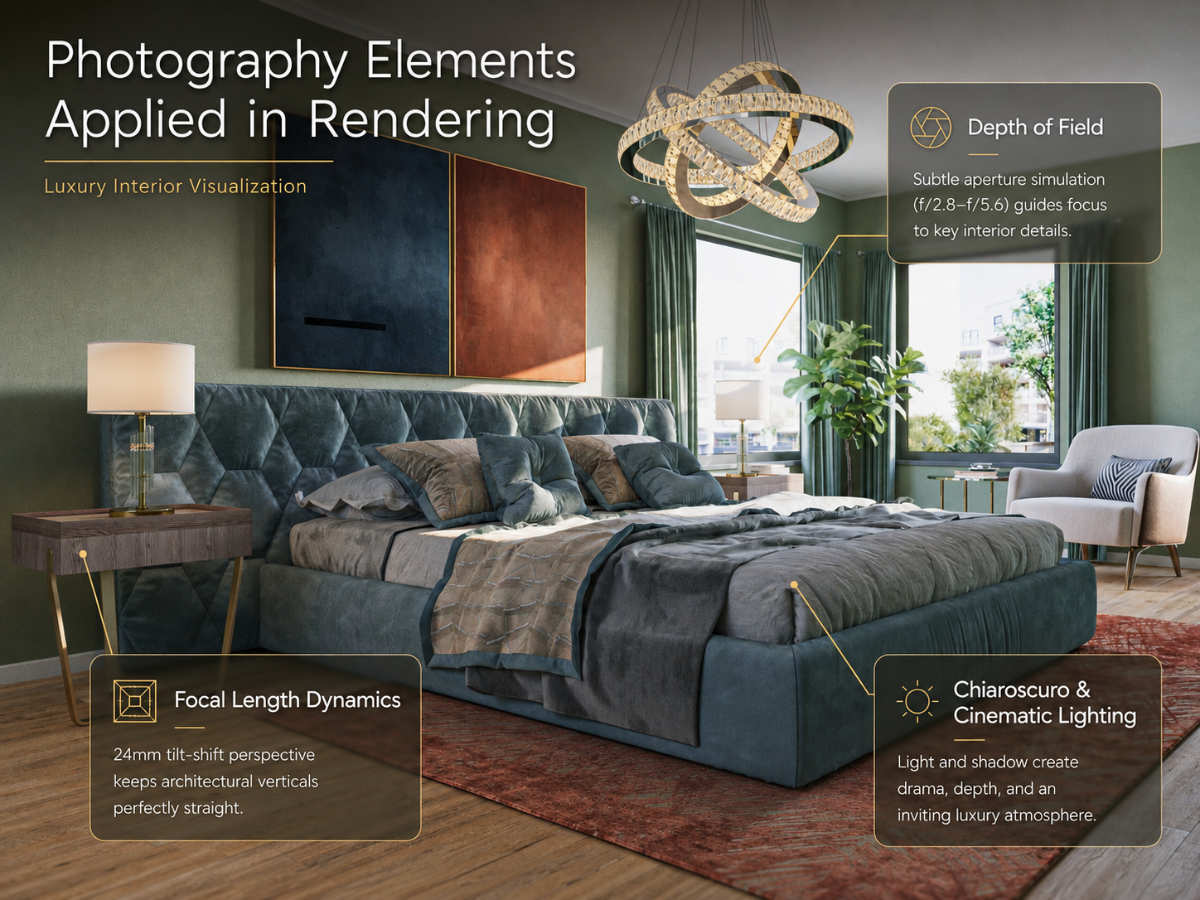
- Focal length dynamics: Using equivalent 24mm tilt-shift lens settings to ensure vertical architectural lines remain perfectly straight, preventing converging verticals that distort spatial geometry.
- Depth of field (Aperture simulation): Incorporating subtle background blur (f/2.8 to f/5.6 equivalent) on interior detail shots to direct the viewer’s eye precisely where you want it, whether onto a designer dining table or a custom copper faucet.
- Chiaroscuro & cinematic lighting: Instead of lighting a scene uniformly, leverage light and shadow (chiaroscuro) to create drama. A dusk render ("blue hour") accentuates warm interior lighting against a deep blue sky, creating an inviting, luxurious atmosphere.
3.2. Virtual staging vs. full CGI architectural walkthroughs
While static renders establish the initial visual anchor, interactive visual media takes engagement to another level.
|
Static renders |
Interactive CGI/Walkthroughs |
|
Hero visual collateral |
Deep spatial exploration |
Combining photorealistic static visuals with full CGI video walkthroughs allows potential buyers to experience the layout dynamically. A virtual camera tracking smoothly through a sunlit corridor into an open-plan living room mimics the feel of a high-end architectural film, driving dwell time on real estate web portals by up to 300%.
4. Why post-production outsourcing is essential for modern visual creators & developers
Whether you are a property developer running an in-house marketing team, a high-end real estate photographer expanding into CGI offerings, or a commercial videographer producing property trailers, the post-production bottleneck is a real challenge.
In-house processing (Bottleneck): [Field capture / 3D modeling] ──► [Exhaustive post-production] ──► [Burnt-out team / Delayed launch]
Outsourced ecosystem (Scalable): [Field capture / 3D modeling] ──► [Fotober scaled engine] ──► [Rapid delivery / Unlimited growth]
4.1. The bottleneck of in-house production
High-end visual asset creation is computationally heavy and labor-intensive.
- Rendering time: A single 4K photorealistic frame can take hours to render on standard workstations.
- Post-processing expertise: Achieving true color grading, sky replacement, foliage blending, and light balancing requires dedicated post-production specialists.
- Opportunity cost: When top photographers, cinematographers, or developers spend 60 to 70% of their work week sitting in front of editing software, they are not focusing on client acquisition, property acquisition, shooting on-site, or closing multi-million-dollar deals.
 In-house production always faces a lot of bottlenecks.
4.2. Speed-to-market: The competitive edge in real estate launch windows
In real estate development, market timing is critical. A delay of two weeks in launching a marketing campaign can mean missing a prime seasonal buying window (such as Spring or Autumn sales cycles), costing developers hundreds of thousands of dollars in holding costs and carrying interest.
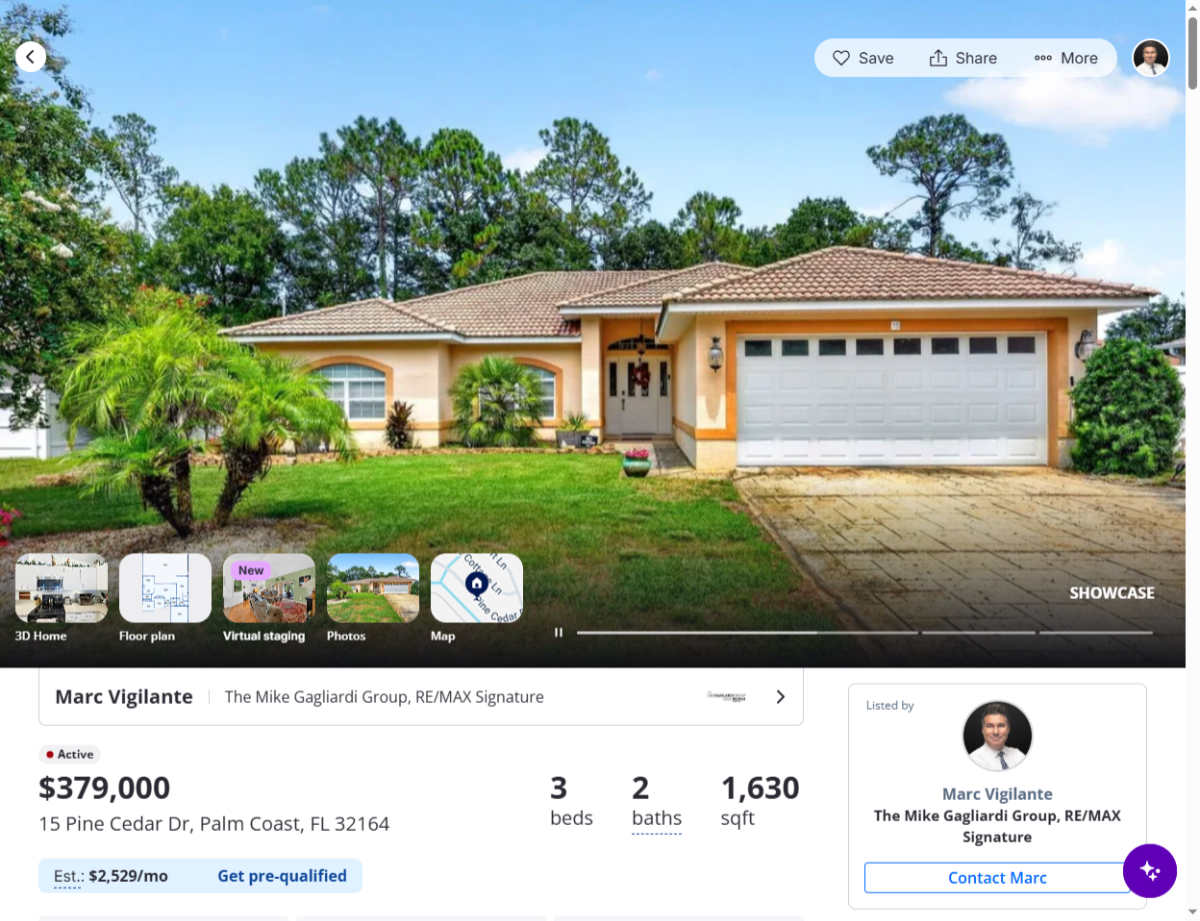 You can get your listings ready in much less time while providing more immersive media options.
Outsourcing post-production and 3D rendering for property developers enables project pipelines to run 24/7. While your local team sleeps, specialized global post-production teams process RAW imagery, fine-tune CGI materials, and execute complex multi-layer compositing.
4.3. Cost efficiency without sacrificing cinematic quality
Maintaining an in-house post-production suite complete with high-end render farms, licensed software, and full-time visual effects (VFX) artists carries immense fixed overhead. By leveraging an external post-production and editing house, agencies and developers convert fixed operational overhead into flexible, variable project costs. You pay only for the assets you need, when you need them, while maintaining world-class output standards.
5. Why Fotober is the strategic outsourcing partner for realtors, photographers, and videographers
In an industry flooded with generic editing providers, Fotober stands out as a specialized post-production partner for the real estate media sector. Designed from the ground up to support real estate professionals, architectural photographers, cinematographers, and property developers, Fotober serves as the invisible engine driving elite visual content.
|
Fotober integrated ecosystem | ||
|
FOR REAL ESTATE AGENTS |
FOR PHOTOGRAPHERS / CREATORS |
FOR PROPERTY DEVELOPERS |
|
Rapid listing turnaround |
Scale volume without staff |
End-to-end CGI & virtual media |
|
Consistent brand aesthetics |
Focus purely on creative capture |
Fast-track pre-construction sales |
|
High-converting media assets |
Lower operational overhead |
World-class photorealistic quality |
5.1. Tailored post-production excellence across all media formats
Fotober does not just process images; it understands spatial aesthetics and visual storytelling. The agency offers an end-to-end post-production ecosystem:
- Advanced real estate photo editing: Expert day-to-dusk conversions, sky replacement, flash-ambient (Flambient) blending, HDR processing, and perspective correction that keeps verticals sharp and natural.
- Architectural & pre-construction rendering services: Turning raw CAD files and architectural plans into hyper-realistic 3D interior and exterior renderings.
- Cinematic video post-production: Color grading, dynamic speed ramping, title animations, audio mixing, and seamless transitions for property highlight videos and aerial drone films.
- Virtual staging & floor plan redraws: Transforming vacant space photos or raw construction files into fully furnished, beautifully styled digital environments.
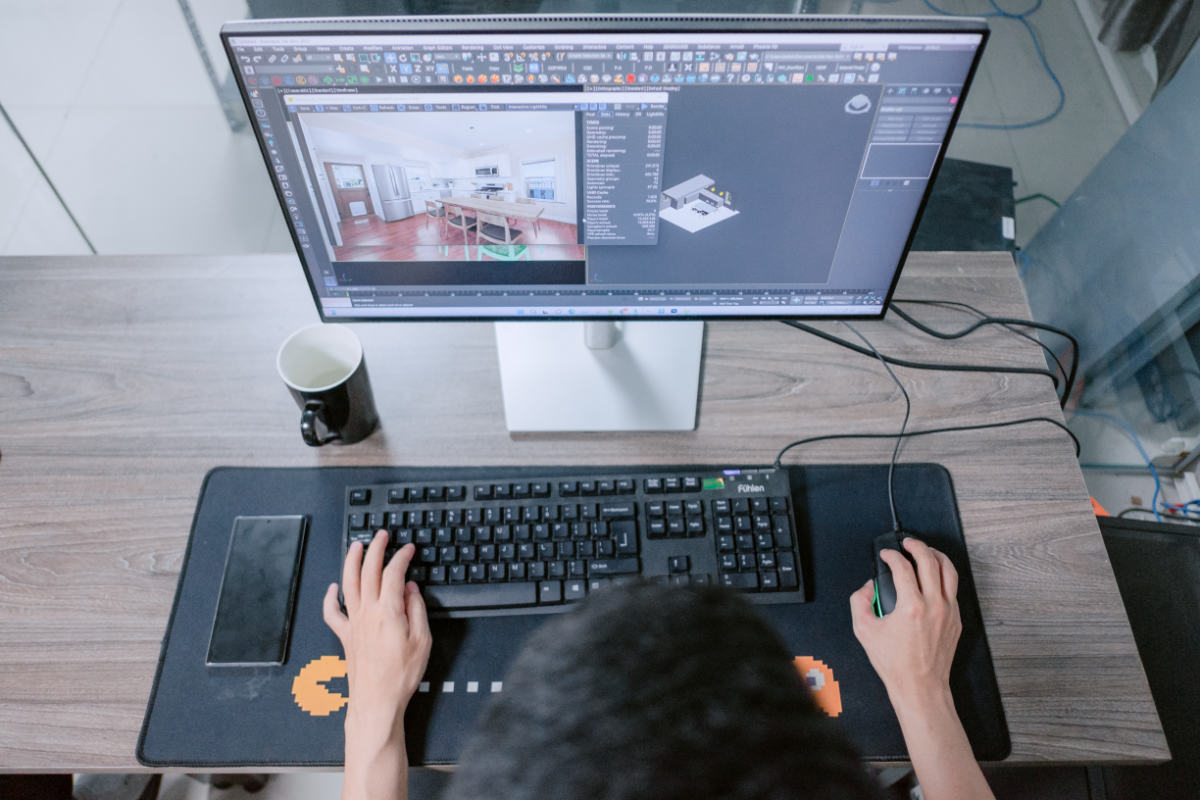
5.2. Seamless workflow integration for high-volume creators
For real estate photographers and videographers, capacity limits how fast your business can grow. You can only shoot a certain number of homes a day if you have to spend your nights editing.
Fotober acts as a seamless extension of your creative team:
- Overnight turnaround: Upload your RAW files, brackets, or video clips at the end of a shoot day, and receive polished, client-ready assets by the next morning.
- Rigorous quality control: Dedicated QA managers ensure that every output adheres strictly to your unique editing style, brand guidelines, and spatial accuracy standards.
- Scalability on demand: Whether you shoot 5 properties a week or manage visual asset rollouts for 50 developments simultaneously, Fotober scales effortlessly to match your volume without compromising quality.
5.3. Empowering visual artists to scale business ROI
By delegating post-production to Fotober:
- Photographers & videographers can double or triple their daily shooting schedule, elevating their gross revenue while dramatically reducing personal burnout.
- Real estate marketers & agents can deploy high-end, consistent marketing campaigns within hours of capturing a property, securing faster listings and higher purchase offers.
- Property developers gain access to high-end 3D architectural rendering services without maintaining costly in-house rendering infrastructure.
6. Step-by-step guide: Integrating 3D rendering into your real estate marketing campaign
To maximize return on investment when executing pre-construction 3D visualization for developers, follow this strategic production framework:
|
PHASE 1: Foundations |
PHASE 2: Art direction |
PHASE 3: Execution & polish |
|
CAD/BIM file export |
Material/texture selection |
Lighting & render passes |
|
Camera angle selection |
Interior styling & mood |
Fotober post-processing |
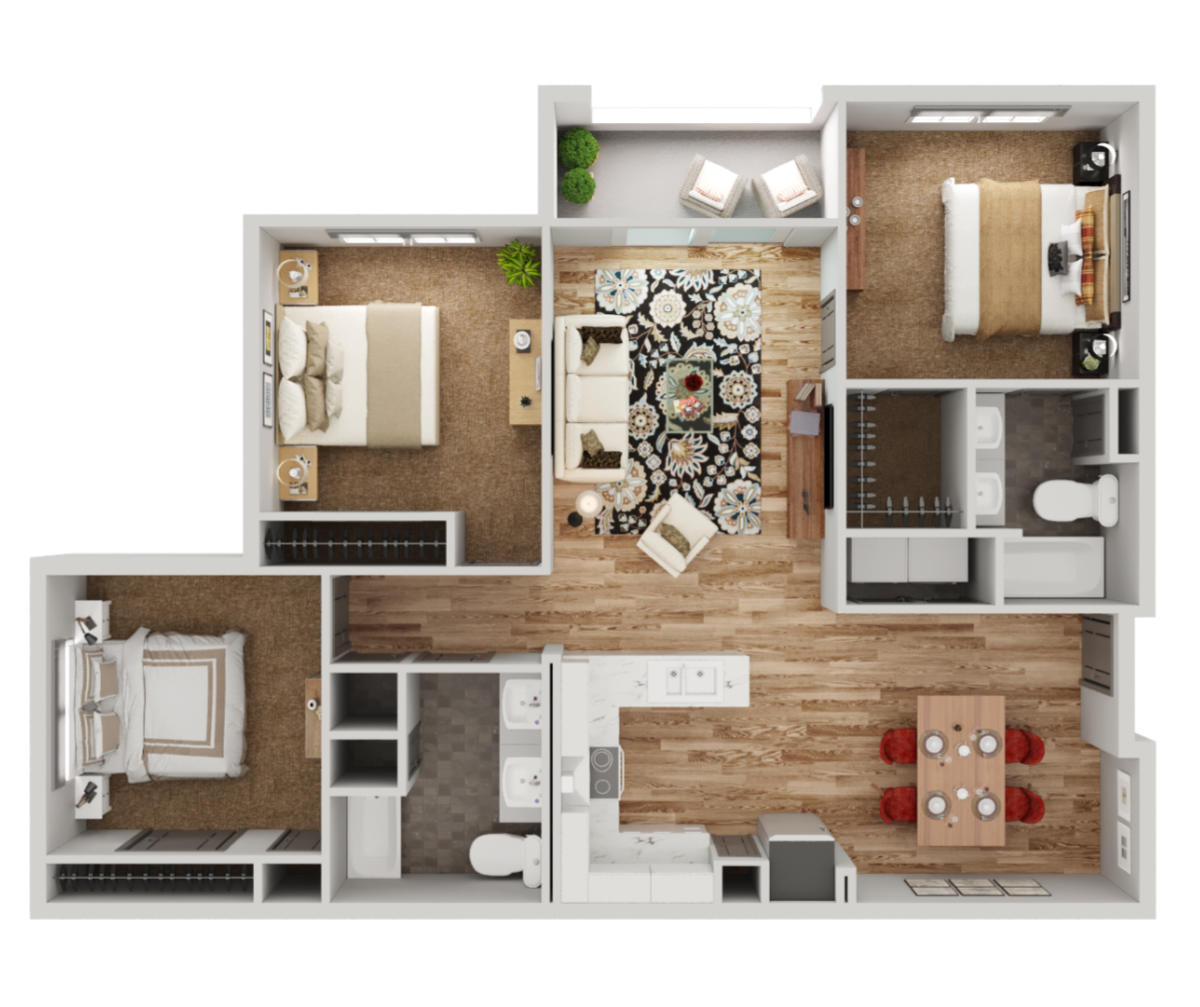
6.1. Phase 1: Conceptualization and architectural input
1. Source blueprint audit: Gather all architectural CAD drawings, elevations, floor plans, and landscape plans.
2. Determine key visual angles (Virtual camera placement):
- The hero exterior: Typically taken from a low angle to convey stature, shot during "Golden Hour" or dusk.
- The main living space: Wide-angle shot emphasizing open-plan layouts, natural light flow, and sightlines to outdoor amenities.
- Amenity highlights: Focusing on signature features such as infinity pools, rooftop lounges, or wellness centers.
6.2. Phase 2: Mood boards, lighting, and material selection
1. Material spec sheets: Provide exact digital swatches or physical material references for concrete finish, wood grains, metal patinas, stone veins, and glass reflectiveness.
2. Lighting atmosphere definition: Select the time of day and mood for each space:
- Morning light: Fresh, crisp, optimistic, ideal for master bedrooms and breakfast nooks.
- Mid-day sun: Bright, clear, expansive, great for exterior courtyard spaces and pools.
- Twilight/dusk: Sophisticated, warm, luxurious, perfect for high-end dining areas, facades, and evening entertainment spaces.

6.3. Phase 3: Rendering iterations & final cinematic polishing
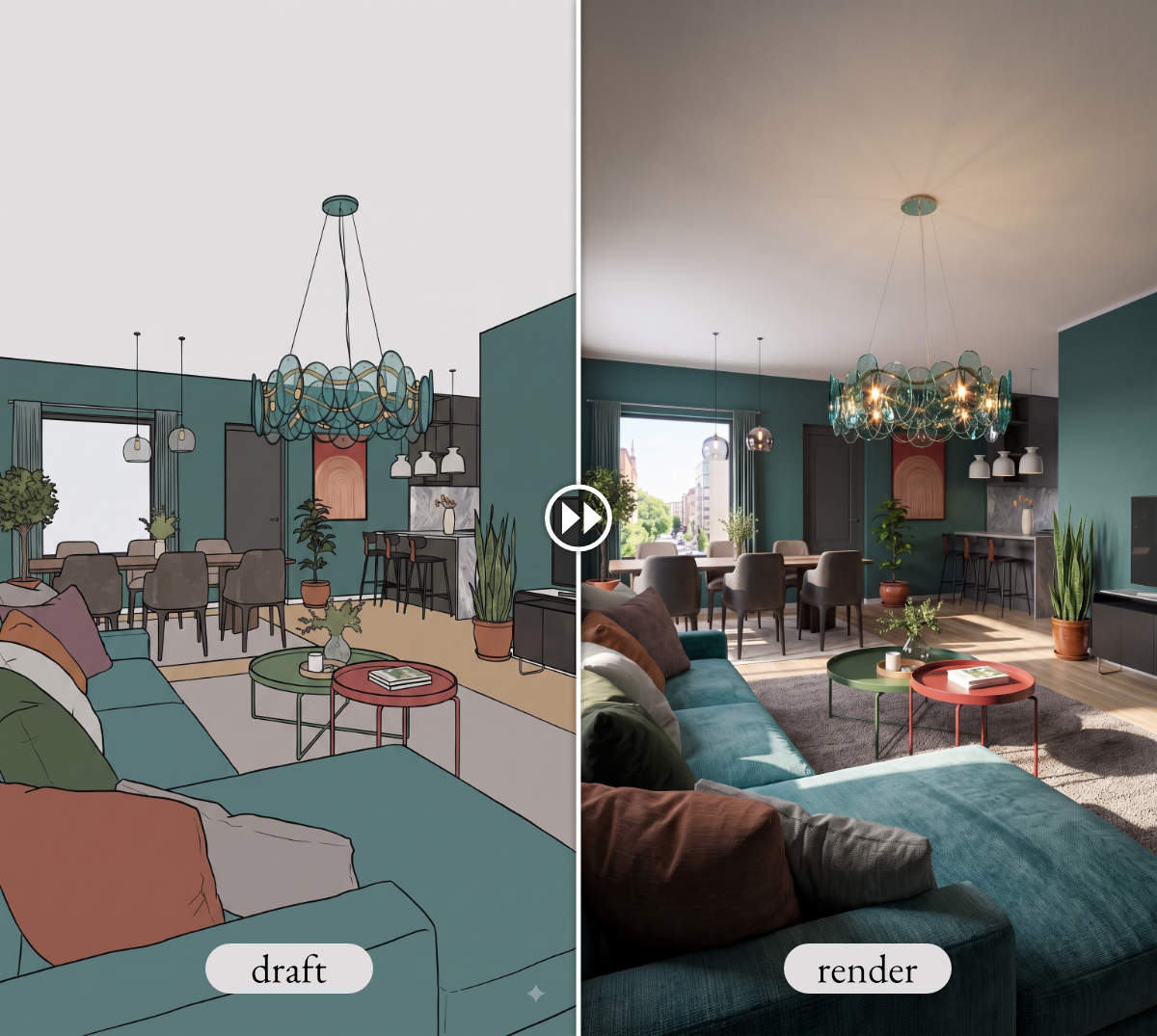
1. Clay render review: Review untextured, gray-model renders first to verify spatial geometry, camera placement, and composition without being distracted by color or textures.
2. Texturing and lighting pass: Apply PBR materials, volumetric environmental lighting, and interior lighting fixtures.
3. Post-production & color grading (The Fotober touch): The raw render output is brought into post-production for professional color grading, contrast balancing, lens vignette additions, and fine artistic polishing to ensure it looks indistinguishable from a real photograph.
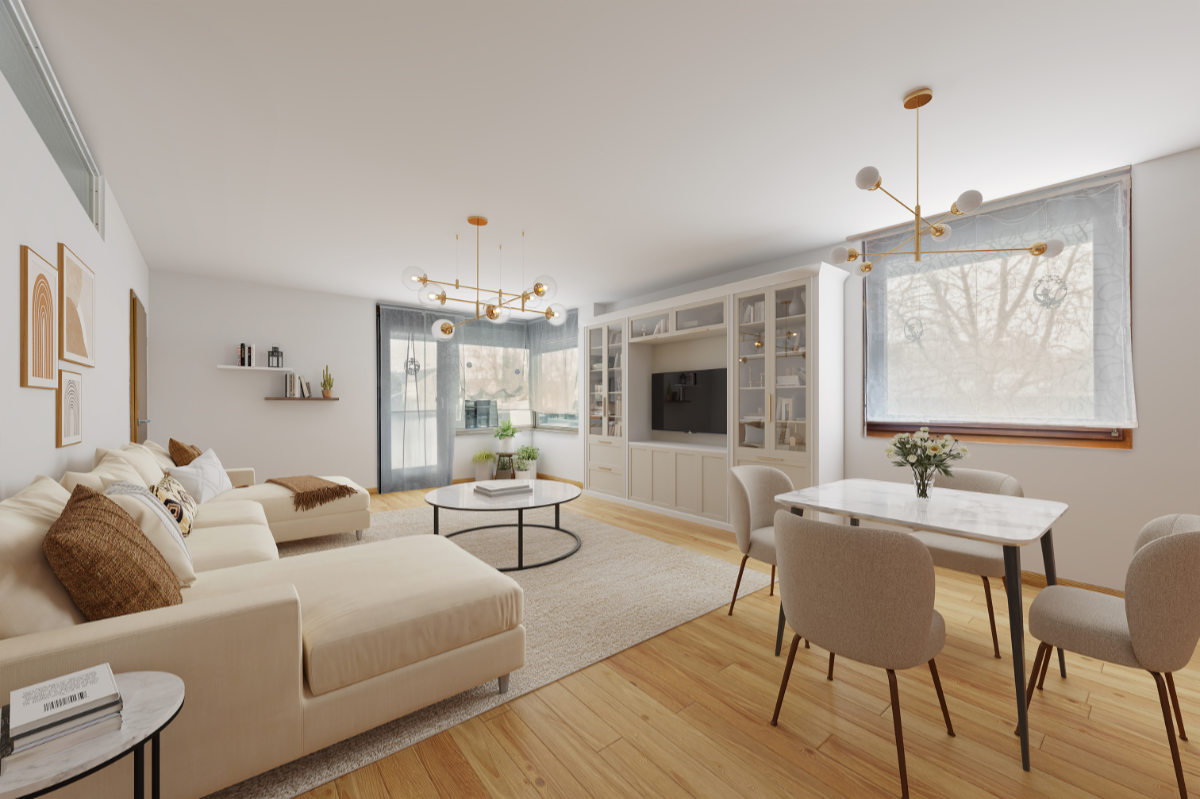 The finished product of 3D rendering for property developers.
7. Comparative analysis: Physical model vs. 2D rendering vs. photorealistic 3D visualizations
|
Metric |
Physical scale models |
2D architectural draftings |
Photorealistic 3D renderings (Fotober standard) |
|
Production speed |
Slow (Weeks/Mo) |
Moderate |
Fast & Iterative |
|
Cost efficiency |
Low (High cost) |
High |
Extremely high ROI |
|
Emotional buyer engagement |
Moderate |
Very low |
Maximum/high conversion |
|
Distribution flexibility |
Physical only |
Print/digital |
Multiple digital platforms |
|
Design modification flexibility |
Impossible |
Moderate |
Immediate virtual edit |
As illustrated, 3D rendering for property developers provides unparalleled flexibility, rapid turnaround, and superior emotional engagement compared to outdated physical scale models or flat 2D drawings.
8. Real-world case example: Preselling a luxury high-rise development with 3D rendering
Consider a 40-story luxury residential tower planned in a downtown metropolitan core. The development group required 35% pre-sales to unlock a $120 million construction loan. Construction had not yet started; the site was still an empty lot surrounded by utility hoardings.
8.1. The visual strategy
1. Drone aerial photomontage: High-resolution drone photography was captured at the exact altitude of the future penthouse units (Floor 35 to 40) at sunset.
2. Integrated 3D rendering: Utilizing photorealistic 3D rendering for real estate marketing, the architectural model was seamlessly composited into the actual real-world cityscape photo.
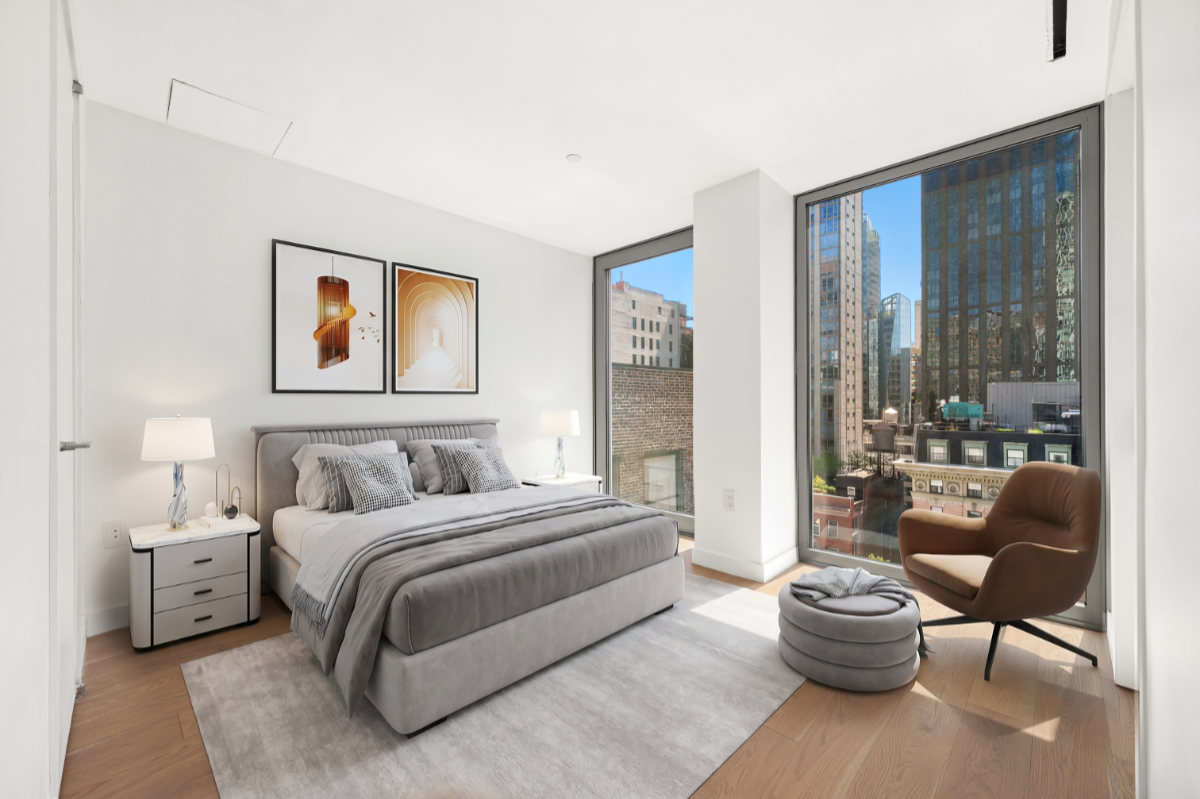
3. Interior virtual experience: Using 3D architectural rendering services for developers, the interior design team created detailed CGI walk-throughs showcasing floor-to-ceiling glass vistas looking out over the actual city skyline.
4. Post-production polish: All assets were routed through a streamlined post-production pipeline to ensure color harmony, lighting warmth, and consistent atmospheric realism across digital web assets, printed coffee-table brochures, and sales gallery touchscreens.
8.2. The result
With 3D rendering for property developers, the development team achieved their target presale quota three months ahead of schedule, unlocking construction financing and generating a waitlist for phase-two penthouse units, all before a single bucket of dirt was moved on site.
9. Future trends in pre-construction visualization
As technology accelerates, the line between physical reality and real-time CGI will continue to blur. Visual creators and developers must stay ahead of several emerging trends:
[Real-Time Ray Tracing] ──► Instantaneous material and light adjustments
[AI-Enhanced Post-Processing] ──► Faster asset optimization and texturing workflows
[Spatial Computing & VR] ──► Fully immersive, 1:1 scale walk-throughs for buyers
9.1. Real-time ray tracing and Unreal Engine pipelines
Real-time render engines allow property developers to walk buyers through digital homes live during sales appointments. Want to see how the kitchen looks with white oak cabinetry instead of dark walnut? A single click changes the material in real-time under physically accurate lighting conditions.
9.2. Hybrid aerial cinematography & CGI
Combining real cinematic FPV (First-Person View) drone footage with embedded 3D building renders allows developers to create dramatic video tours. A drone swoops down from the clouds, glides past the city skyline, flies directly through the virtual balcony of an unbuilt penthouse, and lands gracefully inside the rendered living room.
9.3. AI-assisted post-production optimization
AI tools are increasingly used to accelerate initial rendering passes and upscaling. However, the human artistic eye, mastery over color science, compositional mood, fine detail retouching, and architectural realism, remains irreplaceable. Partnering with elite human-driven post-production networks like Fotober ensures your assets maintain an authentic, organic aesthetic that pure automated algorithms cannot replicate.
10. Conclusion: Elevating your real estate vision with Fotober
In the modern real estate arena, high-quality visual content is your most powerful asset. Whether you are selling an unbuilt luxury estate, marketing a master-planned community, or scaling a real estate photography agency, the visual quality of your marketing assets directly impacts your bottom line.
Using 3D rendering for property developers, investing in 3D architectural rendering services for developers, leveraging photorealistic 3D rendering for real estate marketing, and mastering pre-construction 3D visualization for developers are no longer optional strategies; they are the core pillars of modern property sales.
By partnering with Fotober, you gain access to a world-class post-production powerhouse built specifically to support realtors, photographers, videographers, and property developers. Fotober takes the heavy weight of editing, color grading, virtual staging, photo manipulation, and rendering support off your shoulders, allowing you to scale your production volume, impress high-tier clients, and turn unbuilt visions into real-world commercial success.
Ready to elevate your real estate visual assets? Discover how Fotober can transform your post-production workflow, enhance your visual output, and accelerate your project sales. Visit Fotober’s site today to explore our full suite of real estate photo editing, video post-production, and 3D visualization support services.
Follow us on social media to stay updated with the latest staging and rendering strategies in the property market.
- Facebook: fotobermedia.co
- YouTube: Fotober
- TikTok: @fotober
- Instagram: fotober_media.
Related posts

Cincinnati Housing Market 2026: What Should Buyers & Sellers Expect?
October 20, 2026

Modern Luxe Interior Design: Elements, Style Guide and How to Stage It
October 10, 2026

Minimalist Interior Design: Characteristics, Style Guide, and Staging
October 8, 2026

Coastal Interior Design: Style Definition & Staging Guide
September 30, 2026
