




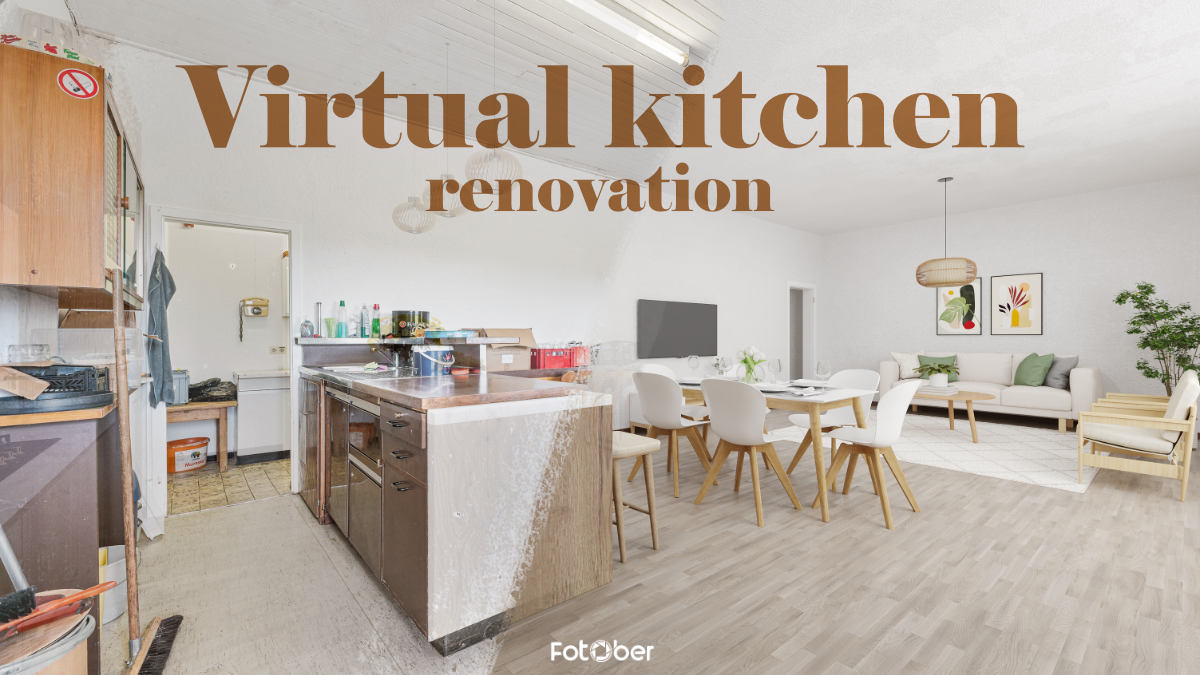
The Art of the Virtual Kitchen Renovation to Make Inviting Listings

Share:
Table of Contents
- 1. The evolution of visualizing space: From blueprints to virtual realism
- 2. Why virtual kitchen renovation is a game-changer for real estate
- 3. Inspiring virtual kitchen remodeling ideas to elevate listings
- 4. The anatomy of a high-converting virtual kitchen remodel photo
- 5. Why outsourcing virtual kitchen renovation is non-negotiable
- 6. Fotober: The ultimate creative partner for realtors, photographers, and videographers
- 7. The step-by-step collaborative workflow to create virtual kitchen renovation: From drab to fab
- 8. Conclusion
In the competitive landscape of modern real estate, visual storytelling has become the very engine of transactions. Ask any seasoned real estate photographer, architectural videographer, or top-producing agent: the kitchen sells the home. Yet, as professionals, we frequently encounter the same roadblock. You walk into a property with great bones, perfect spatial flow, and a prime location, but the kitchen is stuck in 1985. The cabinets are water-damaged oak, the countertops are stained laminate, and the lighting is harsh, yellow, and unflattering. To the untrained eye of a prospective buyer, this space represents a costly, stressful headache. To a photographer, it represents a visual nightmare that will drag down the entire portfolio of the listing.
This is where the intersection of architecture, advanced digital photography, and cutting-edge CGI converges to create a revolutionary solution: virtual kitchen renovation. By leveraging 3D kitchen renovation rendering and sophisticated digital staging, we can bypass the dust, delay, and immense cost of physical remodeling. Instead, we present buyers with a vision of what can be, rendered in photorealistic perfection. If that possibility has piqued your interest, we will now explore the science, aesthetics, and business of virtual kitchen transformations, and why partnering with an elite post-production agency like Fotober is the ultimate leverage strategy for real estate professionals today.
1. The evolution of visualizing space: From blueprints to virtual realism
|
Traditional 2D blueprints |
Basic SketchUp models |
Hyper-realistic 3D renderings |
|
Hard to interpret |
Lacked texture/light |
Indistinguishable from reality |
Historically, architects and realtors relied on blueprints, floor plans, or crude hand-drawn sketches to convey design potential. While these tools worked for builders, they failed to connect with the average buyer. Human beings are deeply emotional, visual creatures. We do not fall in love with line drawings; we fall in love with how light refracts off a polished quartz countertop at sunset.
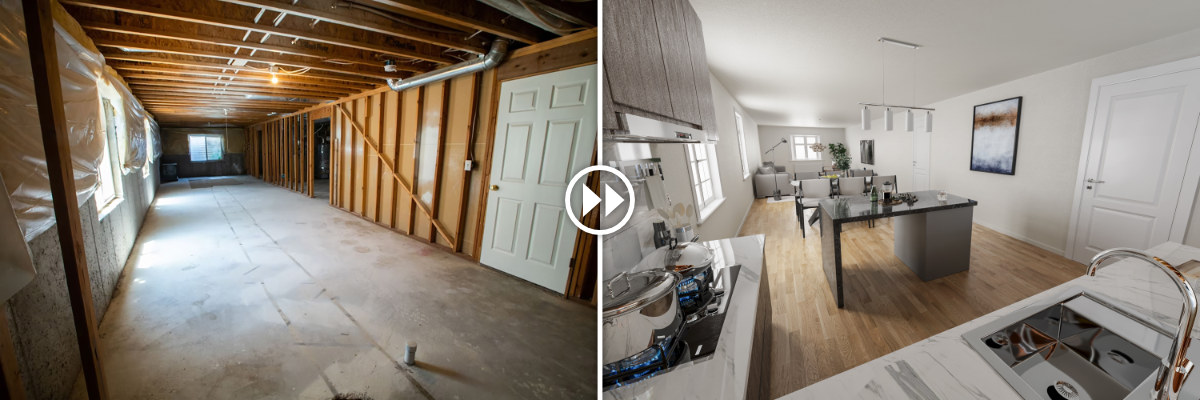
With the advent of computer-aided design (CAD) and subsequently, advanced ray-tracing render engines, the industry shifted. Today, virtual kitchen renovation has evolved to a point where the digital output is indistinguishable from a high-end architectural photograph.
As photographers, we understand that a photograph is a capture of light interacting with physical surfaces. In a virtual environment, we recreate this physics. We calculate how ambient occlusion shadows pool in the corners of shaker cabinets. We simulate how 5000K LED pendant lights bounce off polished concrete floors. This level of realism transforms a listing from a "fixer-upper" into an aspirational lifestyle. It allows buyers to mentally move in before they even set foot on the property.
2. Why virtual kitchen renovation is a game-changer for real estate
From an investment and marketing standpoint, the traditional route of physically remodeling a kitchen before listing it is rarely viable. A minor kitchen remodel can easily cost upwards of $25,000, while a major overhaul can exceed $80,000. Furthermore, construction introduces delays, months of contractors, permits, and supply chain issues while the property sits off the market.
|
Virtual kitchen renovation | ||
|
Cost efficiency |
Time to market |
Emotional hook |
|
Save $20k-$80k over physical staging. |
In hours/days, not months of construction. |
Sell the lifestyle, not the current mess. |
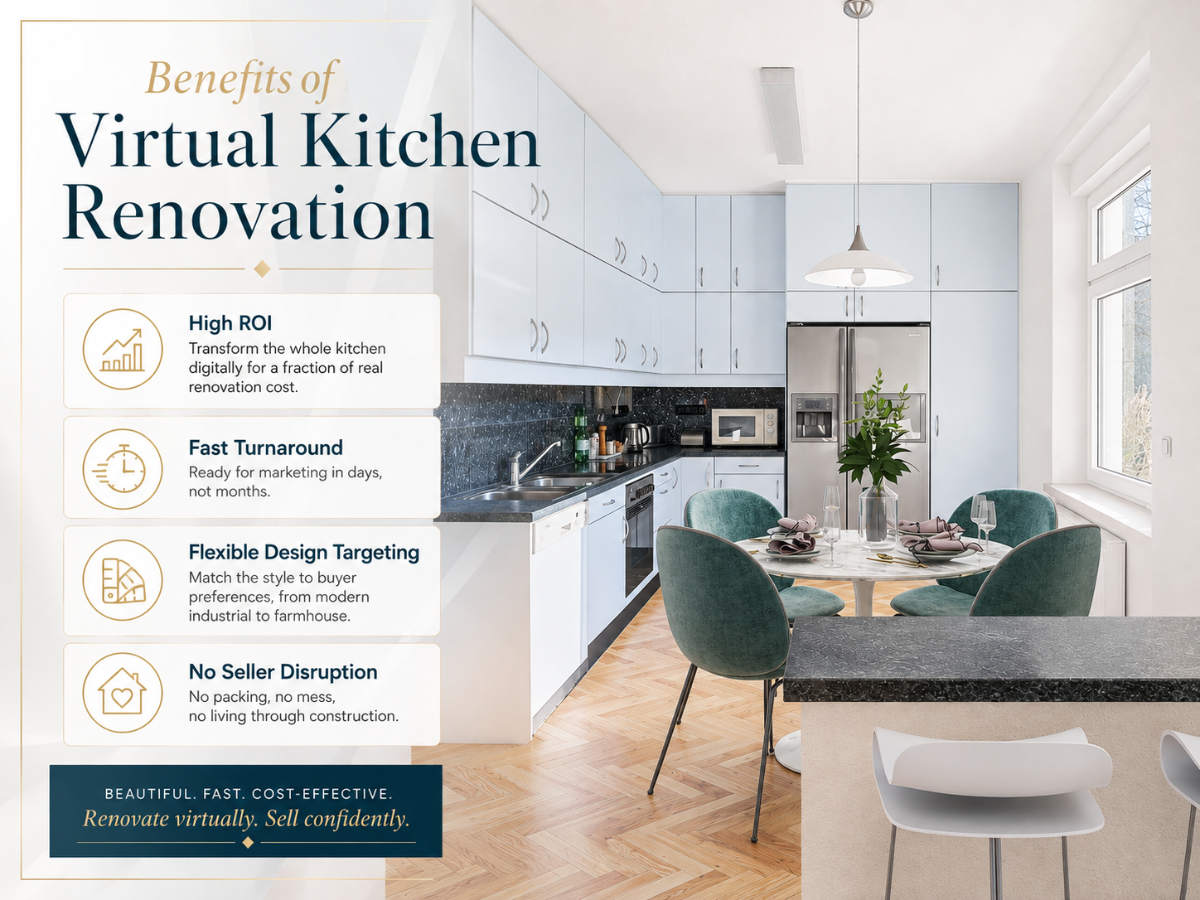
Virtual kitchen renovation solves these pain points simultaneously:
- Unrivaled ROI: For a fraction of the cost of a single physical appliance, you can digitally overhaul an entire kitchen.
- Zero construction latency: Instead of waiting six months for a contractor, a professional virtual renovation can be executed and ready for marketing in a matter of days.
- Targeted demographic marketing: If the local demographic prefers modern industrial design, you can render the kitchen to match. If they prefer classic farmhouse, you can pivot the design with a few clicks. You are no longer locked into one physical design choice.
- Preserving seller sanity: Sellers do not have to pack up their lives or live in a construction zone while their home is prepared for the market.
When you present a high-quality virtual kitchen remodel photo alongside the original "as-is" photograph, you do not just show a room; you show potential. You show the buyer that their dream home is already here, waiting to be unlocked.
3. Inspiring virtual kitchen remodeling ideas to elevate listings
When executing a virtual remodel, we must think like both architects and interior designers. The goal is not just to make the kitchen "look clean," but to apply contemporary design principles that resonate with luxury and high-end aesthetics.
Here are four high-converting virtual kitchen remodeling ideas that can transform any mundane space into a showstopper:
|
Concept |
Key materials |
Lighting strategy |
|
Modern Minimalism |
Matte black, white quartz |
Hidden LED, Recessed |
|
Warm Biophilic |
White oak, fluted wood panels |
Soft morning sunlight |
|
Bold Transitional |
Navy/Forest green, brass |
Statement pendants |
|
Industrial Loft |
Concrete, exposed brick, steel |
Edison bulbs, track |
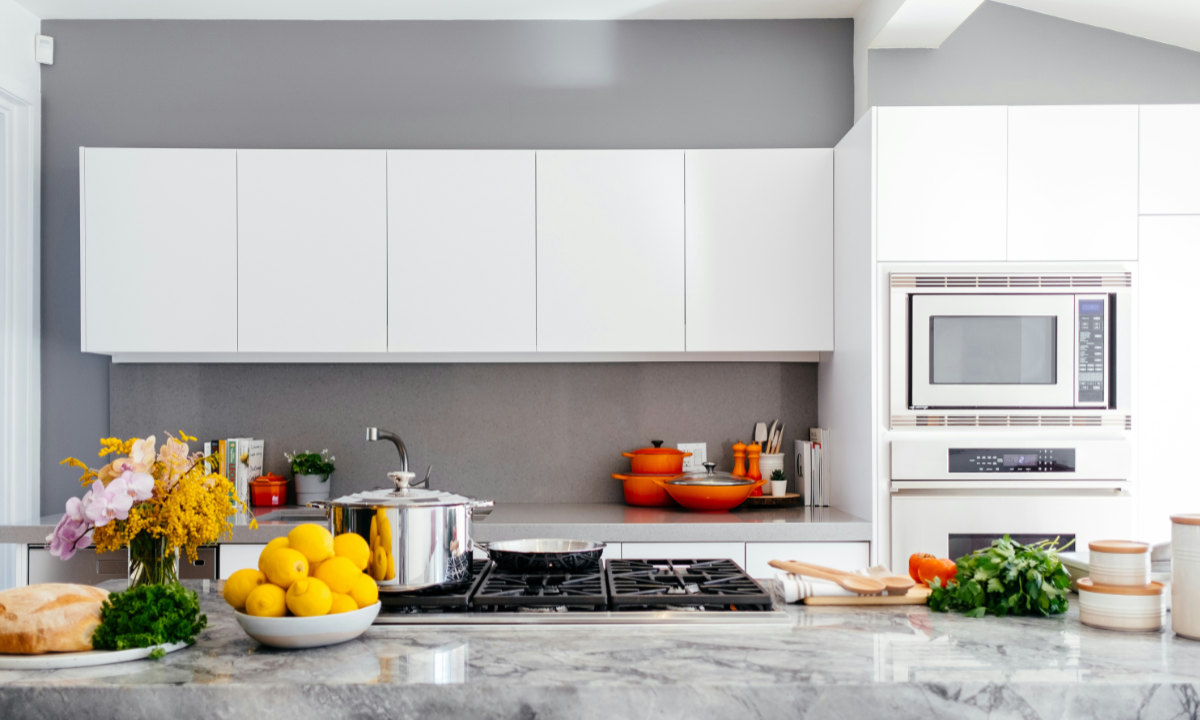
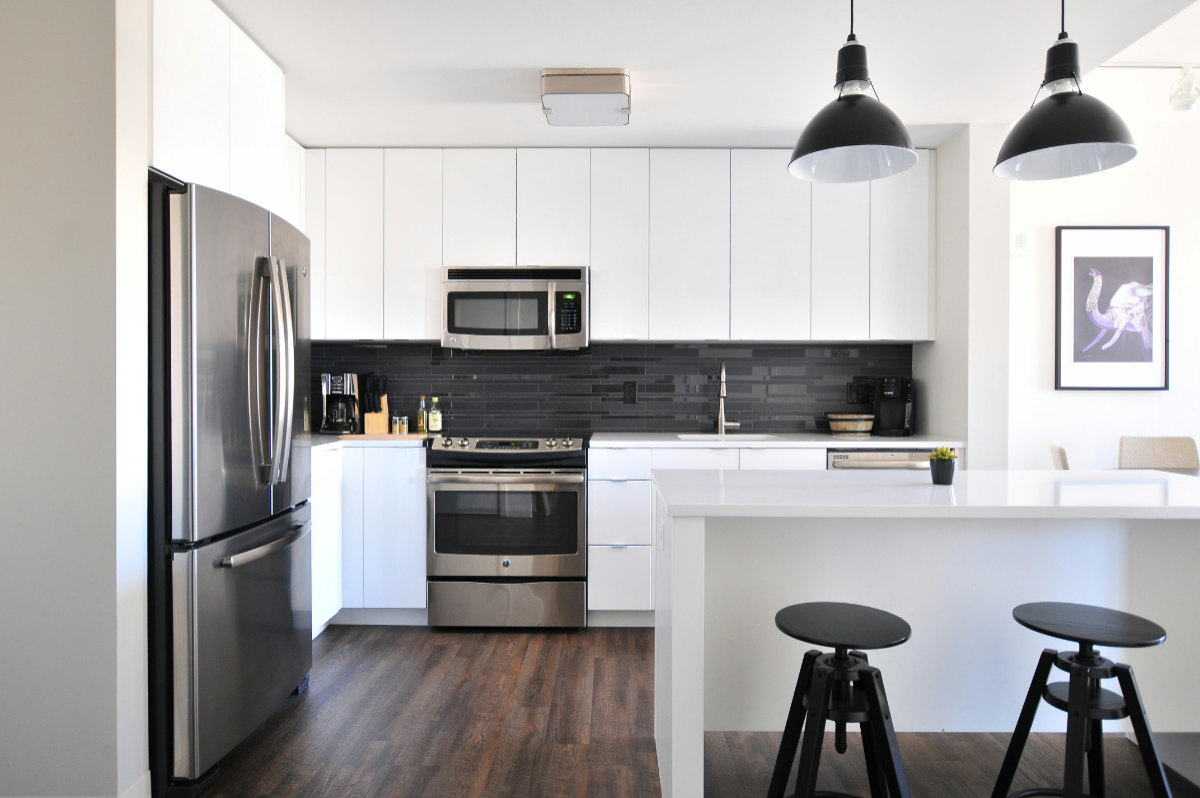
3.1. The modern minimalist (Monochromatic & sleek)
For urban condos and contemporary suburban homes, minimalism remains king.
- The blueprint: Replace bulky, dated raised-panel cabinets with flat-panel, handleless Italian-style cabinetry in matte black or soft charcoal gray.
- Surfaces: Introduce white quartz countertops with subtle, book-matched Calacatta marble veining. Extend this material up the wall as a full-height backsplash to create a seamless, monolithic look.
- The photographic angle: Render this kitchen from a low, wide-angle perspective to emphasize horizontal lines and spatial flow. Use soft, diffused interior lighting to highlight the matte textures and prevent harsh glare on the polished stone.
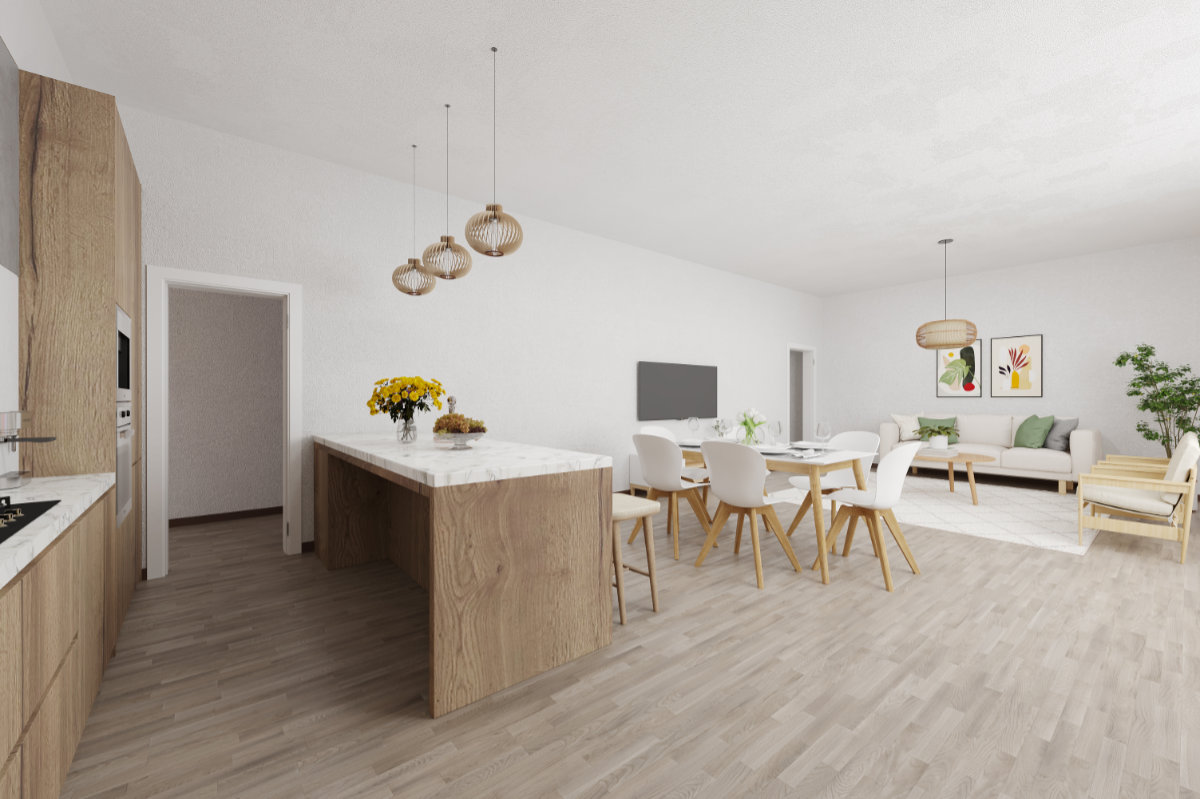
3.2. The warm biophilic (Natural wood & organic tones)
Post-pandemic design trends have leaned heavily toward organic, natural elements that bring the outdoors in.
- The blueprint: Swap out dark cherry wood for beautiful rift-sawn white oak or light ash cabinets. Integrate fluted wood detailing on the kitchen island to add architectural texture.
- Surfaces: Combine the warm wood tones with a honed soapstone or concrete-look countertop. Add open shelving made of reclaimed wood to display styled ceramics and greenery.
- The photographic angle: Simulate warm morning golden-hour sunlight streaming through a nearby window. This creates beautiful long shadows and highlights the rich grain of the wood, evoking feelings of comfort, peace, and luxury.
3.3. The bold transitional (Contrast & character)
Transitional design bridges the gap between traditional charm and modern clean lines, perfect for family homes in established neighborhoods.
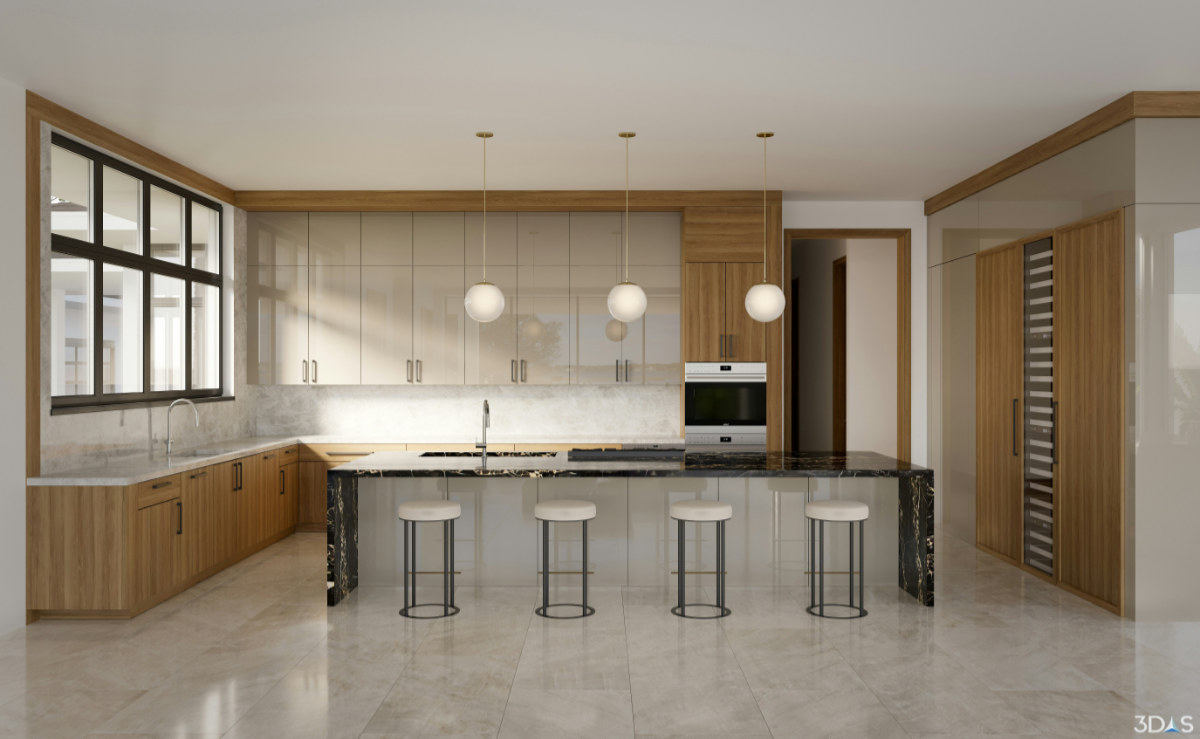
- The blueprint: Keep classic shaker-style cabinets but paint them in deep, sophisticated hues like forest green, navy blue, or rich espresso. Use brass or champagne bronze hardware to act as "jewelry" for the kitchen.
- Surfaces: A classic white farmhouse apron-front sink paired with white subway tile laid in a herringbone pattern adds depth without cluttering the view.
- The photographic angle: Utilize a medium-shot focal length (around 35mm equivalent) to focus on the craftsmanship of the island, the gleam of the brass hardware, and the texture of the tiled backsplash.
3.4. The industrial loft (Raw & textural)
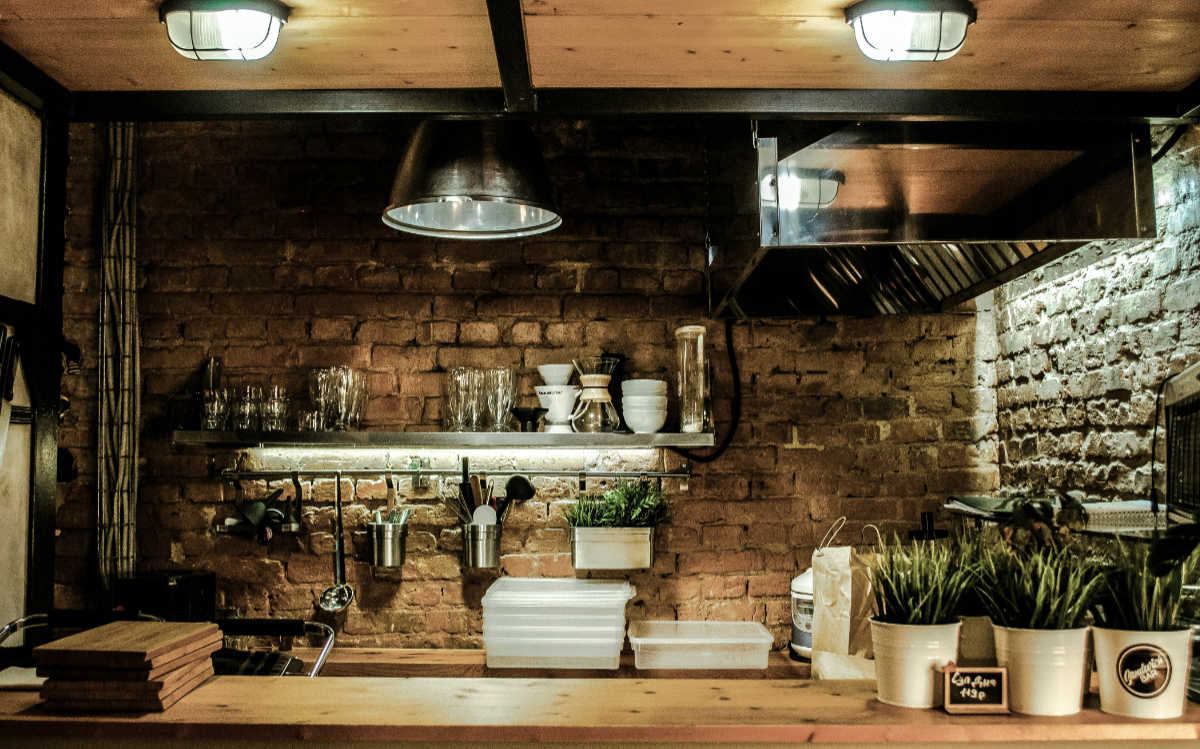
Ideal for virtual kitchen renovation in converted warehouses, lofts, or modern homes with an edge.
- The blueprint: Exposed brick backsplashes, matte black steel framing for open shelving, and distressed concrete floors.
- Surfaces: Thick-slab concrete countertops or dark stainless steel.
- The photographic angle: Emphasize high ceilings and raw textures. Use dramatic, high-contrast lighting (chiaroscuro) to emphasize the ruggedness of the brick and the sleekness of the metal.
4. The anatomy of a high-converting virtual kitchen remodel photo
Creating a photorealistic virtual kitchen remodel photo requires far more than dropping 3D models into a template. It requires a deep understanding of photographic physics, material science, and spatial composition. If a rendering looks "fake" or "cartoonish," it instantly breaks trust with the buyer. Here is the technical and artistic checklist that separates amateur renders from master-level architectural visualizations:
|
Light physics |
PBR texture mapping |
Camera simulation |
|
Refraction, bounce, and ambient occlusion. |
Micro-scratches, grain, roughness, and gloss. |
Depth of field, lens flare, natural perspective warping. |
4.1. Physically based rendering (PBR) materials
In real life, no surface is perfectly flat or perfectly clean. To make a 3D kitchen renovation rendering look real, we must use PBR textures. This means:
- Roughness maps: Determining how glossy or matte a cabinet is.
- Normal maps: Adding micro-reliefs to brick, tile grout, or wood grain so they catch the light realistically.
- Specularity: How light reflects off different materials: stainless steel reflects differently than polished marble or painted drywall.
4.2. The physics of light (Global illumination)
Amateur renders often look flat because they use uniform, artificial digital light. A professional virtual kitchen renovation uses global illumination (GI) algorithms to simulate how light actually behaves:
- Color bleeding: If you have dark wood floors, the light bouncing off those floors should carry a subtle warm, brown hue onto the underside of the white cabinets.
- Soft shadows: Shadows should not be hard black lines. They must soften as they stretch away from the light source, featuring realistic penumbras.
- Refraction: Light passing through pendant glass or window panes must bend and scatter realistically.
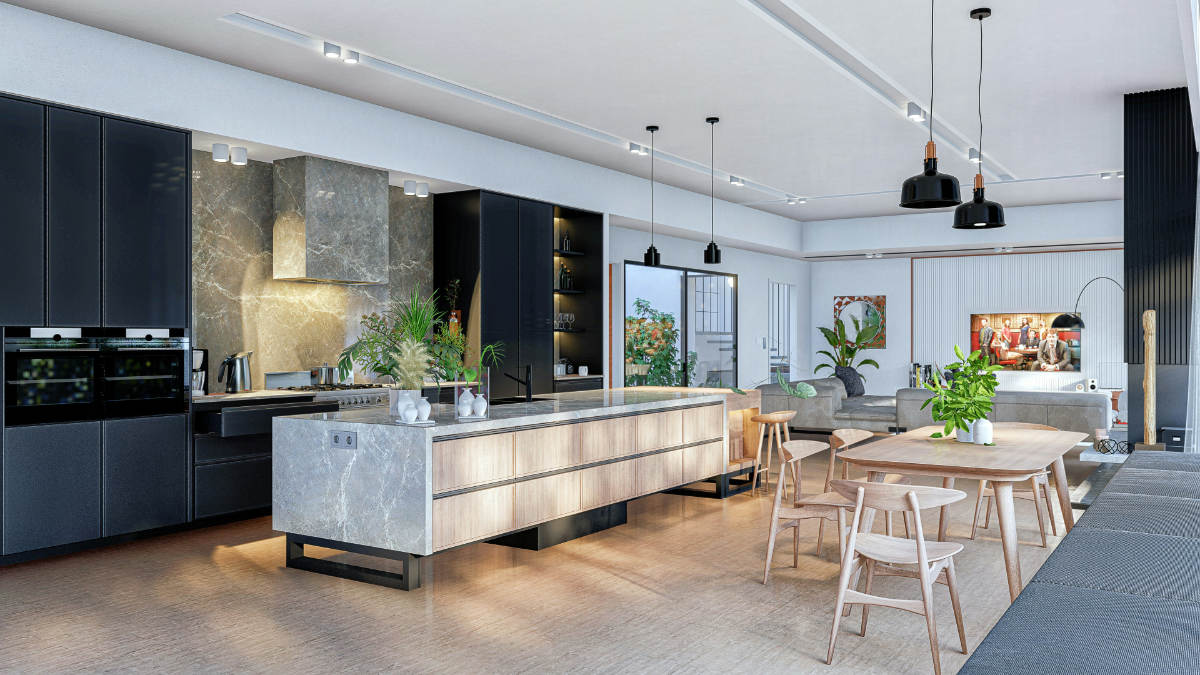
4.3. Camera lens simulation
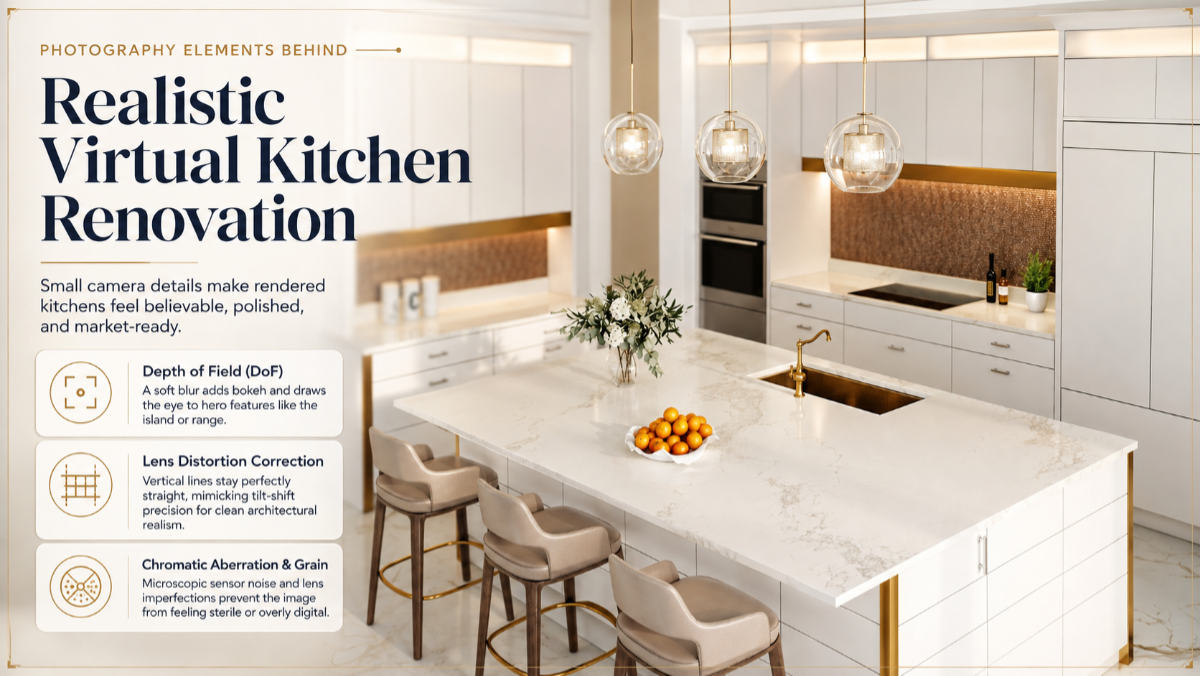
A virtual camera must behave like a physical DSLR or mirrorless camera:
- Depth of field (DoF): A subtle blur in the background or foreground (bokeh) helps direct the buyer’s eye to key design features, like a luxury range stove or a styled island centerpiece.
- Lens distortion correction: Vertical lines (like door frames and cabinet edges) must be perfectly vertical. Professional rendering software mimics tilt-shift lenses to eliminate perspective distortion.
- Chromatic aberration & grain: Adding a microscopic amount of camera sensor noise and lens imperfections prevents the image from looking "sterile" or overly digitally perfect.
5. Why outsourcing virtual kitchen renovation is non-negotiable
As a real estate photographer, videographer, or agent, your time is your most valuable asset. The modern real estate market moves at breakneck speed. While you might understand the concept of 3D rendering, the actual execution is an entirely different beast. Here is why trying to handle 3D modeling and rendering in-house is a massive bottleneck, and why professional outsourcing is the only logical business path:
|
The time & cost bottleneck (in-house vs outsourced) | |
|
In-house 3D production (The hard way) |
Outsourcing to Fotober (The smart way) |
|
❌ Thousands spent on high-end GPU workstations |
Paid-per-project model; zero overhead. |
|
❌ 10-20 hours spent modeling and rendering |
Images returned within 24-48 hours. |
|
❌ Steep learning curve for complex software |
Architectural-grade quality, guaranteed. |
|
❌ Limits your ability to shoot new properties |
Scale your business by shooting more homes. |
- The technical barrier: High-end rendering requires massive computing power. To render a single high-resolution image with complex ray-tracing can take hours, even on a high-spec workstation. It also requires expensive software licenses (like 3ds Max, Corona Renderer, V-Ray, or Blender) and years of training to master.
- Opportunity cost: Every hour a photographer spends adjusting vertices, mapping textures, or waiting for a render bar to complete is an hour they are not out in the field shooting new properties, building relationships, or closing deals. For realtors, every hour spent wrestling with consumer-grade design apps is an hour not spent hosting open houses or negotiating contracts.
- Quality consistency: Architectural visualization is an art form. Professional editors understand how to blend digital elements seamlessly with the original photograph's lighting, angle, and grain structure. A poorly edited photo looks deceptive and cheap; a professionally edited one looks like a high-end editorial spread from Architectural Digest.
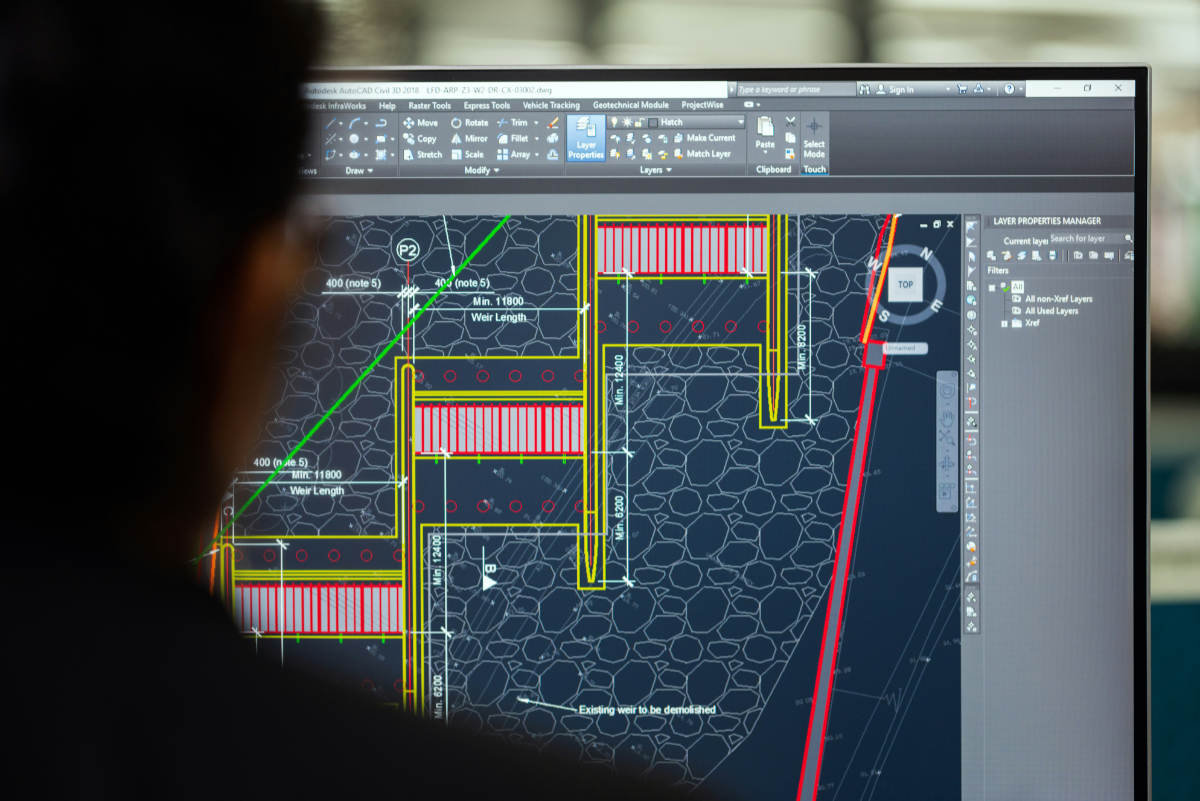
By outsourcing post-production of virtual kitchen renovation, you transform your workflow from a linear bottleneck into a scalable, high-efficiency system.
6. Fotober: The ultimate creative partner for realtors, photographers, and videographers
|
For photographers |
For videographers |
For realtors |
|
Turn raw captures into high-end 3D portfolios. |
Integrate seamless CGI into motion assets. |
Convert stale listings into premium visual magnets. |
For creative professionals and real estate marketers worldwide, Fotober represents the pinnacle of digital real estate post-production. We do not just edit photos; we build visual realities that inspire buyers and drive transactions.
Whether you need a simple virtual refresh or a complete virtual kitchen renovation, Fotober acts as your dedicated, back-end production studio, allowing you to scale your business effortlessly.
6.1. How Fotober empowers real estate photographers & videographers
As a photographer or videographer, your reputation rests on the quality of your deliverables. Fotober acts as your secret weapon:
- Speed & scale: Upload your raw files or base images, specify your design direction (or let our design experts choose), and receive stunning, ready-to-publish assets within a rapid turnaround window. You can shoot multiple properties a day, confident that your editing pipeline is running flawlessly in the background.
- Advanced CGI integration: We don’t just slap furniture over old spaces. Our artists meticulously align the perspective, match the ambient light color temperature of your original shots, and render lifelike textures that respect the architectural boundaries of the room.
- Consistency across media: If you are shooting both stills and video, Fotober can help ensure that the virtual design language remains consistent across your entire package, establishing a cohesive narrative for the listing.
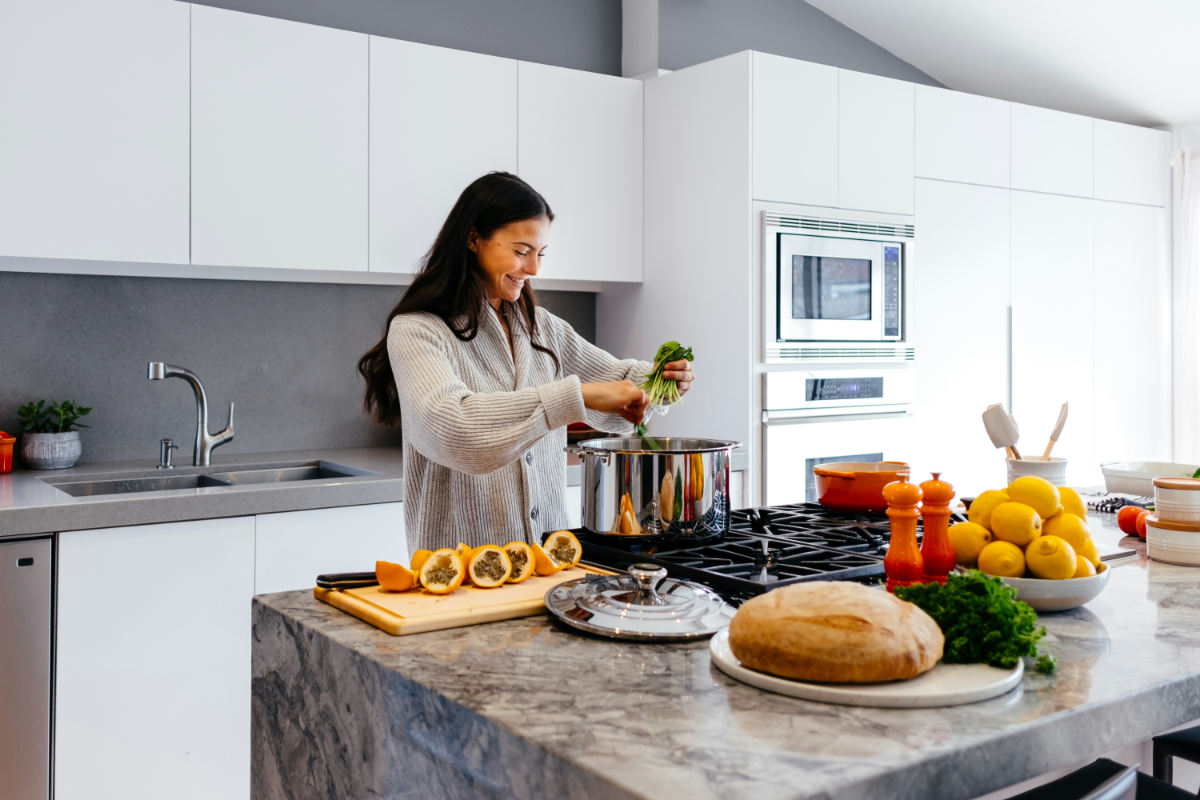
6.2. How Fotober elevates real estate agents & brokers
For real estate agents, listing presentation is directly tied to your commission and your brand authority:
- Unlock frozen listings: Have a listing that has been sitting on the market for months because of an outdated kitchen? Refresh the listing with a gorgeous virtual kitchen remodel photo from Fotober and watch the inquiry rates skyrocket.
- Attract high-value sellers: When you walk into a listing presentation armed with a portfolio of before-and-after virtual renovations you’ve done with Fotober, you prove to the sellers that you are a forward-thinking, tech-savvy marketer. This wins you more listings at higher commission rates.
- Cost-efficient marketing: Avoid the expense of physical staging while showcasing the true potential of the home. Use Fotober's renderings for digital ads, print brochures, and large-format displays at open houses.
6.3. The Fotober edge: Unmatched quality, experience, and collaboration
At Fotober, we combine an artistic eye with technical mastery. Our team consists of skilled digital artists, interior design specialists, and quality control experts who understand the nuances of architectural photography.
We don't believe in generic templates. Every kitchen we renovate virtually is treated as a unique piece of architecture, tailored to fit the bones of the property and the target demographic of the market. Our commitment to clear communication, competitive pricing, and uncompromising quality makes us the preferred partner for real estate professionals around the globe.
7. The step-by-step collaborative workflow to create virtual kitchen renovation: From drab to fab
Partnering with Fotober is an incredibly smooth, streamlined process designed to fit seamlessly into your existing workflow:
|
1. Capture & upload photo |
2. Submit & define vision |
3. Professional CGI rendering |
4. Download & close deals |
|
Raw file showing current kitchen |
Select style, materials, vibe |
Fotober team works magic |
Deliver stunning high-res photos |
1. Capture the "as-is" space: Shoot the existing kitchen using your professional setup. Make sure to capture a clean, wide-angle shot that highlights the overall layout, even if the appliances and cabinets are outdated.
2. Submit your project & design brief: Upload your high-resolution images to Fotober. Provide us with your design ideas. Want a "Modern Minimalist" look with white oak accents and matte black fixtures? Or do you prefer to let our design team analyze the property’s architectural style and choose the perfect trending design?
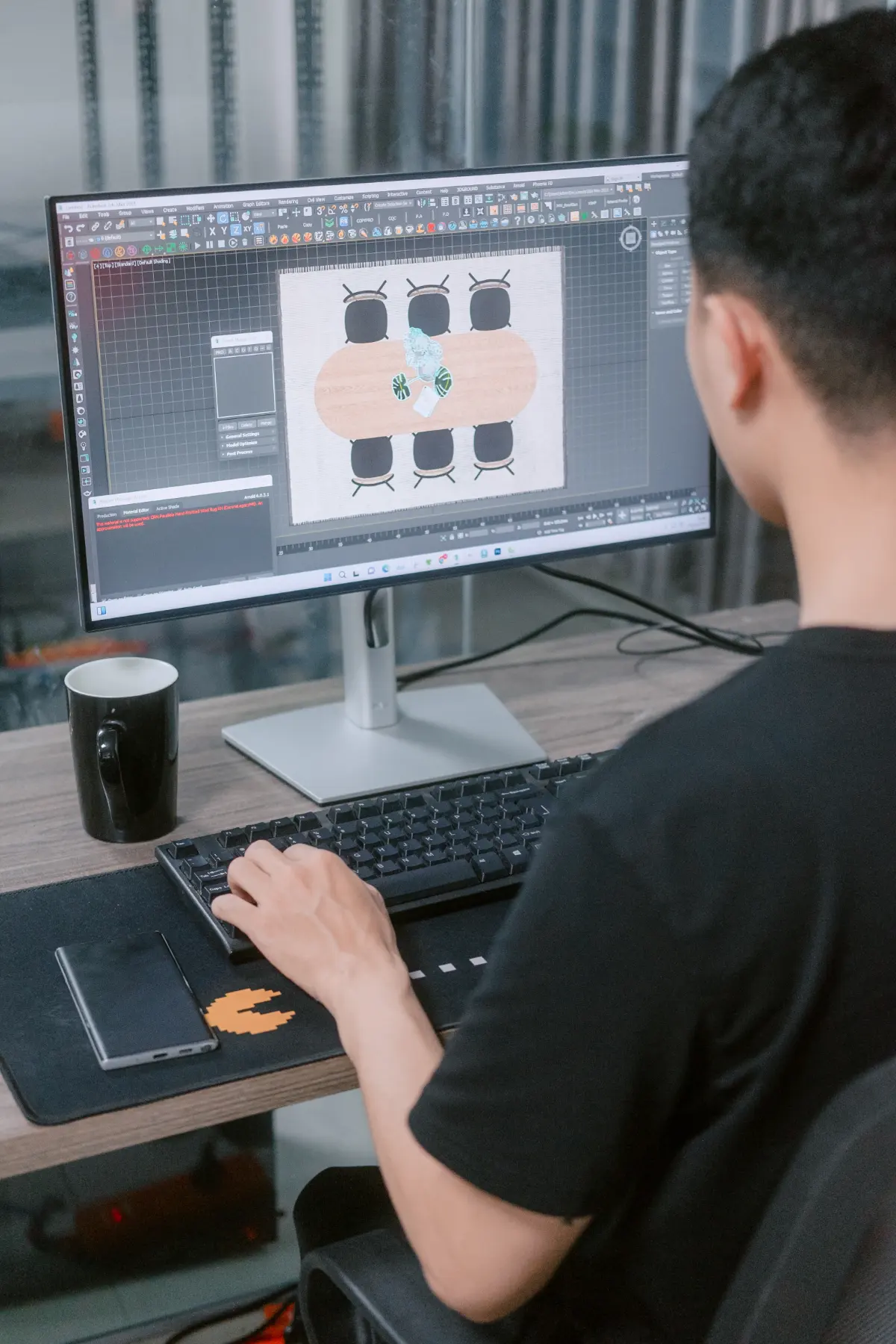
3. The rendering phase: Our digital artists build a precise 3D model over your photo, aligning the perspective grid perfectly. We apply premium PBR textures, build realistic lighting schemes, and render the final scene using state-of-the-art engines.
4. Review and download: You receive your high-resolution, photorealistic virtual kitchen renovation. If any minor adjustments are needed, our responsive feedback loop ensures they are addressed promptly. Once approved, you are ready to dazzle your clients, supercharge your listings, and close the deal.
8. Conclusion
The physical world has boundaries: budgets, supply lines, physics, and time. The digital world has none of these limitations, only opportunities. By integrating virtual kitchen renovation into your marketing toolkit, you free yourself from the constraints of "what is" and embrace the limitless potential of "what could be." You save your clients money, elevate your brand, and create visual assets that demand attention in a crowded, noisy digital marketplace.
Do not let outdated kitchens hold back your listings, your photography business, or your videography agency. Partner with the industry leaders in real estate photo editing and 3D rendering. Let Fotober handle the heavy lifting of digital post-production while you focus on what you do best: capturing beauty, building relationships, and closing deals.
Are you ready to transform your listings and supercharge your business? Contact the team at Fotober today to start your first virtual kitchen renovation project!
Follow us on social media to stay updated with the latest visualization services to make every home look premium and drive more pre-sales.
- Facebook: fotobermedia.co
- YouTube: Fotober
- TikTok: @fotober
- Instagram: fotober_media.
Related posts

Modern Luxe Interior Design: Elements, Style Guide and How to Stage It
October 10, 2026

Minimalist Interior Design: Characteristics, Style Guide, and Staging
October 8, 2026

Coastal Interior Design: Style Definition & Staging Guide
September 30, 2026

Contemporary Interior Design: Key Elements and How to Stage This Style
September 30, 2026
