




Mortgage Rate Rise on Oil Shock: Survival Strategies for Real Estate

Share:
Table of Contents
- 1. The 2026 geopolitical catalyst: Why oil is shaking the foundation
- 2. The economic chain reaction: From barrels to borrowing
- 3. Market predictions for 2026-2027: What should realtors expect amidst the oil shock?
- 4. The psychology of the 2026 home buyer: Key takeaways for real estate marketers
- Conclusion
The first quarter of 2026 has been redefined by a seismic global oil shock, triggered by escalating geopolitical tensions that have pushed crude prices toward historic thresholds. This surge forced central banks to maintain aggressive monetary policies, resulting in a sharp spike in 30-year fixed mortgage rates. As borrowing costs climb, the real estate sector faces a cooling effect characterized by buyer hesitation and an "inventory lock-in" among sellers.
However, this volatility creates a mandatory "flight to quality." When every dollar in a buyer’s pocket is scrutinized, property presentation has become a fundamental survival strategy. This analysis explores the correlation between energy markets and housing finance, positing that visual content mastery is the primary hedge against a mortgage rate rise on oil shock.
1. The 2026 geopolitical catalyst: Why oil is shaking the foundation
The economic turbulence of 2026 is a direct consequence of a fractured global order. As of mid-2026, the primary catalyst for the current "oil shock" is a series of escalating geopolitical deadlocks in the Middle East and Eastern Europe, which have effectively stifled global supply chains. The most critical flashpoint remains the Strait of Hormuz, where maritime security concerns have led to a 20% reduction in daily tanker traffic. When the world's most vital energy artery is restricted, the market reacts with a "risk premium" that ignores traditional supply-and-demand metrics, pushing Brent Crude well beyond the $120 per barrel mark.
1.1. The Iranian flashpoint and asymmetric responses
The primary engine behind the 2026 oil surge is the unprecedented escalation of hostilities targeting Iranian energy infrastructure. In early March 2026, a series of precision drone strikes, widely attributed to regional adversaries, severely disabled the Abadan and Bandar Abbas refineries, which account for a significant portion of Iran’s domestic fuel production and export capacity. These strikes did more than just smoke out local supply; they signaled a new era of "energy warfare" where critical infrastructure is no longer off-limits.
In a swift and calculated retaliation, Tehran has activated its "Forward Defense" doctrine across the Middle East. This response has moved beyond rhetoric, manifesting in:
- Targeting regional infrastructure: Reports of "swarming" drone attacks on major pumping stations and desalination plants across the Arabian Peninsula have sent insurance premiums for energy companies into the stratosphere.
- The "grey zone" maritime strategy: Iran has deployed advanced naval mines and semi-autonomous "suicide boats" near the Strait of Hormuz. Rather than a total blockade, which would invite a full-scale global military response, Tehran is employing a "slow-bleed" strategy, harassing VLCCs (Very Large Crude Carriers) and forcing them to take longer, more expensive routes around the Cape of Good Hope.
1.2. The Strait of Hormuz: The global chokehold
The Strait remains the world’s most sensitive energy artery, with over 20 million barrels of oil passing through daily. The current standoff has led to a "war risk" surcharge on global shipping, effectively adding an invisible tax to every barrel of oil produced in the Persian Gulf.
For the real estate market, the implication is clear: as long as the Strait of Hormuz remains a contested zone, energy prices will remain structurally high. This creates a persistent "inflationary floor" that prevents central banks from cutting interest rates. Consequently, the mortgage rate rise on the oil shock isn't just a temporary blip; it is a reflection of a fundamental shift in global security, making the visual marketing of real estate, as discussed in later sections, the only variable that agents can truly control.
 Oil prices are expected to fluctuate as tensions in the Middle East region escalate.
1.3. The pivot point for the energy and real estate markets
Furthermore, 2026 has exposed what economists call the "green transition gap." While the global shift toward renewable energy has made significant strides over the last decade, the infrastructure for electric grids and battery storage has not yet reached the scale necessary to decouple the global economy from fossil fuels. This transitional phase has left the market in a vulnerable "limbo": investment in traditional oil exploration has dwindled, yet the demand for petroleum-based transport and heating remains high. Consequently, any minor disruption in oil output creates a disproportionately massive shockwave, as there is no "buffer" of surplus fossil fuel production to stabilize prices.
This energy volatility acts as a master lever for global inflationary pressures. As oil is the "blood" of the global supply chain, when crude prices soar, the cost of transporting everything from timber to groceries rises in tandem. For the Federal Reserve and other central banks, this "cost-push inflation" is a worst-case scenario. Unlike consumer-driven inflation, which can be dampened by higher taxes or reduced spending, energy-driven inflation is structural.
 Mortgage rate rise on oil shock is a result of the Fed’s effort to combat inflation
To prevent a 1970s-style inflationary spiral, the Fed has been forced to adopt a "higher for longer" monetary stance. This has a direct, devastating impact on the bond market. As investors dump long-term bonds in anticipation of rising inflation, the 10-Year Treasury Yield, the primary benchmark for 30-year fixed mortgage rates, has surged to levels not seen in decades. For the real estate market, this means the "oil shock" will lead to a fundamental reassessment of what it costs to borrow money, effectively shaking the foundation of property valuation worldwide.
2. The economic chain reaction: From barrels to borrowing
The transition from a spike in Brent Crude prices to a surge in a homeowner’s monthly mortgage statement is neither accidental nor indirect; it is a meticulously linked economic chain reaction. In the 2026 financial landscape, this "transmission mechanism" begins with the Consumer Price Index (CPI). As energy costs permeate every sector from manufacturing to last-mile delivery, inflationary expectations become "unanchored." When the market senses that inflation will remain sticky due to high oil prices, the immediate casualty is the bond market.
2.1. The yield curve response
The primary benchmark for the 30-year fixed-rate mortgage is the 10-year Treasury yield. In a stable economy, these two figures move in a synchronized dance. However, the 2026 oil shock has caused investors to dump long-term government bonds in favor of shorter-term protections against inflation. This sell-off drives bond prices down and yields up. As the 10-year Treasury yield breaches the 5.5% resistance level, mortgage lenders are forced to widen their spreads to account for increased risk and capital costs.
2.2. Mortgage rate rise on oil shock: Affordability crisis 2.0
We are currently witnessing what analysts call "the borrowing shock." In early 2025, a 6.5% mortgage rate was considered the "new normal." Leading analysts at Goldman Sachs and Moody’s Analytics have now shifted their 'Upper-Bound' projections, suggesting that if the Strait of Hormuz remains contested, we may see mortgage rates peak between 8.2% and 8.5% by the end of Q2.
To put this into perspective, a buyer purchasing a $500,000 home with a 20% down payment faces a monthly principal and interest jump of nearly $600 compared to just twelve months ago. Over the life of a 30-year loan, this equates to over $215,000 in additional interest, a staggering erosion of purchasing power.
 Mortgage rates in the US have reversed from a cooling period and resurged in Q1 2026
Based on the current market data as of late March 2026, including reports from Freddie Mac and the National Association of Realtors (NAR), here is the comparison of 30-year fixed mortgage rates across key U.S. states. The data highlights a significant "V-shaped" reversal: after a brief cooling period in late 2025, rates have surged in Q1 2026 due to the "Oil Shock" and renewed geopolitical instability.
30-year fixed mortgage rate comparison (state-by-state)
|
State |
Q4 2025 (Dec Average) |
Q1 2026 (March - Current) |
Change (Basis Points) |
|
California |
6.31% |
6.48% |
+17 bps |
|
Texas |
6.15% |
6.32% |
+17 bps |
|
Florida |
6.24% |
6.45% |
+21 bps |
|
New York |
6.28% |
6.46% |
+18 bps |
|
Washington |
6.20% |
6.38% |
+18 bps |
|
Illinois |
6.18% |
6.35% |
+17 bps |
|
National average |
6.15% - 6.22% |
6.30% - 6.40% |
+15 to +20 bps |
2.3. The "lock-in" effect and inventory paralysis
This spike has triggered a secondary crisis: inventory paralysis. According to data from the European Central Bank (ECB) and the FHFA’s National Mortgage Database, approximately 80% of current American and European homeowners are "locked in" to mortgages with rates below 4.5%. For these individuals, moving to a new home doesn't just mean a higher price tag; it means doubling their interest expense.
Consequently, the supply of existing homes has evaporated. The few properties that do reach the market are under immense pressure to perform. When the market is defined by high costs and low inventory, buyers have adopted a "hyper-selective" mindset of looking for a justified investment. This psychological shift is precisely why the visual presentation of a property, its digital first impression, has become the deciding factor in whether a transaction occurs or the listing stagnates.
3. Market predictions for 2026-2027: What should realtors expect amidst the oil shock?
As we look toward the horizon of late 2026 and into 2027, the real estate market is entering a phase of profound structural realignment. The "oil shock" has acted as a catalyst, accelerating trends that were already simmering beneath the surface. Navigating this period requires an understanding of three distinct shifts: market liquidity, buyer psychology, and regional divergence.
3.1. The short-term "price discovery" freeze (0-6 months)
In the immediate wake of the mortgage rate rise on the oil shock, we predict a "great stagnation." Transaction volumes are expected to hit 10-year lows as both buyers and sellers enter a standoff. Sellers, anchored to the high valuations of 2024-2025 and locked into low-interest loans, will be reluctant to list. Buyers, on the other hand, are hitting the "affordability ceiling." This period will be defined by price discovery, where the few motivated sellers must compete aggressively for an even smaller pool of qualified buyers. During this window, properties that lack premium digital marketing will simply "sit" on the market, becoming "stale" listings that eventually require deep price cuts to attract attention.
3.2. The mid-term "flight to quality" (6-18 months)
By 2027, the market will likely begin to thaw, but not in a uniform fashion. We anticipate a "flight to quality" where the "average" home no longer sells itself. As mortgage rates continue to rise, buyers are hyper-focused on value retention and move-in readiness.
- The "digital first" filter: Buyers will use high-end media like 4K cinematic tours and 3D floor plans to eliminate 90% of listings before ever booking a physical viewing.
- New construction pivot: Large-scale builders, burdened by high diesel and material costs (a direct result of the oil shock), will pivot away from price reductions. Instead, they will offer "rate buydowns" and heavy investments in "model home" experiences. To compete with these builders, individual sellers must upgrade their marketing to a "builder-grade" professional level, utilizing virtual staging to show the lifestyle potential of their older assets.
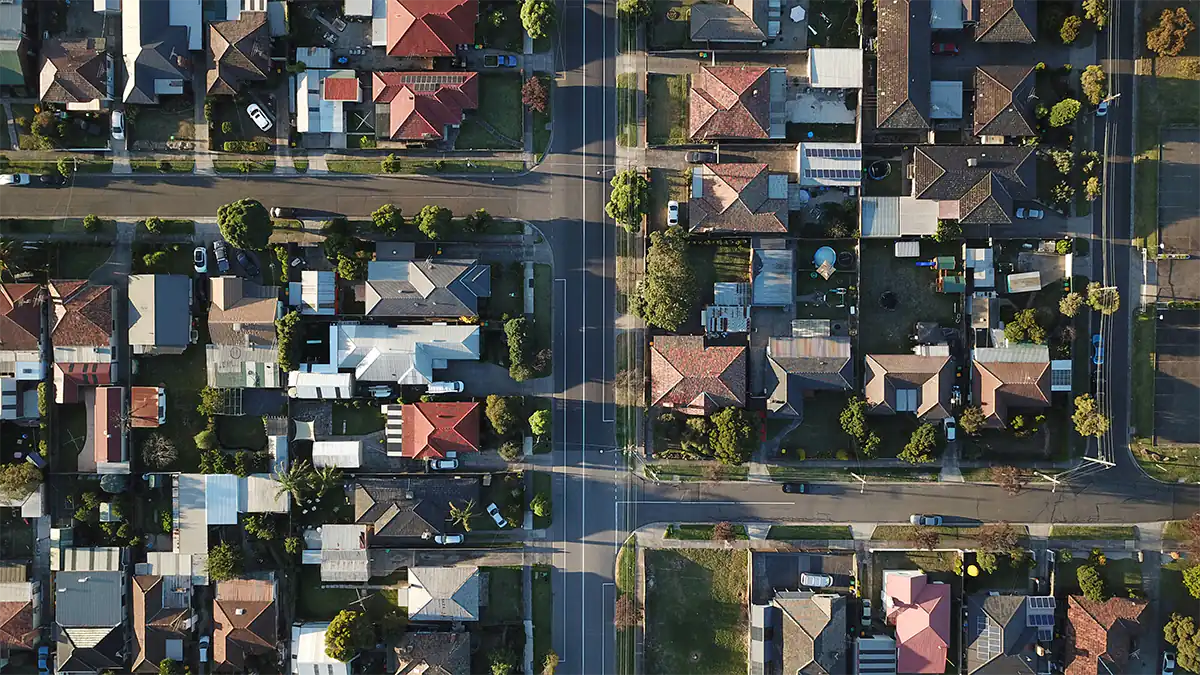 Home developers have to find new stimulus measures, such as providing virtual experiences, as buyers are becoming more circumspect.
3.3. Regional divergence: Energy winners and losers
The 2026-2027 landscape will see a stark divide based on regional energy profiles.
- Energy-producing hubs: Regions like Texas, the Gulf Coast, and parts of the Middle East and Norway may see localized real estate booms as oil wealth flows into the local economy, offsetting higher borrowing costs.
- Energy-consuming markets: High-density urban centers and regions with long commute times may see a decline in demand as "cost-of-living" pressures (gasoline + mortgage) compound. In these more reserved markets, the role of real estate video becomes even more critical to showcase proximity to amenities or "Work from Home" suitability to justify the property's cost.
3.4. The shift to a "marketer’s market"
Ultimately, the prediction for 2027 is the demise of the "list it and they will come" passive sale era. Industry experts and leading marketing strategists in 2026 have coined a new 'golden rule': a marketer’s market. While economic fundamentals (price, rates, and location) account for roughly 30% of a deal’s viability, the remaining 70% of the heavy lifting is done by presentation. Data from the National Association of Realtors (NAR) supports this, showing that listings with high-end video and professional staging receive 403% more inquiries, proving that emotional resonance via media is now the primary driver of closing success. Those who embrace high-fidelity photography, drone storytelling, and professional editing will capture the "scarcity premium", selling faster and at higher valuations than the market average despite the broader economic headwinds.
4. The psychology of the 2026 home buyer: Key takeaways for real estate marketers
The 2026 home buyer is a vastly different profile than the impulsive participant of the early 2020s. Shaped by the "oil shock" and the ensuing mortgage volatility, the modern buyer has adopted a "zero waste" mentality. In an era where gasoline prices have surged and borrowing costs have doubled, the casual "Sunday open house" has become an extinct hobby. For the 2026 consumer, time and fuel are precious commodities; every physical visit to a property is now viewed as a high-stakes financial investment in itself.
4.1. The digital gatekeeper
Consequently, the smartphone screen has transitioned from a browsing tool to the ultimate gatekeeper. Buyers now employ a "swipe-left" culture for real estate. If a listing fails to provide a high-fidelity, frictionless digital experience within the first three seconds, it is discarded. This psychological shift means that the "first showing" now happens right in the palm of the buyer's hand. They are looking for visual validation; they need to see professional-grade HDR photography and 4K video tours to "pre-qualify" a home before they are willing to burn expensive fuel or commit to an 8% interest rate.
 The energy crisis further reinforces digital real estate pre-qualification as a common choice for buyers who are hesitant due to rising fuel prices and mortgage rates.
4.2. Overcoming financial friction with emotion
Furthermore, there is a growing tension between logical friction (the high monthly payment) and emotional aspiration (the dream of homeownership). When a buyer looks at a mortgage calculator, they feel anxiety. To counteract this, the marketing must pivot toward high-impact storytelling.
Cinematic video and expert editing do more than show a layout; they evoke a feeling of "home" that can override the cold, hard logic of a high interest rate and mortgage rate rise on the oil shock. If the media presentation portrays a property as a "sanctuary" or a "turn-key asset," the buyer is psychologically more likely to justify the premium cost. In short, the 2026 buyer demands a "what you see is what you get" (WYSIWYG) level of transparency, making professional media the only bridge capable of crossing the chasm of buyer hesitation.
4.3. The solution: Real estate media as a strategic hedge
In an economy where mortgage rates rise on oil shock, the real estate market ceases to be a game of "location” and becomes one of "presentation, perception, and persuasion." High-interest rates have made buyers more risk-averse, meaning they are actively looking for reasons to disqualify a home. To prevent a listing from becoming a stagnant asset and accelerate liquidity in a frozen market, real estate professionals must deploy a strategic hedge: high-fidelity media.
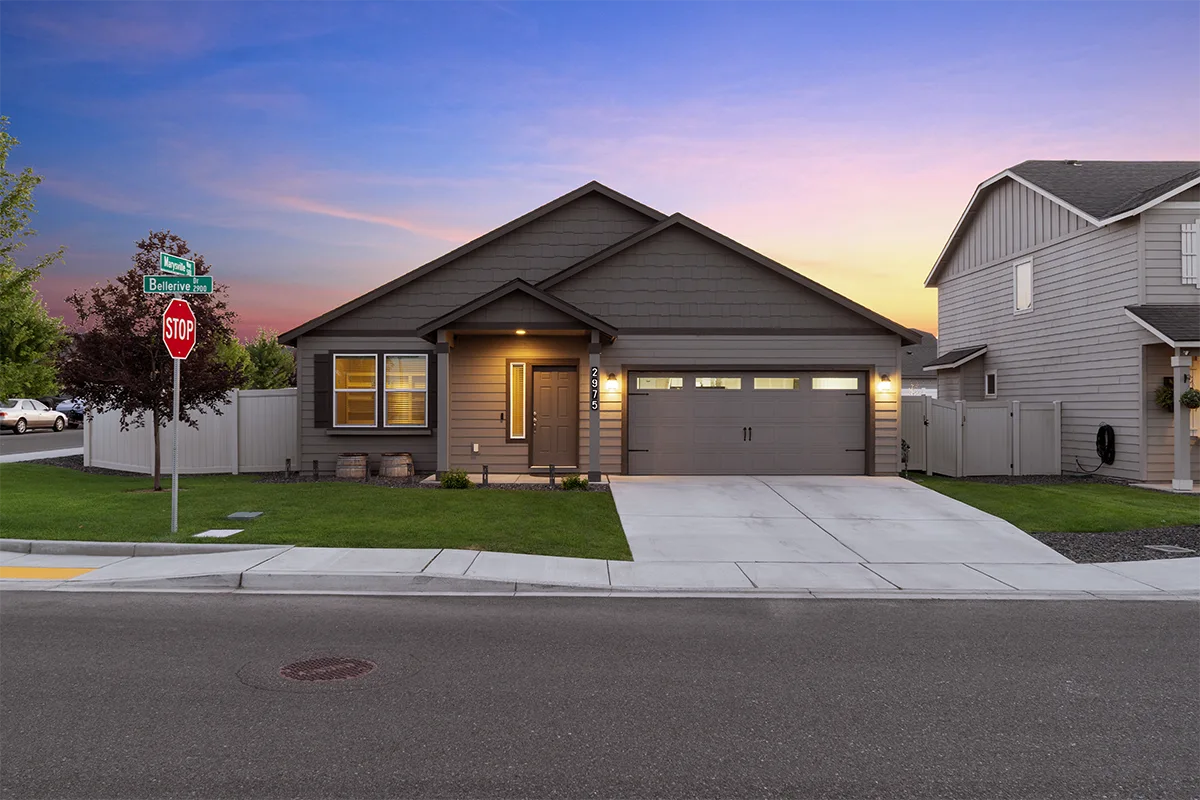 High-quality real estate photography is the minimum requirement for a listing to attract online buyers.
Low-quality photography stands out as a red flag, signaling a lack of care or a "fixer-upper" status that buyers, already burdened by high monthly payments, simply cannot afford to entertain. Professional architectural photography, utilizing flash-ambient (Flambient) blending and high-dynamic-range (HDR) photo editing techniques, creates a "perception premium." By capturing a home in its best possible light, photographers can justify a higher asking price that offsets the buyer's anxiety over interest rates. That’s when the mortgage payment feels like a worthwhile investment in a high-quality lifestyle rather than a financial burden.
While photography captures the "what," cinematic video captures the "why." As we’ve established, buyers are minimizing physical tours due to high fuel costs and time constraints. A 4K cinematic video tour serves as a 24/7 virtual open house, allowing high-intent buyers to develop an emotional connection with the property from their smartphone.
Furthermore, as buyers are increasingly concerned about the long-term viability of a neighborhood, drone footage suffices them by providing the "macro-context", showing proximity to transit hubs, green spaces, and local infrastructure. This sense of "future-proofing" is a critical selling point that helps buyers look past current economic volatility toward long-term asset appreciation.
4.4. Professional editing & virtual staging to maintain a competitive edge
Perhaps the most powerful tool in the 2026 marketing arsenal is post-production and virtual staging. With the cost of physical furniture rental and home renovations skyrocketing due to oil-driven transport and material costs, virtual staging offers an incredibly cost-effective alternative.
- Digital renovation: Professional editors can "update" a kitchen or "repaint" a living room digitally, allowing buyers to see the potential of a space without the immediate need for a high-interest construction loan.
- Day-to-dusk (Twilight) editing: This "golden hour" transformation triggers an aspirational response, making the property stand out in a crowded digital feed.
- Decluttering & enhancement: Removing distracting elements ensures that the buyer’s focus remains on the structural value, effectively "cleaning" the listing for a fraction of the cost of a physical cleaning crew.
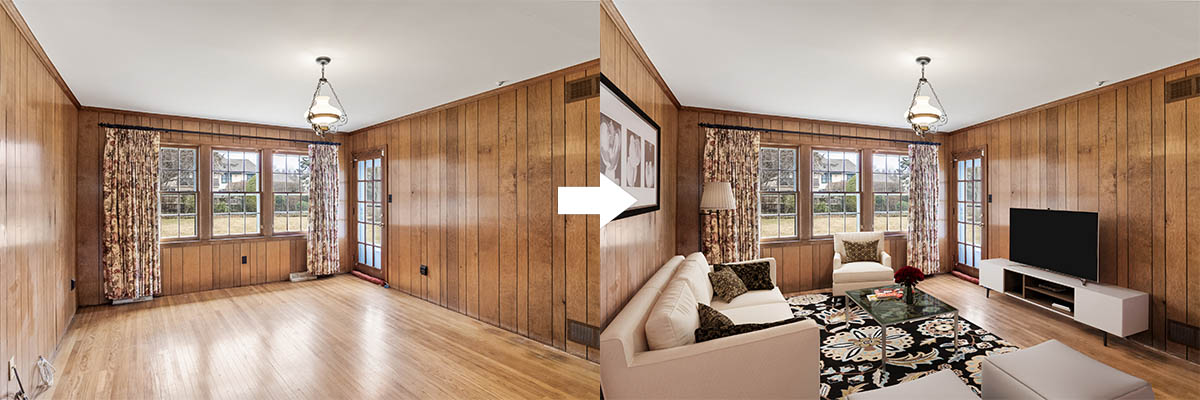 Virtual staging and virtual renovation are bridging the potential clients to their dream living space
The 2026 "oil shock" has further transformed the real estate market into a battle for attention. In this environment, spending on professional media is a strategic hedge against price reductions. A $1,500 investment in a full media suite (Photo, Video, and Drone) is significantly more affordable than a $20,000 price cut after a listing has sat on the market for 60 days. By investing in superior visual storytelling, agents and sellers can navigate the high-rate landscape with confidence, ensuring their properties remain the "first choice" for the modern, discerning buyer.
4.5. Future-proofing: AI & virtual tour in real estate media
The industry has standardized the use of 3D digital twins (powered by platforms like Matterport Pro3 and LiDAR-enabled mobile devices). Unlike static galleries, these high-fidelity models offer 24/7 "virtual open houses" with millimeter-level accuracy. In a high-rate environment, these twins serve as a "Digital First" filter, allowing international and remote buyers to perform detailed inspections, measuring furniture clearances and assessing structural layouts, without the logistical costs of travel. This technology has effectively reduced unnecessary physical site visits, streamlining the sales funnel for high-intent prospects.
 New rendering technologies are being implemented to level up immersive real estate visual marketing
Today’s elite editors use AI-driven tools for more than just "sky replacement" or "clutter removal." We are now in the era of virtual renovation, where AI can instantly transform a dated, oil-heated fixer-upper into a modern, energy-efficient sanctuary in a single render.
These tools allow agents to market "potential" rather than just "current state," which is crucial when buyers are hesitant to take on additional high-interest construction loans. By utilizing AI to automate lighting correction (Flash-Ambient blending) and perspective alignment, media services can deliver magazine-quality assets at a fraction of the traditional turnaround time. For the 2026 realtor, these technologies are the ultimate hedge: they provide the visual "wow factor" necessary to override financial friction and secure a premium price point in a volatile market.
Conclusion
The 2026 real estate market is undeniably complex, shaped by the convergence of geopolitical instability and a sharp oil-induced interest rate spike. While this "oil shock" has introduced significant financial friction, it has also forced a necessary evolution in how properties are sold. In an era where buyers are deterred by 6.4% mortgage rates and high cost-of-living pressures, only the most professionally presented listings will survive the scrutiny. High-fidelity media, comprising architectural photography, cinematic video storytelling, and AI-driven editing, is virtually required to protect property equity and maintain liquidity in a volatile economic landscape.
Contact us today for a custom 2026 real estate media package. Let us help you turn current economic challenges into your competitive advantage and accelerate your closing times. Follow us on social media to stay updated with the latest insights into the real estate market.
- Facebook: fotobermedia.co
- YouTube: Fotober
- TikTok: @fotober
- Instagram: fotober_media.
Related posts

Modern Luxe Interior Design: Elements, Style Guide and How to Stage It
October 10, 2026

Minimalist Interior Design: Characteristics, Style Guide, and Staging
October 8, 2026

Coastal Interior Design: Style Definition & Staging Guide
September 30, 2026

Contemporary Interior Design: Key Elements and How to Stage This Style
September 30, 2026
