




360 Editing vs Standard Photo Editing: Go Immersive, Sell Homes Faster

Share:
Table of Contents
- 1. Real estate 360 editing vs. standard photo editing: A technical deep dive
- 2. Panorama editing vs. standard photo retouching
- 3. The craft of 360 photo stitching vs. normal editing
- 4. Virtual tour editing vs. real estate photo editing: From static to interactive
- 5. The power of 360 photography in numbers: Proving the ROI
- 6. Elevate your virtual tours with Fotober’s 360 image enhancement
- 7. Choosing the right tool for your 360-degree listing
- 8. Conclusion
Real estate buyers now want to “feel” the floor plan before they ever step through the door. While traditional real estate photography remains a foundational tool, modern buyers don’t just settle for it. They crave more context. This demand has sparked a pivotal debate: 360 vs traditional real estate photography. Whether you are aiming for a flawless "hero shot" or a seamless immersive experience, understanding the nuances of 360 editing vs standard photo editing is the secret sauce to maximizing your marketing ROI.
1. Real estate 360 editing vs. standard photo editing: A technical deep dive
At first glance, the goal of both 360 editing vs standard photo editing is identical: to make a property look its absolute best. However, once you open the raw files, the technical workflows diverge into two completely different dimensions. Standard photo editing deals with a fixed, two-dimensional frame, while 360 editing requires the editor to manipulate a three-dimensional "wrap-around" environment.
1.1. The constraint of the frame vs. the freedom of the sphere
In standard photo editing, the editor’s primary focus is on composition and "the hero shot." They work within a rectangular boundary to correct vertical lines, enhance colors, and balance high-dynamic-range (HDR) exposures. The viewer only sees what the lens was pointed at. Consequently, the editor can easily "hide" flaws just outside the frame, like a messy corner or a photography light stand.
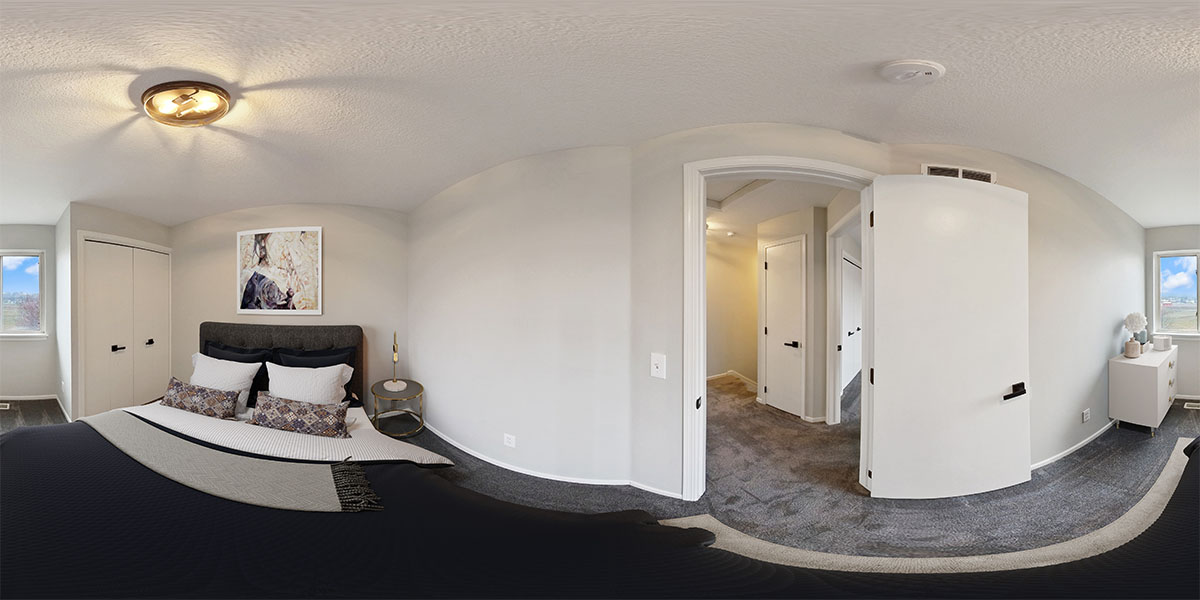 360 photos consist of many “scans” from many angles, which bring an extra level of sophistication for editors to maintain the coherence of the overall image
Conversely, 360 image enhancement utilizes an equirectangular projection (typically a 2:1 aspect ratio) that captures every single inch of a room. There is no "behind the camera." This creates a unique set of technical challenges:
- The Nadir and Zenith: In a 360-degree shot, the camera’s tripod is inevitably visible at the bottom (the nadir), and sometimes the ceiling fan or light fixture directly above (the zenith) becomes distorted. A critical part of 360 editing is the "patching" process, seamlessly removing the tripod and replacing it with a reconstructed floor texture or a branded "nadir patch."
- Optical distortion correction: While standard editing fixes minor lens flares, 360 editors must manage extreme wide-angle distortions. If not handled correctly, straight walls will appear curved, breaking the immersion and making the space feel "rubbery" or unrealistic.
- Global exposure balancing: In a standard photo, you balance the light for one direction. In a 360 photo, you might have a bright sun-drenched window on the left and a dark hallway on the right, all in the same file. The editor must ensure a perfectly even exposure across the entire 360-degree field to prevent "blown-out" spots as the user pans around the room.
1.2. Quick comparison: 360 editing vs. standard photo editing
|
Feature |
Standard photo editing |
360 photo editing |
|
Perspective |
Fixed, single-angle (2D) |
Immersive, all-around (360° Sphere) |
|
Primary goal |
Creating a "Hero Shot" for first impressions |
Creating a "Digital Twin" for exploration |
|
Workflow |
Linear (Import → Retouch → Export) |
Geometric (Stitch → Patch → Wrap) |
|
Technical core |
Composition, HDR, & Color Grading |
Stitching, Warping, & Nadir Patching |
|
Equipment removal |
Rarely needed (hidden behind lens) |
Mandatory (Removing tripod/shadows) |
|
Distortion |
Minimal (Lens profile correction) |
High (Managing equirectangular curves) |
|
User interaction |
Passive (Viewing) |
Active (Navigating & Zooming) |
1.3. The verdict on complexity
While standard editing is about perfecting a moment, 360 editing is about perfecting an environment. It requires specialized software and a deep understanding of spherical geometry to ensure that when the "flat" file is wrapped back into a VR viewer, every seam is invisible and every proportion is true to life.
2. Panorama editing vs. standard photo retouching
While they may appear similar at first glance, 360 editing vs standard photo editing represent two distinct philosophies in the world of high-end real estate media. Standard photo retouching is primarily an aesthetic endeavor focused on a single, fixed-perspective frame. The editor’s goal is to create a visually striking "hero shot" that captures the viewer's attention instantly. This process typically includes techniques such as color correction, white balance adjustment, sky replacements, and the removal of minor eyesores like wall scuffs or distracting outdoor power lines. It is a linear process where the editor enhances the existing composition within the two-dimensional boundaries of the image.
Panorama editing, by contrast, is a geometric and spatial challenge that goes far beyond simple beautification. A panorama is not just a "wide" photo; it is a mathematical assembly of multiple overlapping images captured from a single nodal point. The editing process begins with "stitching," a task that requires surgical precision. Unlike standard retouching, where a slight misalignment might be easily masked, a one-pixel error in a panorama creates a "seam" or a "ghosting" effect that immediately breaks the viewer's sense of immersion. The editor must utilize specialized software engines to manage complex spherical metadata and ensure that every transition point is invisible.
Furthermore, panorama editing involves sophisticated projection management. When multiple photos are flattened into a single equirectangular file, architectural lines naturally want to curve or distort. An editor must manually correct these distortions to ensure that the property's walls and ceilings look structurally sound and true to life. While standard retouching focuses on making a room look "appealing," panorama editing focuses on making it feel "spatially accurate."
In modern marketing, these two workflows are complementary. Standard retouching provides the "glamour" necessary for brochures and social media feeds, while panorama editing provides the "spatial truth" for interactive virtual experiences. Successfully mastering the technical nuances of panorama editing ensures that the final result is not only beautiful but also geometrically perfect, maintaining the professional standard required for high-stakes real estate listings.
3. The craft of 360 photo stitching vs. normal editing
To understand the fundamental shift in modern real estate media, one must look at the technical "glue" that holds immersive content together: stitching. When comparing 360 editing vs standard photo editing, the primary difference lies in the complexity of the source material and the mathematical precision required during post-production.
3.1. The intuitiveness of still image editing
Editing normal photos is typically a linear workflow involving a single RAW or JPEG file captured in one shutter click. There are special cases, like HDR bracketing, where multiple exposures of the same scene in the same composition are stacked together to form a balanced image without clipped light details. Nevertheless, the editor’s task is still to refine that specific moment, adjusting the contrast, sharpening the details, and ensuring the colors pop. It is a straightforward process of enhancing what is already within the frame.
3.2. Unlocking a new dimension with 360 photo stitching
360 photo stitching, however, is an entirely different beast. It is the sophisticated process of taking anywhere from 6 to 24 individual high-resolution images and fusing them into a single, seamless 360-degree sphere. Although some of the best 360 cameras for real estate complete this task by themselves, manual editing is still the most reliable method for achieving pristine results.
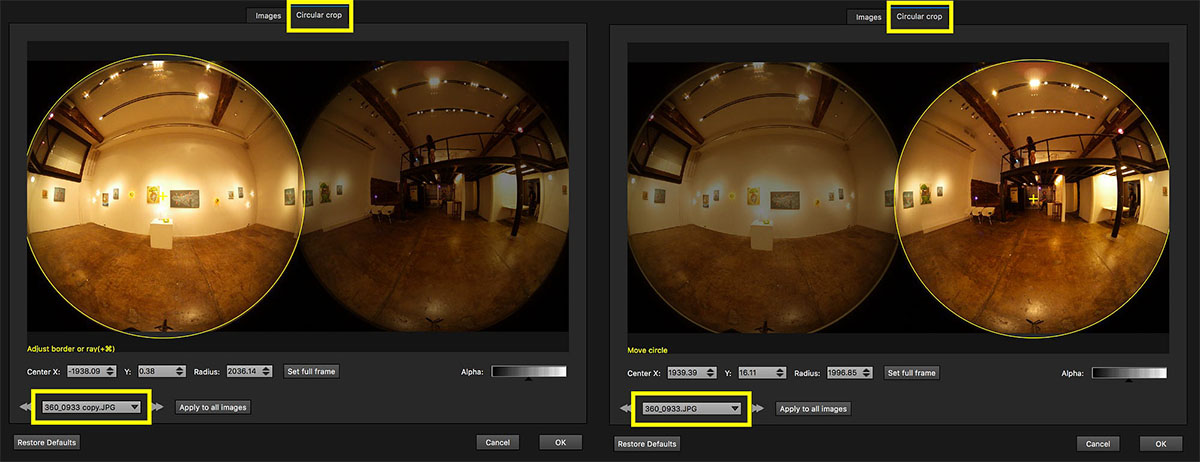 Merging multiple 360° scans requires specialized tools and meticulous editing to create a flawless base image
The technical hurdles in stitching are far more demanding than those found in standard retouching. The most notorious issue is the parallax error. If the camera’s nodal point shifts even a few millimeters between shots, the lines of a hardwood floor or a door frame will not align perfectly in the final output. In normal editing, you might fix a crooked horizon with a simple rotate-and-crop tool, but in 360 stitching, a misalignment requires complex warping and manual "control point" adjustments to prevent the room from looking broken.
Furthermore, an editor must manage exposure and color consistency across a global scale. In normal editing, you balance the light for one fixed direction. In a 360-degree environment, the camera captures a bright, sun-drenched balcony in one frame and a dimly lit hallway in the next. The editor must meticulously "blend" these exposures so that as a user pans around the room, there are no jarring shifts in brightness or color temperature.
Ultimately, while normal editing is a path toward a beautiful static image, 360 photo stitching is a multi-dimensional puzzle. It serves as the critical backbone of any virtual tour; if the stitching is flawed, the illusion of "being there" is shattered for the prospective buyer.
4. Virtual tour editing vs. real estate photo editing: From static to interactive
While the previous sections focused on the technical construction of a single image, in this part, we are exploring the broader scope of the user journey. The comparison between virtual tour editing vs real estate photo editing is essentially the difference between creating a beautiful "postcard" and building a fully functional "digital twin" of a property.
4.1. The art of the "hero shot" (Real estate photo editing)
Standard real estate photo editing is primarily concerned with the "glamour" aspect of marketing. Its goal is to stop the scroll. Whether it’s a high-definition twilight shot or a perfectly staged living room, the editor focuses on a single, fixed perspective. The workflow is optimized for aesthetic perfection: clearing away distracting power lines, enhancing the green of the lawn, and ensuring the blue of the sky is inviting. It is a one-way communication where the viewer looks at the photo, absorbs the beauty, and moves to the next one.
4.2. The logic of the journey (Virtual tour editing)
In contrast, virtual tour editing is an exercise in digital architecture and user experience (UX). When an editor moves from static photos to a virtual tour, they are no longer just adjusting colors; they are designing a navigable environment. This process involves several layers of complexity that standard editing never touches:
- Hotspot integration: The editor must strategically place "hotspots", interactive points that allow users to "walk" from the kitchen to the dining room. These must be placed with spatial logic to ensure the transition feels natural and doesn't disorient the viewer.
- Floor plan alignment: A high-end virtual tour often includes an integrated floor plan. The editor must synchronize the 360-degree views with the 2D map so the "radar" icon points in the correct direction as the user spins around.
- Informational overlays: Virtual tour editing often includes "matter-tags" or info-spots that highlight premium features, such as "Quartz Countertops" or "Smart Home System," providing a layer of sales copy directly within the visual experience.
4.3. The psychological impact of a virtual tour
The shift from real estate photo editing to virtual tour editing marks a transition from passive observation to active engagement. A static photo tells a buyer what a house looks like; an interactive tour allows them to discover how the house feels. For the editor, this means prioritizing the "flow" of the home. If the transitions are jarring or the spatial orientation is off, the buyer loses interest. By mastering the interactive nuances of virtual tour editing, professionals can provide a level of transparency and immersion that traditional photography simply cannot match.
5. The power of 360 photography in numbers: Proving the ROI
In the competitive landscape of 360 vs traditional real estate photography and the resulting battle of 360 editing vs standard photo editing, the winner isn't decided by artistic preference alone, but by financial data. While static images have been the industry standard for decades, modern analytics prove that immersive 360-degree content significantly outperforms traditional media across every key performance indicator (KPI).
According to research from Realtor.com, property listings that feature a virtual tour receive a staggering 87% more views than those relying solely on standard photography. This massive gap in engagement highlights a fundamental shift: today’s buyers are no longer satisfied with being "shown" a house; they want to explore it. This transparency builds immediate trust, often resulting in more qualified leads who are already familiar with the home's layout before they step through the front door.
 Immersive listings are attracting more views and engagement from potential buyers on many platforms
Furthermore, the "stickiness" of a listing is dramatically enhanced by 360-degree content. Industry data from Panomatics indicates that users spend 5 to 10 times longer on websites that offer 360-degree photography. For real estate professionals, this increased time on site is a critical SEO signal, informing search engines that the content is highly relevant and engaging, which naturally boosts the listing's organic ranking.
When it comes to the final transaction, the impact is even more profound. Zillow has reported that listings featuring 3D home tours are sold, on average, 10% faster and receive significantly more "saves" and "shares" than those without them. The psychological impact is so strong that nearly 50% of home buyers now state they would likely skip a listing entirely if it lacked a 3D tour or 360-degree views.
Ultimately, the numbers tell a clear story: while traditional photography provides the introduction, 360-degree media provides the conversion. Knowing real estate 360 photography pricing and investing in high-quality 360 editing is no longer a luxury, it is a data-backed necessity for any serious real estate marketing strategy.
6. Elevate your virtual tours with Fotober’s 360 image enhancement
In the competitive landscape of real estate, the difference between a lead and a lost opportunity often lies in the quality of your visuals. This is where Fotober becomes an invaluable partner for photographers and agencies. Understanding the difference between 360 editing vs standard photo editing, our 360 image enhancement service is specifically engineered to handle the complex technicalities of spherical media, allowing you to focus on shooting while they master the post-production.
 Fotober provides comprehensive solutions for perfecting your real estate 360° images
Why Fotober is the ideal choice for your business:
- Seamless stitching & geometry correction: Fotober’s editors are experts at eliminating the "seams" and parallax errors that often plague DIY 360 photos. They ensure every line is straight and every transition is invisible, maintaining the spatial truth of the property.
- Professional Nadir & zenith patching: One of the hallmark signs of amateur 360 photography is a visible tripod or a distorted ceiling. Fotober flawlessly removes equipment and reconstructs floor/ceiling textures for a truly immersive, "tripod-free" experience.
- Advanced HDR balancing: Managing extreme light contrasts, like a dark bedroom next to a sunlit balcony, is Fotober’s specialty. They balance exposures across the entire 360 sphere, ensuring natural colors and crisp details in every corner.
- Scalability with speed: Whether you have one listing or one hundred, Fotober offers a rapid turnaround that doesn't compromise on quality, making it the perfect "secret weapon" for scaling your real estate marketing business.
By choosing Fotober, you are not just getting an editing service; you are ensuring that your virtual tours meet the highest industry standards, providing the professional polish that modern buyers expect.
7. Choosing the right tool for your 360-degree listing
Selecting the right medium depends entirely on the property's narrative and your target audience. Standard real estate photo editing is still required as the bare minimum for social media ads, print brochures, and eye-catching thumbnails that "stop the scroll." These high-impact, static images are designed to spark an emotional connection in a fraction of a second.
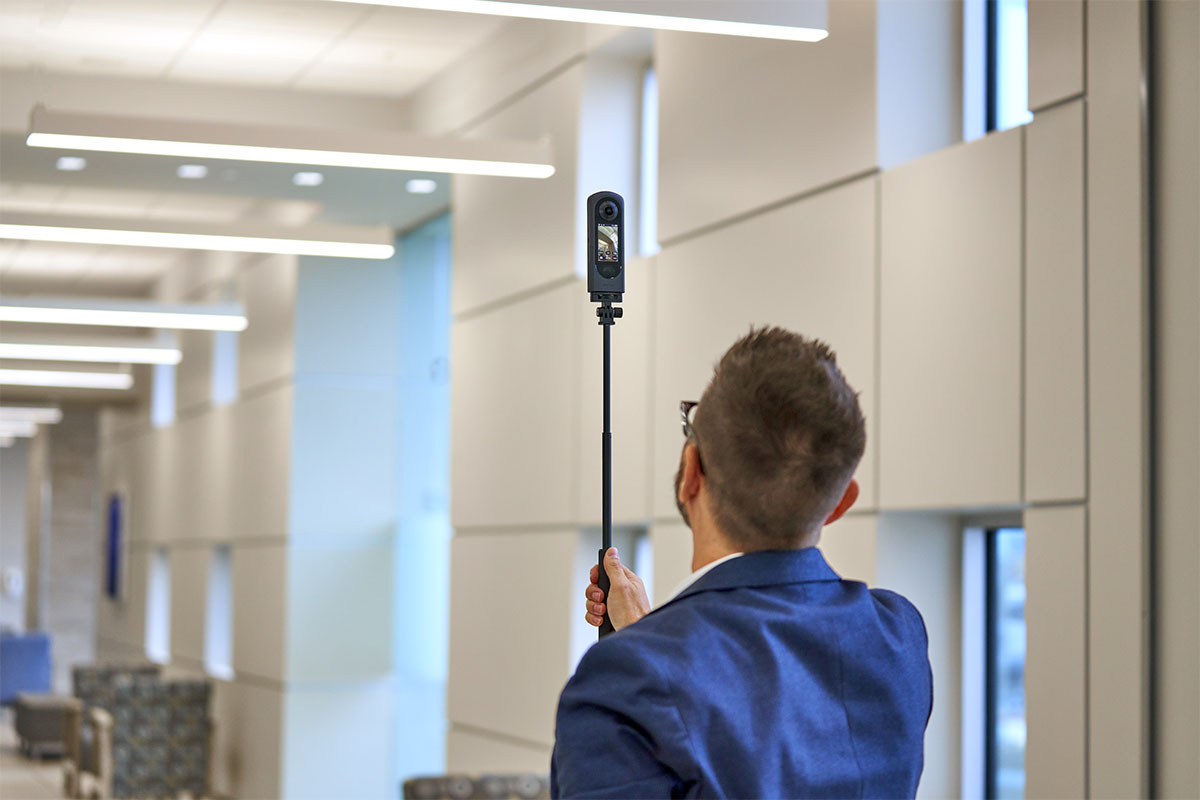 Real estate agents should incorporate 360° imagery into their marketing strategy to not be outpaced in the modern market
However, for luxury listings, commercial spaces, or properties targeting out-of-state and international buyers, 360° photography is no longer optional. The most effective modern marketing suite isn't a binary choice of 360 vs traditional real estate photography, but rather a strategic hybrid. You should use high-resolution "hero" stills to draw the viewer in and an immersive virtual tour to keep them there. This multi-layered approach not only satisfies the user's curiosity but also signals to search engine algorithms that your listing is a high-value, high-engagement destination.
7.1. When should you use 360 editing instead of standard photo editing?
While standard photos are the "hook," 360-degree content is the "closer." You should prioritize 360 editing in the following scenarios:
- Luxury & high-end estates: For premium properties, buyers expect a premium digital experience. 360 editing allows you to showcase grand architectural flows and high-end finishes that a single frame cannot capture.
- Targeting remote or international buyers: If your audience is purchasing from another city or country, 360-degree tours provide the transparency and "spatial truth" needed to make a confident offer without a physical walkthrough.
- Properties with unique layouts: If a home has an unconventional floor plan or open-concept living, standard photos can often be confusing. 360 editing connects the spaces logically, helping the buyer understand how the rooms relate to one another.
- Commercial & large-scale spaces: For offices, warehouses, or retail spaces, 360 editing is essential to demonstrate scale and utility, allowing tenants to visualize their operations within the square footage.
The most effective modern marketing suite isn't a binary choice of 360 vs traditional real estate photography, but rather a strategic hybrid. You should use high-resolution "hero" stills to draw the viewer in and an immersive virtual tour to keep them there. This multi-layered approach not only satisfies the user's curiosity but also signals to search engine algorithms that your listing is a high-value, high-engagement destination.
8. Conclusion
In the evolving landscape of digital marketing, the debate between 360 editing vs standard photo editing highlights a shift from passive viewing to active exploration. While standard retouching captures the "glamour" of a home, 360 stitching and virtual tour editing capture its "truth" and spatial flow.
As the data consistently shows, the future of real estate is interactive. By investing in professional post-production for both formats, real estate professionals can provide a comprehensive digital twin that builds trust and accelerates the closing process. In today’s market, providing a 360-degree perspective isn't just a technical upgrade, it’s the ultimate competitive advantage.
Contact our team today for a custom quote and see how our 360° photo retouching can turn your next listing into an engaging virtual experience for your buyers.
Follow us on social media to acquire more useful tips and in-depth analysis on real estate marketing, 360° photography and up-to-date details of our services!
- Facebook: fotobermedia.co
- YouTube: Fotober
- TikTok: @fotober
- Instagram: fotober_media.
Related posts

Cincinnati Housing Market 2026: Prices, Trends, and What It Means for Buyers, Sellers, and Investors
October 20, 2026

Modern Luxe Interior Design: Elements, Style Guide and How to Stage It
October 10, 2026

Minimalist Interior Design: Characteristics, Style Guide, and Staging
October 8, 2026

Coastal Interior Design: Style Definition & Staging Guide
September 30, 2026
